

172
5. Nonaromatic Compounds
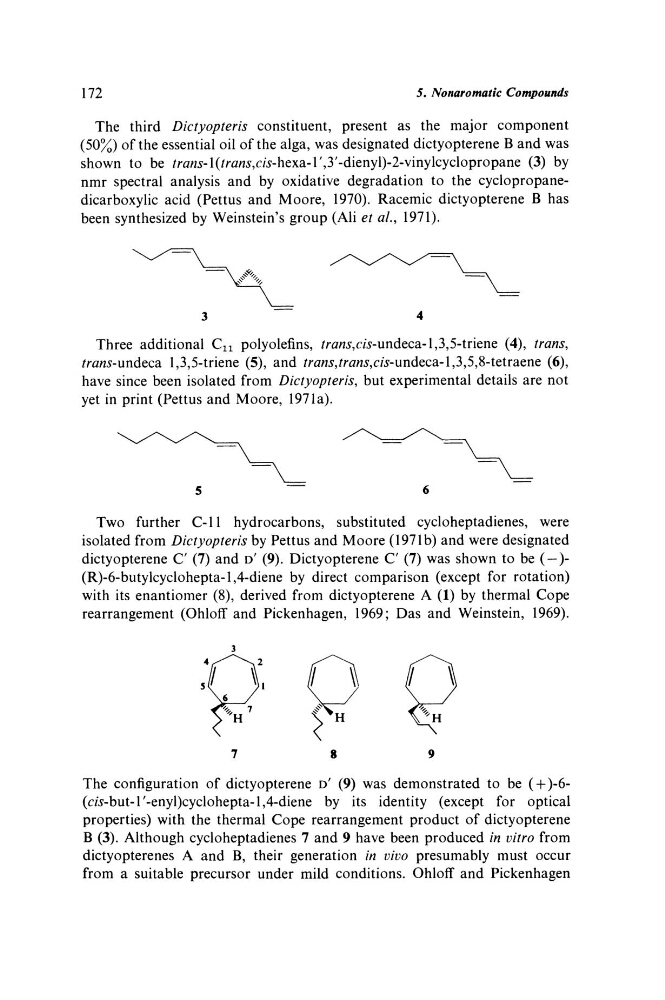
The third Dictyopteris constituent, present as the major component
(50%) of the essential oil of the alga, was designated dictyopterene Β and was
shown to be /ra« 1 y-l(ir«^,c/5
, -hexa-r,3
, -dienyl)-2-vinylcyclopropane (3) by
nmr spectral analysis and by oxidative degradation to the cyclopropanedicarboxylic acid (Pettus and Moore, 1970). Racemic dictyopterene Β has
been synthesized by Weinstein's group (Ali et ai, 1971).
Three additional C 1X polyolefins, /ra/2£,c7>undeca-l,3,5-triene (4), trans,
ir
yet in print (Pettus and Moore, 1971a).
Two further C-ll hydrocarbons, substituted cycloheptadienes, were
isolated from Dictyopteris by Pettus and Moore (1971b) and were designated
dictyopterene C (7) and D' (9). Dictyopterene C (7) was shown to be ( —)(R)-6-butylcyclohepta-l,4-diene by direct comparison (except for rotation)
with its enantiomer (8), derived from dictyopterene A (1) by thermal Cope
rearrangement (Ohloff and Pickenhagen, 1969; Das and Weinstein, 1969).
3
^O
1
ο
ο
7
8
9
The configuration of dictyopterene D' (9) was demonstrated to be (+)-6(c/.y-but-r-enyl)cyclohepta-l,4-diene by its identity (except for optical
properties) with the thermal Cope rearrangement product of dictyopterene
Β (3). Although cycloheptadienes 7 and 9 have been produced in vitro from
dictyopterenes A and B, their generation in vivo presumably must occur
from a suitable precursor under mild conditions. Ohloff and Pickenhagen
5. Nonaromatic Compounds
The third Dictyopteris constituent, present as the major component
(50%) of the essential oil of the alga, was designated dictyopterene Β and was
shown to be /ra« 1 y-l(ir«^,c/5
, -hexa-r,3
, -dienyl)-2-vinylcyclopropane (3) by
nmr spectral analysis and by oxidative degradation to the cyclopropanedicarboxylic acid (Pettus and Moore, 1970). Racemic dictyopterene Β has
been synthesized by Weinstein's group (Ali et ai, 1971).
Three additional C 1X polyolefins, /ra/2£,c7>undeca-l,3,5-triene (4), trans,
ir
yet in print (Pettus and Moore, 1971a).
Two further C-ll hydrocarbons, substituted cycloheptadienes, were
isolated from Dictyopteris by Pettus and Moore (1971b) and were designated
dictyopterene C (7) and D' (9). Dictyopterene C (7) was shown to be ( —)(R)-6-butylcyclohepta-l,4-diene by direct comparison (except for rotation)
with its enantiomer (8), derived from dictyopterene A (1) by thermal Cope
rearrangement (Ohloff and Pickenhagen, 1969; Das and Weinstein, 1969).
3
^O
1
ο
ο
7
8
9
The configuration of dictyopterene D' (9) was demonstrated to be (+)-6(c/.y-but-r-enyl)cyclohepta-l,4-diene by its identity (except for optical
properties) with the thermal Cope rearrangement product of dictyopterene
Β (3). Although cycloheptadienes 7 and 9 have been produced in vitro from
dictyopterenes A and B, their generation in vivo presumably must occur
from a suitable precursor under mild conditions. Ohloff and Pickenhagen