

Β. Hydrocarbons
171
costatum. Lee and Loeblich (1971) have since investigated the distribution of
the C 2 i hexaene in marine and freshwater algae, as well as the occurrence
of its obvious precursor, the corresponding C 22 hexaenoic acid. In this kind of
research, where emphasis is placed on comparative aspects and where many
of the individual compounds are well characterized, few compounds need to
be isolated. Identification can generally be carried out by gas chromatographic separation and mass spectral analysis of standard and unknown
mixtures. Youngblood et al. (1971) used ingenious micro-techniques of
hydrogénation and ozonization to elucidate the structures of the new olefins.
Moore and his group (Moore et al, 1968) on the other hand, in their
investigation of the essential oil of the brown algae Dictyopteris
plagiogramma
and D. australis have determined the structures of several new hydrocarbons
by actual isolation, chemical degradation, and spectral methods. In interesting
contrast to Professor Irie's group in Japan (Irie et al, 1964; Kurosawa et al,
1966) who isolated sesquiterpenoid constituents from the brown alga Dictyopteris divaricata, Moore and co-workers (1968) have found the essential oil
of D. plagiogramma and D. australis devoid of terpenoid compounds. The
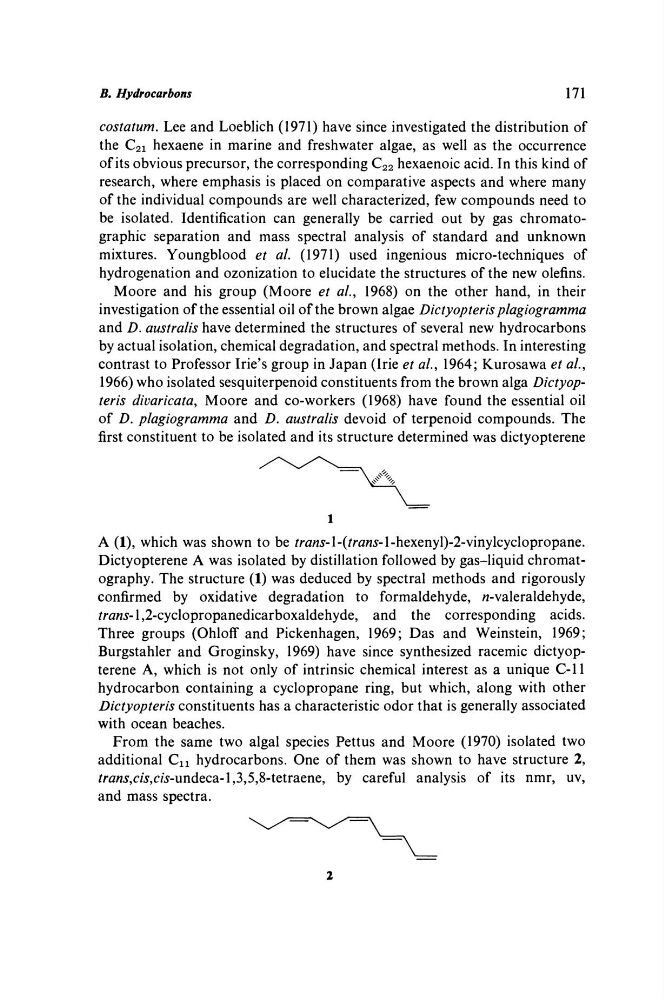
first constituent to be isolated and its structure determined was dictyopterene
1
A (1), which was shown to be
trans-\-(trans-l-hexcny\)-2-vmylcyc\opropam.
Dictyopterene A was isolated by distillation followed by gas-liquid chromatography. The structure (1) was deduced by spectral methods and rigorously
confirmed by oxidative degradation to formaldehyde, w-valeraldehyde,
trans-1,2-cyclopropanedicarboxaldehyde,
and the corresponding acids.
Three groups (Ohloff and Pickenhagen, 1969; Das and Weinstein, 1969;
Burgstahler and Groginsky, 1969) have since synthesized racemic dictyopterene A, which is not only of intrinsic chemical interest as a unique C-ll
hydrocarbon containing a cyclopropane ring, but which, along with other
Dictyopteris constituents has a characteristic odor that is generally associated
with ocean beaches.
From the same two algal species Pettus and Moore (1970) isolated two
additional C n hydrocarbons. One of them was shown to have structure 2,
irur«5',a 1 y,c/ 4 s'-undeca-l,3,5,8-tetraene, by careful analysis of its nmr, uv,
and mass spectra.
2
171
costatum. Lee and Loeblich (1971) have since investigated the distribution of
the C 2 i hexaene in marine and freshwater algae, as well as the occurrence
of its obvious precursor, the corresponding C 22 hexaenoic acid. In this kind of
research, where emphasis is placed on comparative aspects and where many
of the individual compounds are well characterized, few compounds need to
be isolated. Identification can generally be carried out by gas chromatographic separation and mass spectral analysis of standard and unknown
mixtures. Youngblood et al. (1971) used ingenious micro-techniques of
hydrogénation and ozonization to elucidate the structures of the new olefins.
Moore and his group (Moore et al, 1968) on the other hand, in their
investigation of the essential oil of the brown algae Dictyopteris
plagiogramma
and D. australis have determined the structures of several new hydrocarbons
by actual isolation, chemical degradation, and spectral methods. In interesting
contrast to Professor Irie's group in Japan (Irie et al, 1964; Kurosawa et al,
1966) who isolated sesquiterpenoid constituents from the brown alga Dictyopteris divaricata, Moore and co-workers (1968) have found the essential oil
of D. plagiogramma and D. australis devoid of terpenoid compounds. The
first constituent to be isolated and its structure determined was dictyopterene
1
A (1), which was shown to be
trans-\-(trans-l-hexcny\)-2-vmylcyc\opropam.
Dictyopterene A was isolated by distillation followed by gas-liquid chromatography. The structure (1) was deduced by spectral methods and rigorously
confirmed by oxidative degradation to formaldehyde, w-valeraldehyde,
trans-1,2-cyclopropanedicarboxaldehyde,
and the corresponding acids.
Three groups (Ohloff and Pickenhagen, 1969; Das and Weinstein, 1969;
Burgstahler and Groginsky, 1969) have since synthesized racemic dictyopterene A, which is not only of intrinsic chemical interest as a unique C-ll
hydrocarbon containing a cyclopropane ring, but which, along with other
Dictyopteris constituents has a characteristic odor that is generally associated
with ocean beaches.
From the same two algal species Pettus and Moore (1970) isolated two
additional C n hydrocarbons. One of them was shown to have structure 2,
irur«5',a 1 y,c/ 4 s'-undeca-l,3,5,8-tetraene, by careful analysis of its nmr, uv,
and mass spectra.
2