

D. Complex Poly cyclic Compounds
147
Compound 100 could be oxidized with permanganate to the saxitoxin
degradation product 94, which in turn could be hydrogenated to its tetrahydro analog 100. Both synthetic compounds 100 and 94 were identical with
the corresponding degradation products of saxitoxin.
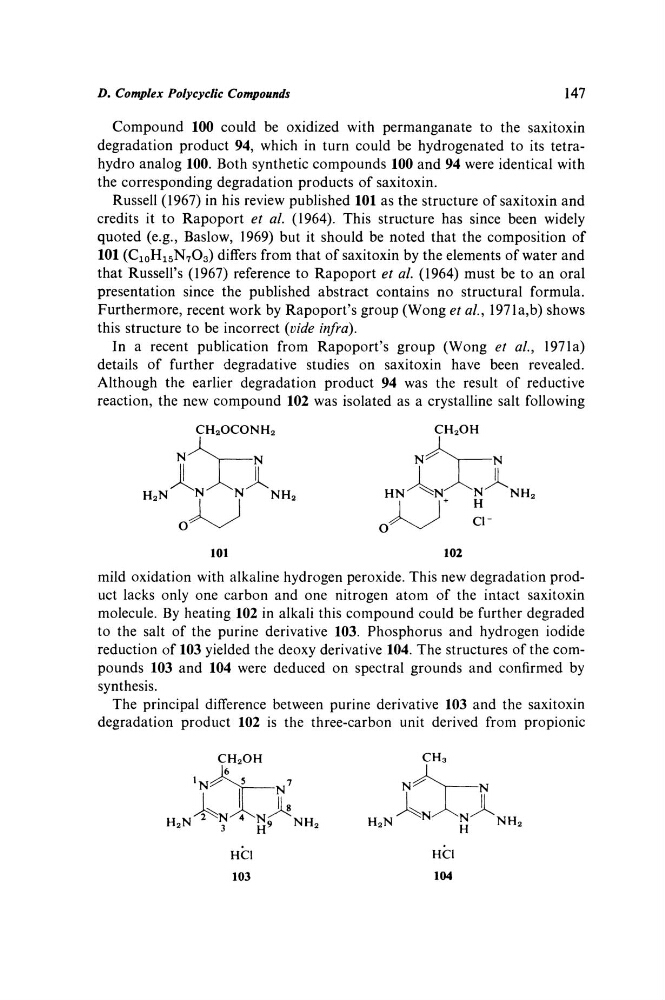
Russell (1967) in his review published 101 as the structure of saxitoxin and
credits it to Rapoport et al. (1964). This structure has since been widely
quoted (e.g., Baslow, 1969) but it should be noted that the composition of
101 (C 10 H 15 N 7 O3) differs from that of saxitoxin by the elements of water and
that Russell's (1967) reference to Rapoport et al. (1964) must be to an oral
presentation since the published abstract contains no structural formula.
Furthermore, recent work by Rapoport's group (Wong et al, 1971a,b) shows
this structure to be incorrect (vide infra).
In a recent publication from Rapoport's group (Wong et al, 1971a)
details of further degradative studies on saxitoxin have been revealed.
Although the earlier degradation product 94 was the result of reductive
reaction, the new compound 102 was isolated as a crystalline salt following
CH 2 OCONH 2
CH 2 OH
N ^ N
Ν
Ν
1 JTX
1
Π
H 2 N
N^^N
NH 2
HN^Nf^N^NH 2
101
102
mild oxidation with alkaline hydrogen peroxide. This new degradation product lacks only one carbon and one nitrogen atom of the intact saxitoxin
molecule. By heating 102 in alkali this compound could be further degraded
to the salt of the purine derivative 103. Phosphorus and hydrogen iodide
reduction of 103 yielded the deoxy derivative 104. The structures of the compounds 103 and 104 were deduced on spectral grounds and confirmed by
synthesis.
The principal difference between purine derivative 103 and the saxitoxin
degradation product 102 is the three-carbon unit derived from propionic
CH 2 OH
CH 3
' T If—
N?
Η—f
HCl
HCl
103
104
147
Compound 100 could be oxidized with permanganate to the saxitoxin
degradation product 94, which in turn could be hydrogenated to its tetrahydro analog 100. Both synthetic compounds 100 and 94 were identical with
the corresponding degradation products of saxitoxin.
Russell (1967) in his review published 101 as the structure of saxitoxin and
credits it to Rapoport et al. (1964). This structure has since been widely
quoted (e.g., Baslow, 1969) but it should be noted that the composition of
101 (C 10 H 15 N 7 O3) differs from that of saxitoxin by the elements of water and
that Russell's (1967) reference to Rapoport et al. (1964) must be to an oral
presentation since the published abstract contains no structural formula.
Furthermore, recent work by Rapoport's group (Wong et al, 1971a,b) shows
this structure to be incorrect (vide infra).
In a recent publication from Rapoport's group (Wong et al, 1971a)
details of further degradative studies on saxitoxin have been revealed.
Although the earlier degradation product 94 was the result of reductive
reaction, the new compound 102 was isolated as a crystalline salt following
CH 2 OCONH 2
CH 2 OH
N ^ N
Ν
Ν
1 JTX
1
Π
H 2 N
N^^N
NH 2
HN^Nf^N^NH 2
101
102
mild oxidation with alkaline hydrogen peroxide. This new degradation product lacks only one carbon and one nitrogen atom of the intact saxitoxin
molecule. By heating 102 in alkali this compound could be further degraded
to the salt of the purine derivative 103. Phosphorus and hydrogen iodide
reduction of 103 yielded the deoxy derivative 104. The structures of the compounds 103 and 104 were deduced on spectral grounds and confirmed by
synthesis.
The principal difference between purine derivative 103 and the saxitoxin
degradation product 102 is the three-carbon unit derived from propionic
CH 2 OH
CH 3
' T If—
N?
Η—f
HCl
HCl
103
104