

146
4. Nitrogenous Compounds
could be crystallized. Among the properties that were reported for saxitoxin
were its catalytic reduction to a nontoxic dihydro derivative (Mold et al,
1957); its two basic functions of pK a 8.1 and 11.5 (Schantz et al., 1961); and
its drastic oxidative degradation (Schantz et al., 1961) with periodic acid or
permanganate that yielded ammonia, carbon dioxide, urea, and guanidinopropionic acid (93).
NH
II
H 2 N—C—N—CH 2 —CH 2 —C0 2 H
H
93
In a significant degradation reported by Schuett and Rapoport (1962)
saxitoxin was treated with phosphorus and hydriodic acid in acetic acid
leading in high yield to a crystalline weakly basic substance that was shown
to be 8-methyl-2-oxo-2,4,5,6-tetrahydropyrrolo[l,2c]pyrimidine (94).
LE
'
N
IF
4
5
94
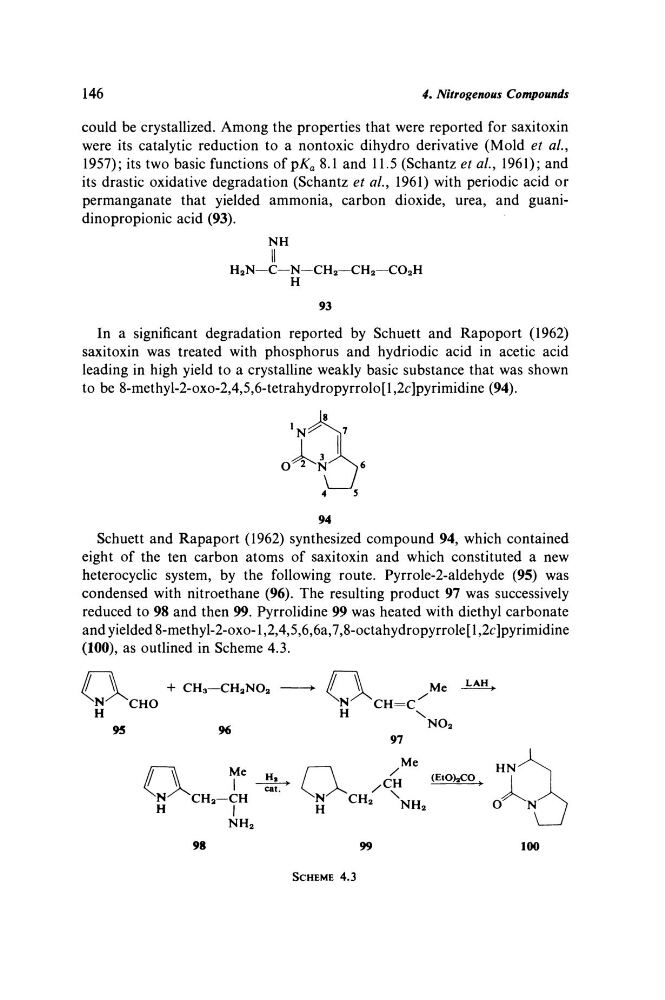
Schuett and Rapaport (1962) synthesized compound 94, which contained
eight of the ten carbon atoms of saxitoxin and which constituted a new
heterocyclic system, by the following route. Pyrrole-2-aldehyde (95) was
condensed with nitroethane (96). The resulting product 97 was successively
reduced to 98 and then 99. Pyrrolidine 99 was heated with diethyl carbonate
and yielded 8-methyl-2-oxo-l,2,4,5,6,6a,7,8-octahydropyrrole[l,2c]pyrimidine
(100), as outlined in Scheme 4.3.
$
\
+ CH 3 —CH 2 N0 2
• /
\
Me
X N^CHO
^
CH=C^
Η
Η
\
95
96
N O
>
97
98
99
100
SCHEME 4.3
4. Nitrogenous Compounds
could be crystallized. Among the properties that were reported for saxitoxin
were its catalytic reduction to a nontoxic dihydro derivative (Mold et al,
1957); its two basic functions of pK a 8.1 and 11.5 (Schantz et al., 1961); and
its drastic oxidative degradation (Schantz et al., 1961) with periodic acid or
permanganate that yielded ammonia, carbon dioxide, urea, and guanidinopropionic acid (93).
NH
II
H 2 N—C—N—CH 2 —CH 2 —C0 2 H
H
93
In a significant degradation reported by Schuett and Rapoport (1962)
saxitoxin was treated with phosphorus and hydriodic acid in acetic acid
leading in high yield to a crystalline weakly basic substance that was shown
to be 8-methyl-2-oxo-2,4,5,6-tetrahydropyrrolo[l,2c]pyrimidine (94).
LE
'
N
IF
4
5
94
Schuett and Rapaport (1962) synthesized compound 94, which contained
eight of the ten carbon atoms of saxitoxin and which constituted a new
heterocyclic system, by the following route. Pyrrole-2-aldehyde (95) was
condensed with nitroethane (96). The resulting product 97 was successively
reduced to 98 and then 99. Pyrrolidine 99 was heated with diethyl carbonate
and yielded 8-methyl-2-oxo-l,2,4,5,6,6a,7,8-octahydropyrrole[l,2c]pyrimidine
(100), as outlined in Scheme 4.3.
$
\
+ CH 3 —CH 2 N0 2
• /
\
Me
X N^CHO
^
CH=C^
Η
Η
\
95
96
N O
>
97
98
99
100
SCHEME 4.3