

C. Naphthalene Derivatives
103
1965). Both of these hydroxynaphthazarins were isolated by Moore et al.
(1966a) from Echinothrix diadema and E. calamaris.
Two further naphthazarin derivatives, isomeric monohydroxymonoacetyl
compounds were also isolated from the spines of the same animals by Moore
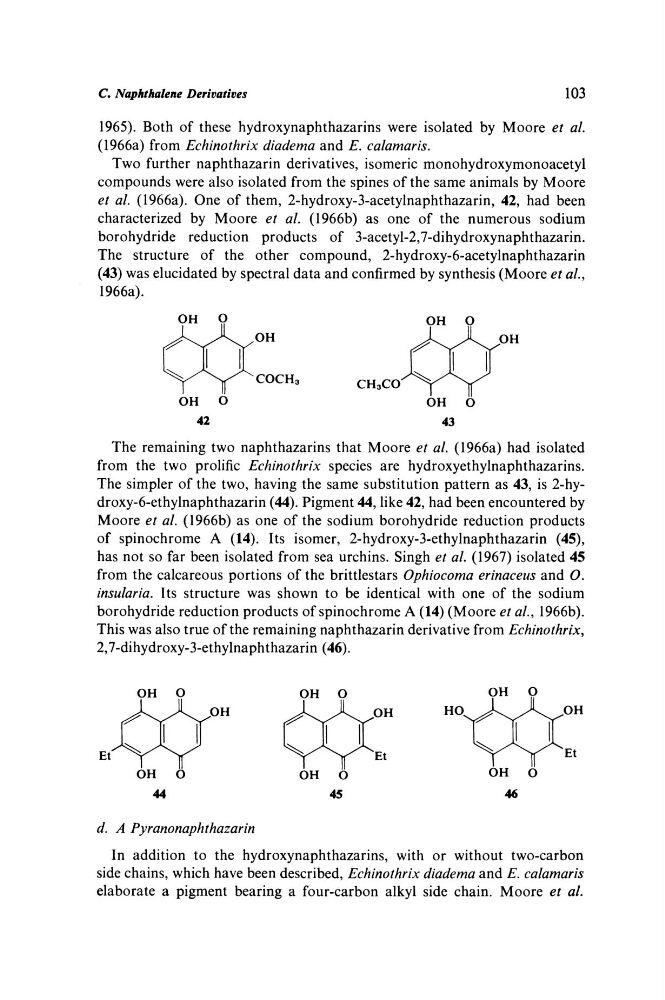
et al. (1966a). One of them, 2-hydroxy-3-acetylnaphthazarin, 42, had been
characterized by Moore et al. (1966b) as one of the numerous sodium
borohydride reduction products of 3-acetyl-2,7-dihydroxynaphthazarin.
The structure of the other compound, 2-hydroxy-6-acetylnaphthazarin
(43) was elucidated by spectral data and confirmed by synthesis (Moore et al,
1966a).
OH
Ο
OH
Ο
C^r"
COCH3
CH 3 CO-J^^^
OH
Ο
OH
Ο
42
43
The remaining two naphthazarins that Moore et al. (1966a) had isolated
from the two prolific Echinothrix species are hydroxyethylnaphthazarins.
The simpler of the two, having the same substitution pattern as 43, is 2-hydroxy-6-ethylnaphthazarin (44). Pigment 44, like 42, had been encountered by
Moore et al. (1966b) as one of the sodium borohydride reduction products
of spinochrome A (14). Its isomer, 2-hydroxy-3-ethylnaphthazarin (45),
has not so far been isolated from sea urchins. Singh et al. (1967) isolated 45
from the calcareous portions of the brittlestars Ophiocoma erinaceus and O.
insularia. Its structure was shown to be identical with one of the sodium
borohydride reduction products of spinochrome A (14) (Moore et al, 1966b).
This was also true of the remaining naphthazarin derivative from Echinothrix,
2,7-dihydroxy-3-ethylnaphthazarin (46).
OH
Ο
OH
Ο
OH
Ο
jt^r <ιχ "W;
OH
Ο
OH
Ο
OH
Ο
44
45
46
d. A
Pyranonaphthazarin
In addition to the hydroxynaphthazarins, with or without two-carbon
side chains, which have been described, Echinothrix diadema and E. calamaris
elaborate a pigment bearing a four-carbon alkyl side chain. Moore et al.
c. Naphthalene Derivatives
103
1965). Both of these hydroxynaphthazarins were isolated by Moore et ale
(1966a) from Echinothrix diadema and E. calamaris.
Two further naphthazarin derivatives, isomeric monohydroxymonoacetyl
compounds were also isolated from the spines of the same animals by Moore
et ale (1966a). One of them, 2-hydroxy-3-acetylnaphthazarin, 42, had been
characterized by Moore et ale (1966b) as one of the numerous sodium
borohydride reduction products of 3-acetyl-2,7-dihydroxynaphthazarin.
The structure of the other compound, 2-hydroxy-6-acetylnaphthazarin
(43) was elucidated by spectral data and confirmed by synthesis (Moore et al.,
1966a).
OH 0
41
OH
OH 0
43
OH
The remaining two naphthazarins that Moore et ale (1966a) had isolated
from the two prolific Echinothrix species are hydroxyethylnaphthazarins.
The simpler of the two, having the same substitution pattern as 43, is 2-hydroxy-6-ethylnaphthazarin (44). Pigment 44, like 42, had been encountered by
Moore et ale (1966b) as one of the sodium borohydride reduction products
of spinochrome A (14). Its isomer, 2-hydroxy-3-ethylnaphthazarin (45),
has not so far been isolated from sea urchins. Singh et ale (1967) isolated 45
from the calcareous portions of the brittlestars Ophiocoma erinaceus and o.
insularia. Its structure was shown to be identical with one of the sodium
borohydride reduction products of spinochrome A (14) (Moore et al., 1966b).
This was also true of the remaining naphthazarin derivative from Echinothrix,
2,7-dihydroxy-3-ethylnaphthazarin (46).
OH 0
OH 0
OH 0
OH
OH
HO
OH
Et
Et
Et
OH 0
OH 0
OH 0
44
45
46
d. A Pyranonaphthazarin
In addition to the hydroxynaphthazarins, with or without two-carbon
side chains, which have been described, Echinothrix diadema and E. calamaris
elaborate a pigment bearing a four-carbon alkyl side chain. Moore et ale
103
1965). Both of these hydroxynaphthazarins were isolated by Moore et al.
(1966a) from Echinothrix diadema and E. calamaris.
Two further naphthazarin derivatives, isomeric monohydroxymonoacetyl
compounds were also isolated from the spines of the same animals by Moore
et al. (1966a). One of them, 2-hydroxy-3-acetylnaphthazarin, 42, had been
characterized by Moore et al. (1966b) as one of the numerous sodium
borohydride reduction products of 3-acetyl-2,7-dihydroxynaphthazarin.
The structure of the other compound, 2-hydroxy-6-acetylnaphthazarin
(43) was elucidated by spectral data and confirmed by synthesis (Moore et al,
1966a).
OH
Ο
OH
Ο
C^r"
COCH3
CH 3 CO-J^^^
OH
Ο
OH
Ο
42
43
The remaining two naphthazarins that Moore et al. (1966a) had isolated
from the two prolific Echinothrix species are hydroxyethylnaphthazarins.
The simpler of the two, having the same substitution pattern as 43, is 2-hydroxy-6-ethylnaphthazarin (44). Pigment 44, like 42, had been encountered by
Moore et al. (1966b) as one of the sodium borohydride reduction products
of spinochrome A (14). Its isomer, 2-hydroxy-3-ethylnaphthazarin (45),
has not so far been isolated from sea urchins. Singh et al. (1967) isolated 45
from the calcareous portions of the brittlestars Ophiocoma erinaceus and O.
insularia. Its structure was shown to be identical with one of the sodium
borohydride reduction products of spinochrome A (14) (Moore et al, 1966b).
This was also true of the remaining naphthazarin derivative from Echinothrix,
2,7-dihydroxy-3-ethylnaphthazarin (46).
OH
Ο
OH
Ο
OH
Ο
jt^r <ιχ "W;
OH
Ο
OH
Ο
OH
Ο
44
45
46
d. A
Pyranonaphthazarin
In addition to the hydroxynaphthazarins, with or without two-carbon
side chains, which have been described, Echinothrix diadema and E. calamaris
elaborate a pigment bearing a four-carbon alkyl side chain. Moore et al.
c. Naphthalene Derivatives
103
1965). Both of these hydroxynaphthazarins were isolated by Moore et ale
(1966a) from Echinothrix diadema and E. calamaris.
Two further naphthazarin derivatives, isomeric monohydroxymonoacetyl
compounds were also isolated from the spines of the same animals by Moore
et ale (1966a). One of them, 2-hydroxy-3-acetylnaphthazarin, 42, had been
characterized by Moore et ale (1966b) as one of the numerous sodium
borohydride reduction products of 3-acetyl-2,7-dihydroxynaphthazarin.
The structure of the other compound, 2-hydroxy-6-acetylnaphthazarin
(43) was elucidated by spectral data and confirmed by synthesis (Moore et al.,
1966a).
OH 0
41
OH
OH 0
43
OH
The remaining two naphthazarins that Moore et ale (1966a) had isolated
from the two prolific Echinothrix species are hydroxyethylnaphthazarins.
The simpler of the two, having the same substitution pattern as 43, is 2-hydroxy-6-ethylnaphthazarin (44). Pigment 44, like 42, had been encountered by
Moore et ale (1966b) as one of the sodium borohydride reduction products
of spinochrome A (14). Its isomer, 2-hydroxy-3-ethylnaphthazarin (45),
has not so far been isolated from sea urchins. Singh et ale (1967) isolated 45
from the calcareous portions of the brittlestars Ophiocoma erinaceus and o.
insularia. Its structure was shown to be identical with one of the sodium
borohydride reduction products of spinochrome A (14) (Moore et al., 1966b).
This was also true of the remaining naphthazarin derivative from Echinothrix,
2,7-dihydroxy-3-ethylnaphthazarin (46).
OH 0
OH 0
OH 0
OH
OH
HO
OH
Et
Et
Et
OH 0
OH 0
OH 0
44
45
46
d. A Pyranonaphthazarin
In addition to the hydroxynaphthazarins, with or without two-carbon
side chains, which have been described, Echinothrix diadema and E. calamaris
elaborate a pigment bearing a four-carbon alkyl side chain. Moore et ale