

60
(1. \. I'Amf HSOS. JR.
(ii) p y-- I. 4 arbitrary. This i4 tlte 4 % discussed by Goldstein (1951).
( X ( m n)) satibfies a difference equation. which in the limit of a continuous
d ist r i bu t ion becomes the telegraph equation.
(iii) q = 1, p arbitrary. After an initial flight, the particle is (r trapped ' * in ;L
region with velocity + 1 to the left and velocity - 1 to the right. ( X ( m . n))
quickly reaches an asymptotic state kklwndent of time.
2.3. Particle Statisticsfor Arbitrary P, Q
The details of solving for ( X ( m , n)) or for R ( j ; n) are sufficiently complicated so that only the briefest of descriptions are given. A considerable
portion of the derivation is given in Patterson (1966), but it is not entirely
complete. As far as possible, solutions were checked against computer experiments and found correct.
In a walk of n steps, there are 2" distinct trajectories. Because of this
distinctness (or disjointness), the probability of any particular event equals
the w m of the probabilities of every trajectory which "contains" that event.
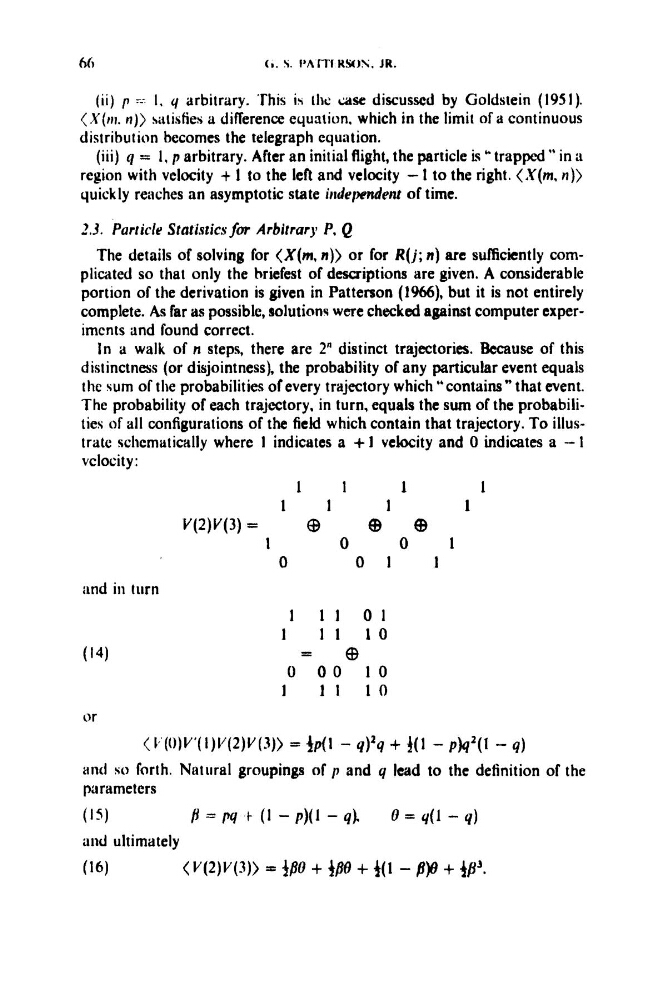
The probability of each trajectory. in turn, equals the sum of the probabilities of all configurations of the field which contain that trajectory. To illustrate schcmutically where 1 indicates a + 1 velocity and 0 indicates a - 1
velocity :
I
1
1
I
1
1
1
1
V ( 2 ) V ( 3 ) =
03
$
@
1
0
0
1
0
0 1
1
ilnd in turn
1 I 1 0 1
1
1 1 1 0
=
@
0 0 0 1 0
1
1 1
1 0
or
(k'(O)V'( 1)1'(2)V(3)) = +p(l - y)Z9 + f ( l - p)qZ(l - q )
and s o forth. Natural groupings of p and 4 lead to the definition of the
pa rametcrs
(15)
P = P 4 t- (1 - P N -4).
0=4(1 - 9 )
atid ultimately
(1. \. I'Amf HSOS. JR.
(ii) p y-- I. 4 arbitrary. This i4 tlte 4 % discussed by Goldstein (1951).
( X ( m n)) satibfies a difference equation. which in the limit of a continuous
d ist r i bu t ion becomes the telegraph equation.
(iii) q = 1, p arbitrary. After an initial flight, the particle is (r trapped ' * in ;L
region with velocity + 1 to the left and velocity - 1 to the right. ( X ( m . n))
quickly reaches an asymptotic state kklwndent of time.
2.3. Particle Statisticsfor Arbitrary P, Q
The details of solving for ( X ( m , n)) or for R ( j ; n) are sufficiently complicated so that only the briefest of descriptions are given. A considerable
portion of the derivation is given in Patterson (1966), but it is not entirely
complete. As far as possible, solutions were checked against computer experiments and found correct.
In a walk of n steps, there are 2" distinct trajectories. Because of this
distinctness (or disjointness), the probability of any particular event equals
the w m of the probabilities of every trajectory which "contains" that event.
The probability of each trajectory. in turn, equals the sum of the probabilities of all configurations of the field which contain that trajectory. To illustrate schcmutically where 1 indicates a + 1 velocity and 0 indicates a - 1
velocity :
I
1
1
I
1
1
1
1
V ( 2 ) V ( 3 ) =
03
$
@
1
0
0
1
0
0 1
1
ilnd in turn
1 I 1 0 1
1
1 1 1 0
=
@
0 0 0 1 0
1
1 1
1 0
or
(k'(O)V'( 1)1'(2)V(3)) = +p(l - y)Z9 + f ( l - p)qZ(l - q )
and s o forth. Natural groupings of p and 4 lead to the definition of the
pa rametcrs
(15)
P = P 4 t- (1 - P N -4).
0=4(1 - 9 )
atid ultimately