

56
STA \ L t Y )R RSI N
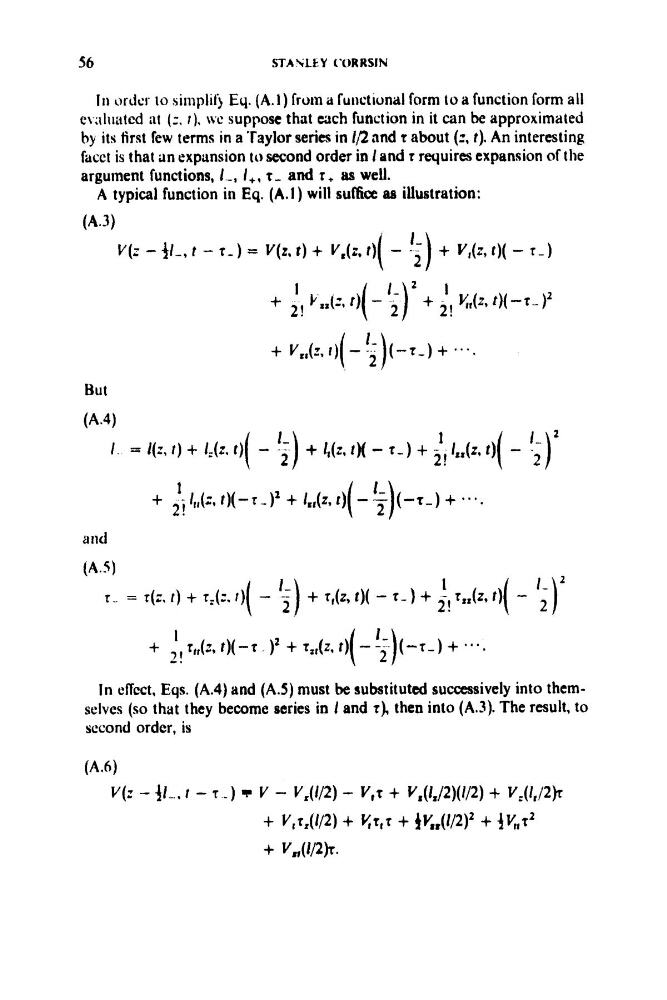
I n order 10 simplilj Eq. (A.l) from a Tutictional form to a function form all
e\;iluutcd at ( :
. I ) , IVC suppose that each function in it can be approximated
hp its tint few terms in a Taylor series in //2 and t about (2, t). An interesting
facet is that an expansion to second order in I and r requires expansion of the
argument functions, I - , I,, t- and I , as well.
A typical function in Eq. (A.l) will s u b aa illustration:
(A.3)
v(; - I/-, r - 7 - 1 = ~ ( z ,
t ) + v,(t, t)( - 'j) + v,(z, t)( - T - 1
In effcct. Eqs. (A.4) and (A.5) must be substituted successively into themselves (so that they become series in I and T ) , then into (A.3). The result, to
second order, is
STA \ L t Y )R RSI N
I n order 10 simplilj Eq. (A.l) from a Tutictional form to a function form all
e\;iluutcd at ( :
. I ) , IVC suppose that each function in it can be approximated
hp its tint few terms in a Taylor series in //2 and t about (2, t). An interesting
facet is that an expansion to second order in I and r requires expansion of the
argument functions, I - , I,, t- and I , as well.
A typical function in Eq. (A.l) will s u b aa illustration:
(A.3)
v(; - I/-, r - 7 - 1 = ~ ( z ,
t ) + v,(t, t)( - 'j) + v,(z, t)( - T - 1
In effcct. Eqs. (A.4) and (A.5) must be substituted successively into themselves (so that they become series in I and T ) , then into (A.3). The result, to
second order, is