

TRANSPORT MODEL LlMlTA TIONS IN TURBULENCE
55
Po\c.rr SvritJ.3 /or Rtrndom N'cilk Transport Rate
Suppose a passive scalar field r(z. t ) undergoes transport in the niean, due
to the random convective action of indelibly tagged particles (tagged with
the .'r substance") which perform random walks. Suppose also that both
the mean step length l(z, t ) and the root-mcansquare speed V ( z , t ) are
smooth functions of position and time. We ignoredensity changes merely for
algebraic simplicity. They. of course, may be important in some applications.
Under hypotheses like those in the crudest kinetic theory of gases (see,
e . g , Loeb, 1934), the mean net transport rate ("flux") of r(z, t ) across the
plane z in the positive direction is something like
- V ( Z + #+, t - 7+)r(; + ji+, t - t+)}.
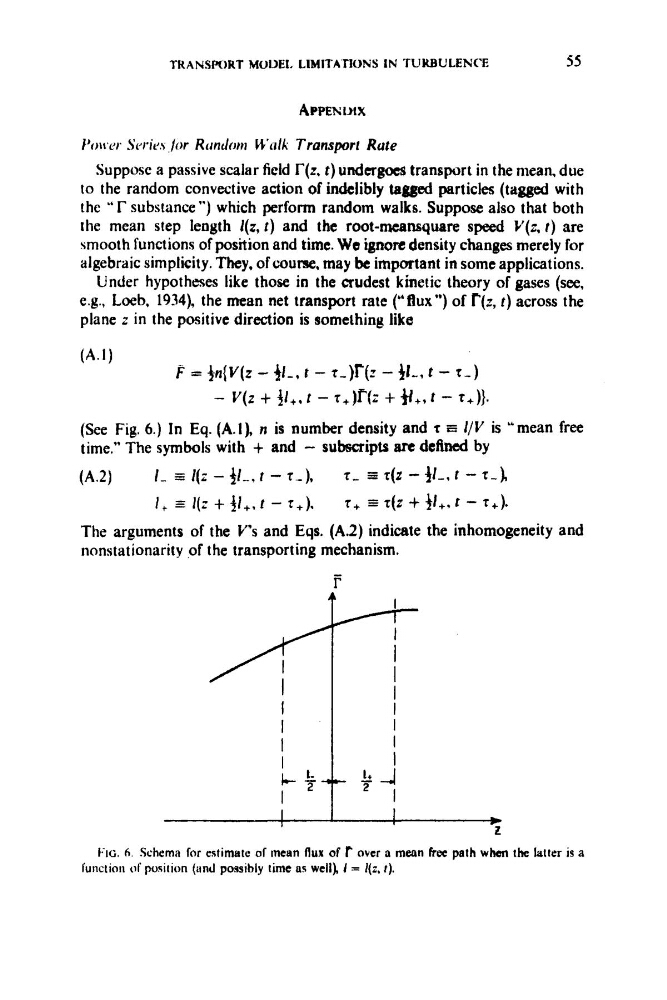
(See Fig. 6.) In Eq. (A.l), n is number density and T E I/V is "mean free
time." The symbols with + and - subscripts are defined by
(A.2)
I - = / ( ~ - i / - , t - 7 - ) ,
T - ~ T ( Z - - I - . ~ - T - X
I , d ( z + f l + , t - ? + ) ,
? + E ? ( Z + + I + , t - ? + ) .
The arguments of the V's and Eqs. (A.2) indicate the inhomogeneity and
nonstationarity of the transporting mechanism.
/ I
1
I
I
I
I
I
I
I
b
i?
FIG. 6. Schema for estimate of inem flux of r over a mean free path when the latter is a
furicrioii of position (and possibly time as well), 1 = l(z, t ) .
55
Po\c.rr SvritJ.3 /or Rtrndom N'cilk Transport Rate
Suppose a passive scalar field r(z. t ) undergoes transport in the niean, due
to the random convective action of indelibly tagged particles (tagged with
the .'r substance") which perform random walks. Suppose also that both
the mean step length l(z, t ) and the root-mcansquare speed V ( z , t ) are
smooth functions of position and time. We ignoredensity changes merely for
algebraic simplicity. They. of course, may be important in some applications.
Under hypotheses like those in the crudest kinetic theory of gases (see,
e . g , Loeb, 1934), the mean net transport rate ("flux") of r(z, t ) across the
plane z in the positive direction is something like
- V ( Z + #+, t - 7+)r(; + ji+, t - t+)}.
(See Fig. 6.) In Eq. (A.l), n is number density and T E I/V is "mean free
time." The symbols with + and - subscripts are defined by
(A.2)
I - = / ( ~ - i / - , t - 7 - ) ,
T - ~ T ( Z - - I - . ~ - T - X
I , d ( z + f l + , t - ? + ) ,
? + E ? ( Z + + I + , t - ? + ) .
The arguments of the V's and Eqs. (A.2) indicate the inhomogeneity and
nonstationarity of the transporting mechanism.
/ I
1
I
I
I
I
I
I
I
b
i?
FIG. 6. Schema for estimate of inem flux of r over a mean free path when the latter is a
furicrioii of position (and possibly time as well), 1 = l(z, t ) .