

TRANSPORT MODEL LIMITATIONS IN TURBULENCE
53
prcsum;ibly coincidcntal, but rcminds us that scahr diffusivity and viscosity
models work better for free shear flows than for wall flows.
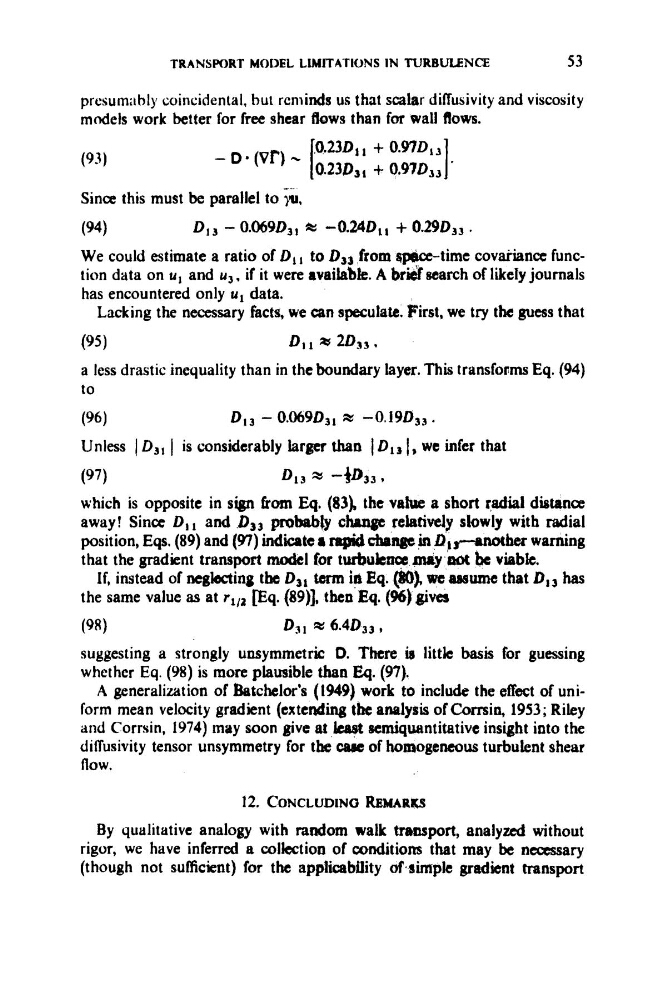
(93)
Since this must be parallel to $I ,
(94)
D13 - 0.069031 -0.24D,1 + 0.29Dj3 .
We could estimate a ratio of DI to D33 from qmcc-time covaiiancc function data on u1 and u3. if it were availabB. A hidsearch of likely journals
has encountered only u1 data.
Lacking the necessary facts, we can speculate. First, we try the guess that
(95 1
D,I a 2033.
a less drastic inequality than in the boundary layer. This transforms Eq. (94)
to
(96)
DI3 - 0.069031 a -0.19D33.
Unless I D3, I is considerably larger than 1 D15 1 , we infer that
which is opposite in sign from Eq. (83), the value a short radial distance
away! Since D I 1 and DS3 probably chpnoe relatively slowly with d i a l
position, Eqs. (89) and (97) indicate 8 npid cbengc in Dj,--another warning
that the gradient transport d l for turbukaoe may lsot be viabk.
If, instead of neglecting the D3, term id Eq. ($0) we assume that D , , has
the same value as at rli3 p q . (8911, then Eq. (%} gives
(98 1
(97)
D13 a - 3 0 3 3 P
DJI * 6.4033 9
suggesting a strongly unsymmetric 0. There is littk basis for guessing
whether Eq. (98) is more plausible tban Eq. (97).
A generalization of Batchelor’s (1949) work to include the effmt of uniform mean velocity gradient (extending tbe analysis of Corrsin, 1953; Riley
arid Corrsin, 1974) may soon give 81 least semiquantitative insight into the
diffusivity tensor unsymmetry for the CIUC of homogeneous turbulent shear
flow.
12. CONCLUDING REMARKS
By qualitative analogy with random walk transport, analyzed without
rigor, we have inferred a coilaction of conditions that may be naxssary
(though not sufficient) for the applicability of.simpk gradient transport
53
prcsum;ibly coincidcntal, but rcminds us that scahr diffusivity and viscosity
models work better for free shear flows than for wall flows.
(93)
Since this must be parallel to $I ,
(94)
D13 - 0.069031 -0.24D,1 + 0.29Dj3 .
We could estimate a ratio of DI to D33 from qmcc-time covaiiancc function data on u1 and u3. if it were availabB. A hidsearch of likely journals
has encountered only u1 data.
Lacking the necessary facts, we can speculate. First, we try the guess that
(95 1
D,I a 2033.
a less drastic inequality than in the boundary layer. This transforms Eq. (94)
to
(96)
DI3 - 0.069031 a -0.19D33.
Unless I D3, I is considerably larger than 1 D15 1 , we infer that
which is opposite in sign from Eq. (83), the value a short radial distance
away! Since D I 1 and DS3 probably chpnoe relatively slowly with d i a l
position, Eqs. (89) and (97) indicate 8 npid cbengc in Dj,--another warning
that the gradient transport d l for turbukaoe may lsot be viabk.
If, instead of neglecting the D3, term id Eq. ($0) we assume that D , , has
the same value as at rli3 p q . (8911, then Eq. (%} gives
(98 1
(97)
D13 a - 3 0 3 3 P
DJI * 6.4033 9
suggesting a strongly unsymmetric 0. There is littk basis for guessing
whether Eq. (98) is more plausible tban Eq. (97).
A generalization of Batchelor’s (1949) work to include the effmt of uniform mean velocity gradient (extending tbe analysis of Corrsin, 1953; Riley
arid Corrsin, 1974) may soon give 81 least semiquantitative insight into the
diffusivity tensor unsymmetry for the CIUC of homogeneous turbulent shear
flow.
12. CONCLUDING REMARKS
By qualitative analogy with random walk transport, analyzed without
rigor, we have inferred a coilaction of conditions that may be naxssary
(though not sufficient) for the applicability of.simpk gradient transport