

52
STA \I.EY CORRSIN
Laboratory data have long been available for a different flow
configurat ion, in which the mean temperature gradient vector covers more
than a full 90" range of directions, the warm turbulent jet (e.g., Corrsin and
Uberoi, 1950).
Fifteen diameters from the round jet nozzle, the fields are fairly well
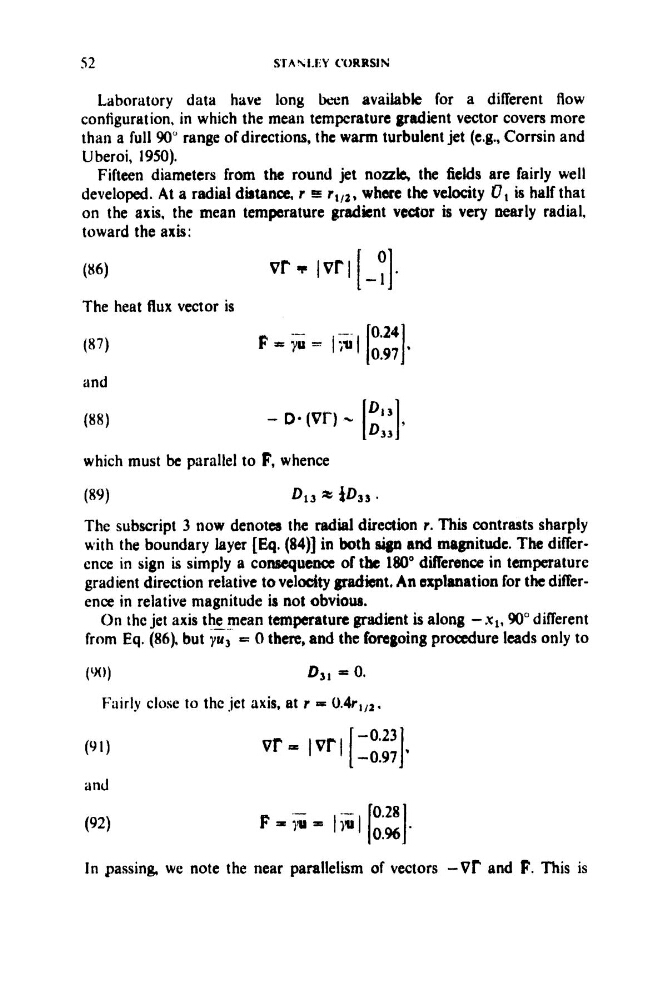
developed. At a radial distance, r DI r1,2, where the velocity 0, is half that
on the axis, the mean temperature gradient vedor is very marly radial,
toward the axis:
The heat flux vector is
and
which must be parallel to F, whence
The subscript 3 now denotes the radial direction r. This contrasts sharply
with the boundary layer [Eq. (8411 in both @ and magnitude. The differcnce in sign is simply a consqucncc of the 180" dinemnce in temperature
gradient direction relative tovelodty gradient, An explanation for the difference in relative magnitude is not obvioue.
On thc jet axis the mean temperature gradient is along -xlr 90" different
from Eq. (86). but F3. = 0 there, and the foregoing procedure leads only to
('W
D i l = 0.
Fairly close to thc jet axis, at r = 0.4r,,2,
a n J
(92)
In passing, we note the near parallelism of vectors -Vr and F. This is
STA \I.EY CORRSIN
Laboratory data have long been available for a different flow
configurat ion, in which the mean temperature gradient vector covers more
than a full 90" range of directions, the warm turbulent jet (e.g., Corrsin and
Uberoi, 1950).
Fifteen diameters from the round jet nozzle, the fields are fairly well
developed. At a radial distance, r DI r1,2, where the velocity 0, is half that
on the axis, the mean temperature gradient vedor is very marly radial,
toward the axis:
The heat flux vector is
and
which must be parallel to F, whence
The subscript 3 now denotes the radial direction r. This contrasts sharply
with the boundary layer [Eq. (8411 in both @ and magnitude. The differcnce in sign is simply a consqucncc of the 180" dinemnce in temperature
gradient direction relative tovelodty gradient, An explanation for the difference in relative magnitude is not obvioue.
On thc jet axis the mean temperature gradient is along -xlr 90" different
from Eq. (86). but F3. = 0 there, and the foregoing procedure leads only to
('W
D i l = 0.
Fairly close to thc jet axis, at r = 0.4r,,2,
a n J
(92)
In passing, we note the near parallelism of vectors -Vr and F. This is