

itt rime r - +- 0 can he expressed as iin integral over thc p d f . at any carlicr
iinic I . weiphlcd u ill1 rtic * * transition probability" T that the particlc movcs
;I dist,iticc A during ~ l i c rime dinerencu: Oh:
(29)
For ~ h t . basic initial value problem of random convective diffusion of a
matcrial point, P ( z . r) is proportional to the (ensemble) mean concentration
r(:, I ) , YO we can associate this with our previous discussions of diffusion.
The function forin of the transition probability contains *'the physics" of the
process.
It is often convcnicnt t o have a differential equation in place of Eq. (29),
itnd the morc or less standard procedure (Chandrasekhar, 1943) is to use the
" Kraniers Moyal expansion." This means to expand the left-hand side as a
power series in 0 and thc integrand as a power series in A. The outcome is a
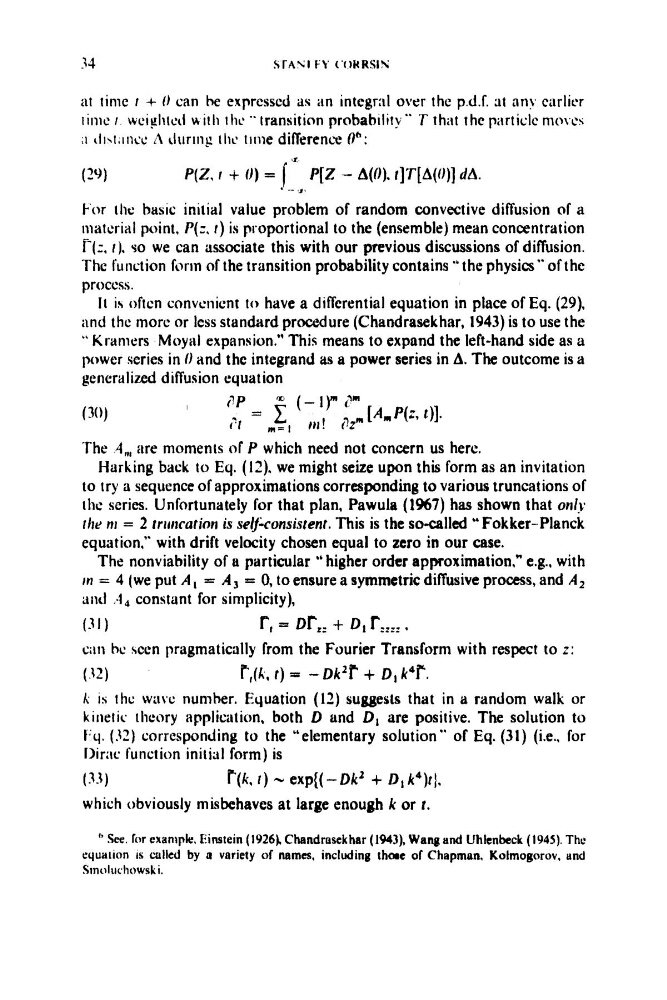
generalized diffusion equation
*I.
P ( Z , I + 0) = 1 P[Z - A(0). I]T[A(O)] dA.
* - ,
,
,
(30)
I
The 4 , iire moments of P which need not concern us here.
Harking back to Eq. (12). we might seize upon this form as an invitation
to try a sequence of approximations corresponding to various truncations of
tlic series. Unfortunately for that plan, Pawula (1%7) has shown that only
the m = 2 rnrrtcurion is seljlconsistent. This is the so-called " Fokker-Planck
equation," with drift velocity chosen equal to zero in our case.
The nonviability of a pctrticular "higher order approximation." e.g., with
rn = 4 (we put A , = A J = 0, to ensure a symmetric diffusive process, and A z
vntl .-I4 constant for simplicity),
cittl hc wen pragmatically from the Fourier Transform with respect to z :
h is rhc wnvc numher. Equation (12) suggests that in a random walk or
kirietic theory ;tpplication. both D and D1 are positive. The solution to
t*q. (32) corresponding to the "elementary solution" of Eq. (31) (i.e.. for
1)ir;tt function initial form) is
(3.3)
Q k , I ) - exp((-Dk2 + ~ , k ~ ) r l ,
which obviously misbehaves at large enough k or r.
(.31)
r, = orl- + D , rzzZz ,
('2)
P,(A, t ) = -DkzF + DI PP.
" See. for exanipk. Einstein (1926). Chandrnsckhsr (1%3), Wang and Uhlenbeck (1945). The
cqualion IS culled by a variety of names. including thorc of Chapman. Kolmogorov. and
Smol ucliowsk i.
iinic I . weiphlcd u ill1 rtic * * transition probability" T that the particlc movcs
;I dist,iticc A during ~ l i c rime dinerencu: Oh:
(29)
For ~ h t . basic initial value problem of random convective diffusion of a
matcrial point, P ( z . r) is proportional to the (ensemble) mean concentration
r(:, I ) , YO we can associate this with our previous discussions of diffusion.
The function forin of the transition probability contains *'the physics" of the
process.
It is often convcnicnt t o have a differential equation in place of Eq. (29),
itnd the morc or less standard procedure (Chandrasekhar, 1943) is to use the
" Kraniers Moyal expansion." This means to expand the left-hand side as a
power series in 0 and thc integrand as a power series in A. The outcome is a
generalized diffusion equation
*I.
P ( Z , I + 0) = 1 P[Z - A(0). I]T[A(O)] dA.
* - ,
,
,
(30)
I
The 4 , iire moments of P which need not concern us here.
Harking back to Eq. (12). we might seize upon this form as an invitation
to try a sequence of approximations corresponding to various truncations of
tlic series. Unfortunately for that plan, Pawula (1%7) has shown that only
the m = 2 rnrrtcurion is seljlconsistent. This is the so-called " Fokker-Planck
equation," with drift velocity chosen equal to zero in our case.
The nonviability of a pctrticular "higher order approximation." e.g., with
rn = 4 (we put A , = A J = 0, to ensure a symmetric diffusive process, and A z
vntl .-I4 constant for simplicity),
cittl hc wen pragmatically from the Fourier Transform with respect to z :
h is rhc wnvc numher. Equation (12) suggests that in a random walk or
kirietic theory ;tpplication. both D and D1 are positive. The solution to
t*q. (32) corresponding to the "elementary solution" of Eq. (31) (i.e.. for
1)ir;tt function initial form) is
(3.3)
Q k , I ) - exp((-Dk2 + ~ , k ~ ) r l ,
which obviously misbehaves at large enough k or r.
(.31)
r, = orl- + D , rzzZz ,
('2)
P,(A, t ) = -DkzF + DI PP.
" See. for exanipk. Einstein (1926). Chandrnsckhsr (1%3), Wang and Uhlenbeck (1945). The
cqualion IS culled by a variety of names. including thorc of Chapman. Kolmogorov. and
Smol ucliowsk i.