

1 KAhSJ'OH I' M0I)EI. LIMII'&TIONS IN TURBUL.EN('F
33
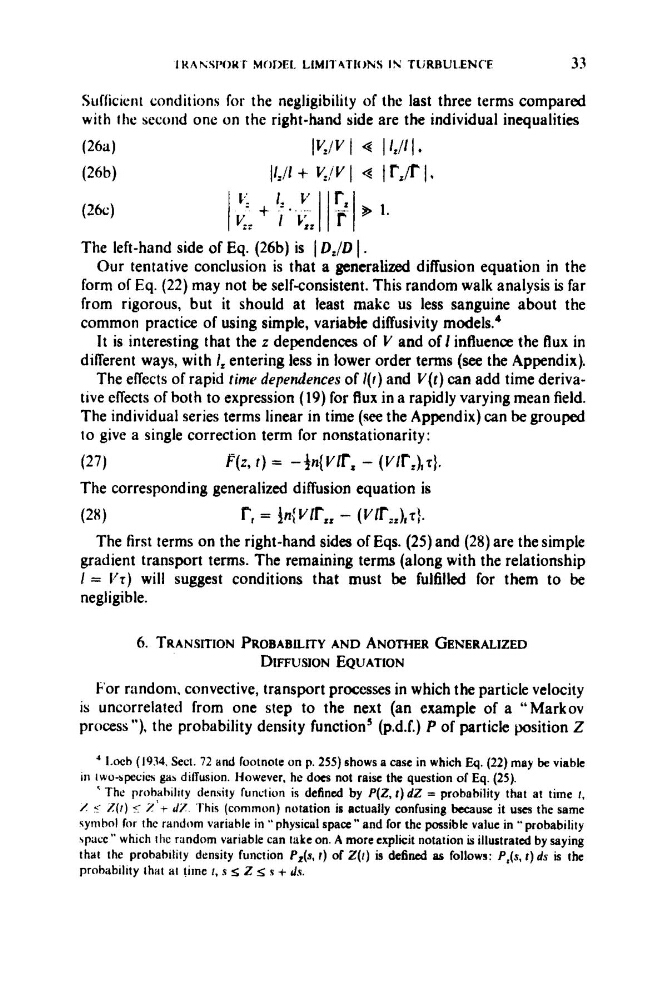
Suflicient conditions for the negligibility of the last three terms compared
with the second one on the right-hand side are the individual inequalities
(26a)
IKlV I I U I I
(26b)
Ibll + v,/v I Q I r,/r 1.
(26c)
The left-hand side of Eq. (26b) is I D,/D I.
Our tentative conclusion is that a generalized diffusion equation in the
form of Eq. (22) may not be self-consistent. This random walk analysis is far
from rigorous, but it should at least make us less sanguine about the
common practice of using simple, variabk diffusivity models.'
It is interesting that the z dependences of V and of I influence the flux in
different ways, with I, entering less in lower order terms (see the Appendix).
The effects of rapid rima dependences of l ( t ) and V ( t ) can add time derivative effects of both to expression (19) for flux in a rapidly varying mean field.
The individual series terms linear in time (see the Appendix) can be grouped
to give a single correction term for nonstationarity :
(27)
(28)
F(z, 1 ) = -tn(vrz - (vrJ1T}.
f, = fm(vr',, - (VIr&].
The corresponding generalized diffusion equation is
The first terms on the right-hand sides of Eqs. (25) and (28) are the simple
gradient transport terms. The remaining terms (along with the relationship
I = 1'7) will suggest conditions that must be fulfilled for them to be
negligible.
6. TRANSITION PROBABILITY AND ANOTHER GENERALIZED
DIFFUSION EQUATION
For random, convective, transport processes in which the particle velocity
is uncorrelated from one step to the next (an example of a "Markov
process "), the probability density function' (p.d.f.) P of particle position Z
' I.mb (1934. Sect. 72 and footnote on p. 255) shows a case in which Eq. (22) may be viable
in two-species pa, diffusion. However, he docs not raise the question of Eq. (25).
' The prohahilily density function is defined by P(Z, t ) d Z = probability that at time I,
L I Z ( / ) symbol for thc random variahle in "physicnl space" and for the possible value in "probability
space" which the random variable can take on. A more explicit notation is illustrated by saying
that the probahility density function Pz(s+ t ) of Z(t) is defined as follows: P,(s9 t ) ds is the
probability that at time I. s s 2 5 s + ds.
33
Suflicient conditions for the negligibility of the last three terms compared
with the second one on the right-hand side are the individual inequalities
(26a)
IKlV I I U I I
(26b)
Ibll + v,/v I Q I r,/r 1.
(26c)
The left-hand side of Eq. (26b) is I D,/D I.
Our tentative conclusion is that a generalized diffusion equation in the
form of Eq. (22) may not be self-consistent. This random walk analysis is far
from rigorous, but it should at least make us less sanguine about the
common practice of using simple, variabk diffusivity models.'
It is interesting that the z dependences of V and of I influence the flux in
different ways, with I, entering less in lower order terms (see the Appendix).
The effects of rapid rima dependences of l ( t ) and V ( t ) can add time derivative effects of both to expression (19) for flux in a rapidly varying mean field.
The individual series terms linear in time (see the Appendix) can be grouped
to give a single correction term for nonstationarity :
(27)
(28)
F(z, 1 ) = -tn(vrz - (vrJ1T}.
f, = fm(vr',, - (VIr&].
The corresponding generalized diffusion equation is
The first terms on the right-hand sides of Eqs. (25) and (28) are the simple
gradient transport terms. The remaining terms (along with the relationship
I = 1'7) will suggest conditions that must be fulfilled for them to be
negligible.
6. TRANSITION PROBABILITY AND ANOTHER GENERALIZED
DIFFUSION EQUATION
For random, convective, transport processes in which the particle velocity
is uncorrelated from one step to the next (an example of a "Markov
process "), the probability density function' (p.d.f.) P of particle position Z
' I.mb (1934. Sect. 72 and footnote on p. 255) shows a case in which Eq. (22) may be viable
in two-species pa, diffusion. However, he docs not raise the question of Eq. (25).
' The prohahilily density function is defined by P(Z, t ) d Z = probability that at time I,
L I Z ( / ) symbol for thc random variahle in "physicnl space" and for the possible value in "probability
space" which the random variable can take on. A more explicit notation is illustrated by saying
that the probahility density function Pz(s+ t ) of Z(t) is defined as follows: P,(s9 t ) ds is the
probability that at time I. s s 2 5 s + ds.