

side of Eq. (I?) we tind for the integr:il of the renortnalizcd higher order
energy [see Elq (IJ)]
-
(24)
1:2 = I:, - 0.0477:
E , = 0.1295
With ,just two ; ~ d j ~ ~ t i t b l e
constants the highcr order term in the expilnsioll
hils been redwed by 40 'I,,. by this criterion. Siniilarly from these determined
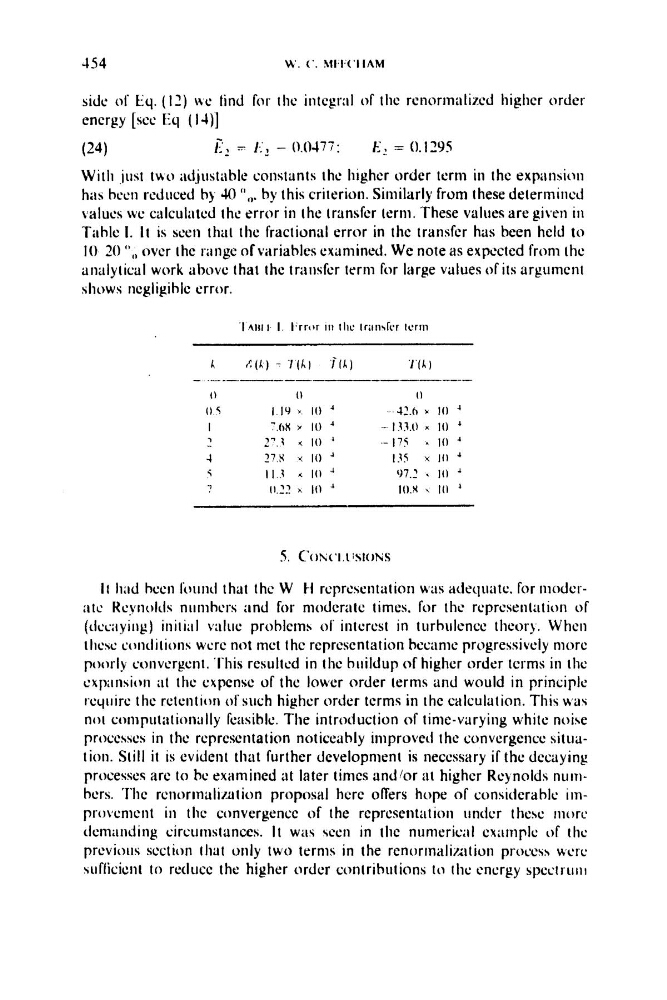
values we ci~lc~liitcd the error i n the transfer term. These values are given i n
Tithlc 1. 11 is seen that the fractional error in the transfer has been held to
10 20 'I,, over the r;ingc ~fviiriables examined. We note as expected from the
analytical work above that the triliisfcr term for large values of its argument
shows ncglipible error.
It ii;id hccii l0und I hat the W ti represenration was adequate. for modctate Kcynolds nuiiihcrs and for moderate times. for thc rcprcsenlntim o f
(c1cc;iyiiip) inilia1 v:iluc prohlcms of intercsl in turbulcnce theory. Whcn
tlicsc coiiclilions were not met thc representation became progressively more
poorly convergent. This resulted in the buildup of higher order tcrms in the
cxp;insioii at thc cxpcnsc of the lower order terms arid would in principle
q u i r e t he rctcntion o f such higher order terms in I hc calculation. This was
no1 c ~ ~ l l ~ t ~ t i ~ t i ~ t l ~ l l y
feasible. The introduction of tinic-varying white noise
procchscs in the representation noticeably improved the convergence situation. Still it is evident tliat further development is necessary if thc decaying
processes are to he examined at later tinics and/or iit higher Reynolds nuinhcrs. The retioritialil.ation proposiil hcrc olfers hope of considcrablc iinprovcment in thc convergence of the representation under t hew iiiorc
clcmii~~ding circuinstanccs. I t was seen in the nurneric;il cx;iiiiplc of 11ic
prcvioiis section that only two terms in the rcnorrnalinition proccss wcrc
suflicicni to reduce the higher order conlrihutions to the cncrgy spcctl-uIiI
energy [see Elq (IJ)]
-
(24)
1:2 = I:, - 0.0477:
E , = 0.1295
With ,just two ; ~ d j ~ ~ t i t b l e
constants the highcr order term in the expilnsioll
hils been redwed by 40 'I,,. by this criterion. Siniilarly from these determined
values we ci~lc~liitcd the error i n the transfer term. These values are given i n
Tithlc 1. 11 is seen that the fractional error in the transfer has been held to
10 20 'I,, over the r;ingc ~fviiriables examined. We note as expected from the
analytical work above that the triliisfcr term for large values of its argument
shows ncglipible error.
It ii;id hccii l0und I hat the W ti represenration was adequate. for modctate Kcynolds nuiiihcrs and for moderate times. for thc rcprcsenlntim o f
(c1cc;iyiiip) inilia1 v:iluc prohlcms of intercsl in turbulcnce theory. Whcn
tlicsc coiiclilions were not met thc representation became progressively more
poorly convergent. This resulted in the buildup of higher order tcrms in the
cxp;insioii at thc cxpcnsc of the lower order terms arid would in principle
q u i r e t he rctcntion o f such higher order terms in I hc calculation. This was
no1 c ~ ~ l l ~ t ~ t i ~ t i ~ t l ~ l l y
feasible. The introduction of tinic-varying white noise
procchscs in the representation noticeably improved the convergence situation. Still it is evident tliat further development is necessary if thc decaying
processes are to he examined at later tinics and/or iit higher Reynolds nuinhcrs. The retioritialil.ation proposiil hcrc olfers hope of considcrablc iinprovcment in thc convergence of the representation under t hew iiiorc
clcmii~~ding circuinstanccs. I t was seen in the nurneric;il cx;iiiiplc of 11ic
prcvioiis section that only two terms in the rcnorrnalinition proccss wcrc
suflicicni to reduce the higher order conlrihutions to the cncrgy spcctl-uIiI