

452
W. ('. MEECtIAM
the transfer function falls off inore slowly than M, for large h. In such a case
the first function. M 2 ( / , ) . will be the dominant term in the representation of
the transfer for large wave numheru. Since M , exactly represents the transfer process, we can guarantee that the behavior of the transfer will be correctly given for large asymptotic values o f its argument.
Continue now with the variational problem. As with the three-mode
process deline a weighting parameter A and minimize by varying the
coefficients urn, [where in, n = 0, 2.4.. . ; we adhere to the notation that the
primed subscripts include the lowest order term given by Eq. (12) whereas
the unprimed include only the functions given by Eq. (lo)]. One finds then
for the variational problem
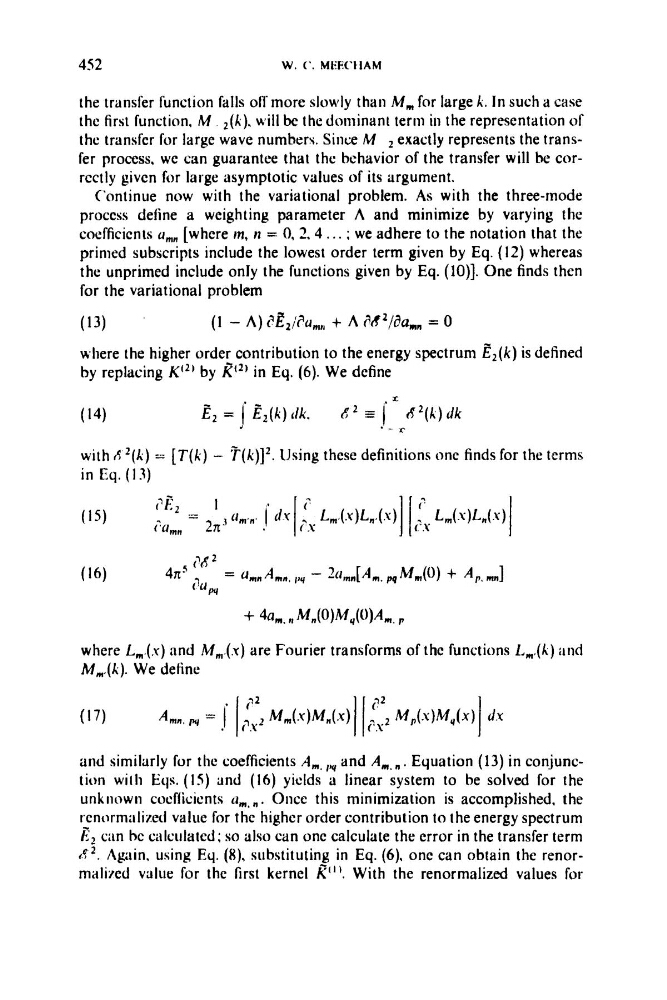
(13)
(1 - A) t'Ez/?umn + A ? 6 2 / d ~ , , = 0
where the higher order contribution to the energy spectrum ,!?,(k) is defined
by replacing K"' by f?") in Eq. (6). We define
. *
E , = j e , ( ~ ) ~ i k , ($2 = 1 A * ( h ) d k
. _
(14)
with rS z(/,) -- [ T ( k ) - $ ( k ) ] , . lJsing these definitions one finds for the terms
in Eq. ( 1 3)
+ 40,. 8, M n ( O ) M q ( O ) A m . p
where L,.(.u) and M,,,.(.u) are Fourier transforms of the functions I,,,,,(/,) ;ind
M,.(k). We detine
arid similarly for the coefficients A,,,. and A,,,". Equation (13) in conjunction with Eqs. (IS) arid (16) yiclds a linear system to be solved for the
unknown cocflicicnts a,, ,,. Once this minimization is accomplished. the
rcnormalized value for the higher order contribution to the energy spectrum
E , ciin he calculated; so also can one calculate the error in the transfer term
(4'. Again, using Eq. (8). substituting in Eq. (6). one can obtain the renormali;led value for the first kernel R"'. With the renormalized values for
W. ('. MEECtIAM
the transfer function falls off inore slowly than M, for large h. In such a case
the first function. M 2 ( / , ) . will be the dominant term in the representation of
the transfer for large wave numheru. Since M , exactly represents the transfer process, we can guarantee that the behavior of the transfer will be correctly given for large asymptotic values o f its argument.
Continue now with the variational problem. As with the three-mode
process deline a weighting parameter A and minimize by varying the
coefficients urn, [where in, n = 0, 2.4.. . ; we adhere to the notation that the
primed subscripts include the lowest order term given by Eq. (12) whereas
the unprimed include only the functions given by Eq. (lo)]. One finds then
for the variational problem
(13)
(1 - A) t'Ez/?umn + A ? 6 2 / d ~ , , = 0
where the higher order contribution to the energy spectrum ,!?,(k) is defined
by replacing K"' by f?") in Eq. (6). We define
. *
E , = j e , ( ~ ) ~ i k , ($2 = 1 A * ( h ) d k
. _
(14)
with rS z(/,) -- [ T ( k ) - $ ( k ) ] , . lJsing these definitions one finds for the terms
in Eq. ( 1 3)
+ 40,. 8, M n ( O ) M q ( O ) A m . p
where L,.(.u) and M,,,.(.u) are Fourier transforms of the functions I,,,,,(/,) ;ind
M,.(k). We detine
arid similarly for the coefficients A,,,. and A,,,". Equation (13) in conjunction with Eqs. (IS) arid (16) yiclds a linear system to be solved for the
unknown cocflicicnts a,, ,,. Once this minimization is accomplished. the
rcnormalized value for the higher order contribution to the energy spectrum
E , ciin he calculated; so also can one calculate the error in the transfer term
(4'. Again, using Eq. (8). substituting in Eq. (6). one can obtain the renormali;led value for the first kernel R"'. With the renormalized values for