

402
MIC'HEL C'OANIIC A N D A l E X A N D R E FAVRI!
-2
- I
0
I
2
3
4
L W o Kt
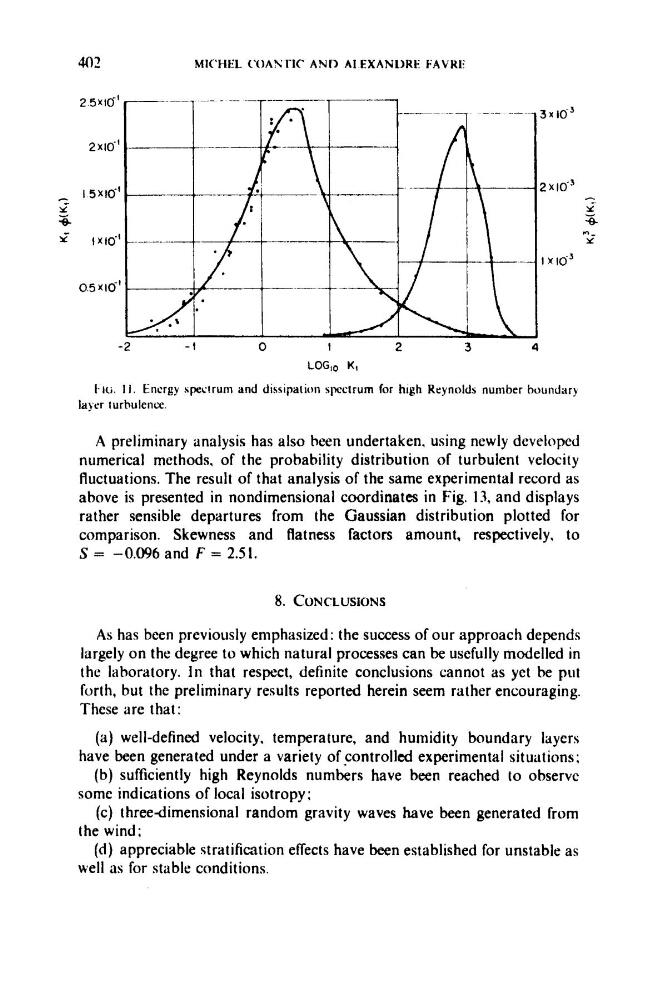
1 . i ~ I I Encrgy qxctruni and dis\tpatioii alwcirurn for high Reynolds number boundary
lalrr turbulence
A preliminary analysis has also been undertaken. using newly developed
numerical methods, of the probability distribution of turbulent velocity
fluctuations. The result of that analysis of the same experimental record as
above is presented in nondimensional coordinates in Fig. 13, and displays
rather sensible departures from the Gaussian distribution plotted for
comparison. Skewness and flatness factors amount, respectively. to
S = -0.096 and F = 2.51.
8. CONCLUSIONS
As has been previously emphasized: the success of our approach depends
largely on the degree to which natural processes can be usefully modelled in
the lahoratory. I n that respect, definite conclusions cannot as yet be put
forth, but the preliminary results reported herein seem rather encouraging.
These are that:
(a) well-defined velocity, temperature, and humidity boundary layers
have been generated under a variety of controlled experimental situations;
(b) sufficiently high Reynolds numbers have been reached to observe
some indications of local isotropy;
(c) three-dimensional random gravity waves have been generated from
the wind;
(d) appreciable stratification effects have been established for unstable as
well as for stable conditions.
MIC'HEL C'OANIIC A N D A l E X A N D R E FAVRI!
-2
- I
0
I
2
3
4
L W o Kt
1 . i ~ I I Encrgy qxctruni and dis\tpatioii alwcirurn for high Reynolds number boundary
lalrr turbulence
A preliminary analysis has also been undertaken. using newly developed
numerical methods, of the probability distribution of turbulent velocity
fluctuations. The result of that analysis of the same experimental record as
above is presented in nondimensional coordinates in Fig. 13, and displays
rather sensible departures from the Gaussian distribution plotted for
comparison. Skewness and flatness factors amount, respectively. to
S = -0.096 and F = 2.51.
8. CONCLUSIONS
As has been previously emphasized: the success of our approach depends
largely on the degree to which natural processes can be usefully modelled in
the lahoratory. I n that respect, definite conclusions cannot as yet be put
forth, but the preliminary results reported herein seem rather encouraging.
These are that:
(a) well-defined velocity, temperature, and humidity boundary layers
have been generated under a variety of controlled experimental situations;
(b) sufficiently high Reynolds numbers have been reached to observe
some indications of local isotropy;
(c) three-dimensional random gravity waves have been generated from
the wind;
(d) appreciable stratification effects have been established for unstable as
well as for stable conditions.