

400
hll('lil-.l~ (X)AN'I'I(' AN11 AIJiXANI)RI( I'AVRI;
c6. 1NtI Lli!N('b' O F ~ I H A T I F I C A ' I I O N UPON TURRUI.ENT PROC'ESSSS
The mean field and the turbulent structure of velocity, temperature, and
humidity have been investigated by R. Bolgiano, Z. Warhaft, and R. Ezraty,
under such conditions that appreciable stratification effects were likely to be
observed. Most of the data have been recorded at a station 25 rn downstream of the entrance section. for velocities ranging from 0.5 to 5 m s-', and
for such temperature and humidity differences as to cover a Richardson's
number's range from +0.8 to -0.7.
Characteristic variation in level and structure of all turbulent variables
have been effectively observed as a function of stability or instability.
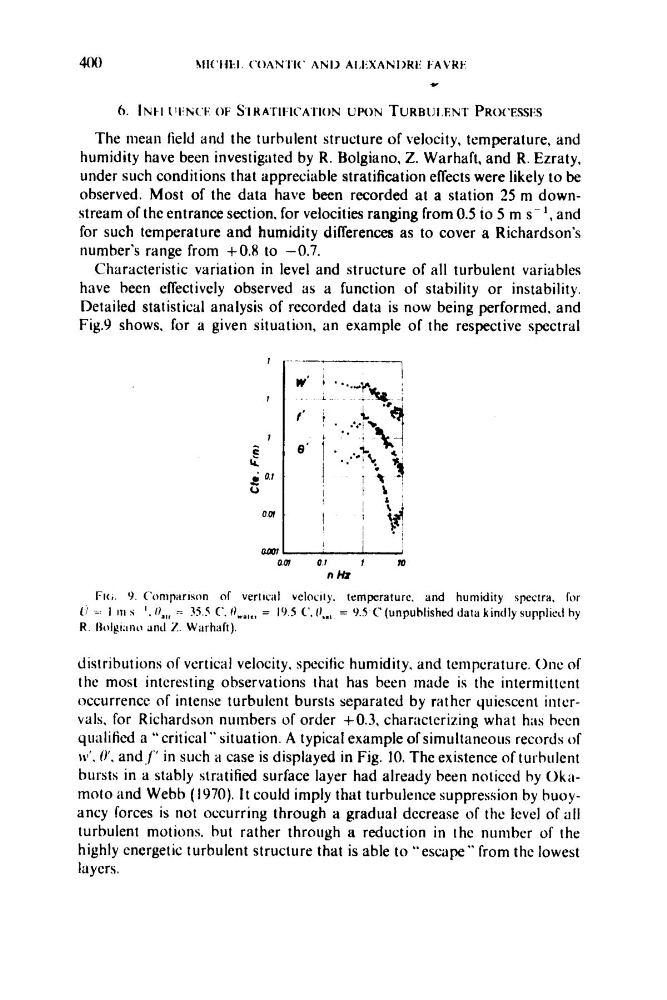
Detailed statistical analysis of recorded data is now being performed, and
Fig.9 shows. for a given situation. an example of the respective spectral
I ,--1
Do01
am
0.1
i
m
n ) h
FN,. 9. ('omparison or verticiil velocity. tempraturc. and humidity spectra. Tor
= 19.5 C'. O,,, = Y.5 C-(unpublished data kindly supplied hy
0 =: 1 iii s I. 01,, = 35.5 C'.
R . 13olgl;tncl ,~nd %. Warhart).
distributions of vertical velocity, specific humidity. and temperature. Onc of
the most interesting observations that has been made is the intermittent
occurrence of intense turbulent bursts separated by rat her quiescent intcrvals, for Richardson nuinbers of order +0.3. characterizing what has bccn
qualified a "critical '' situation. A typical example of simultaneous records o f
w'. 0'. and,f' in such a case is displayed in Fig. 10. The existence of turbirlent
bursts in a stably stratified surface layer had already been noticed by Okamoto and Webb (1070). I t could imply that turbulence suppression by huoyancy forces is no1 occurring through a gradual decrease of the level of all
turbulent motions. but rather through a reduction in the number of the
highly energetic turbulent structure that is able to "escape" from the lowest
layers.
hll('lil-.l~ (X)AN'I'I(' AN11 AIJiXANI)RI( I'AVRI;
c6. 1NtI Lli!N('b' O F ~ I H A T I F I C A ' I I O N UPON TURRUI.ENT PROC'ESSSS
The mean field and the turbulent structure of velocity, temperature, and
humidity have been investigated by R. Bolgiano, Z. Warhaft, and R. Ezraty,
under such conditions that appreciable stratification effects were likely to be
observed. Most of the data have been recorded at a station 25 rn downstream of the entrance section. for velocities ranging from 0.5 to 5 m s-', and
for such temperature and humidity differences as to cover a Richardson's
number's range from +0.8 to -0.7.
Characteristic variation in level and structure of all turbulent variables
have been effectively observed as a function of stability or instability.
Detailed statistical analysis of recorded data is now being performed, and
Fig.9 shows. for a given situation. an example of the respective spectral
I ,--1
Do01
am
0.1
i
m
n ) h
FN,. 9. ('omparison or verticiil velocity. tempraturc. and humidity spectra. Tor
= 19.5 C'. O,,, = Y.5 C-(unpublished data kindly supplied hy
0 =: 1 iii s I. 01,, = 35.5 C'.
R . 13olgl;tncl ,~nd %. Warhart).
distributions of vertical velocity, specific humidity. and temperature. Onc of
the most interesting observations that has been made is the intermittent
occurrence of intense turbulent bursts separated by rat her quiescent intcrvals, for Richardson nuinbers of order +0.3. characterizing what has bccn
qualified a "critical '' situation. A typical example of simultaneous records o f
w'. 0'. and,f' in such a case is displayed in Fig. 10. The existence of turbirlent
bursts in a stably stratified surface layer had already been noticed by Okamoto and Webb (1070). I t could imply that turbulence suppression by huoyancy forces is no1 occurring through a gradual decrease of the level of all
turbulent motions. but rather through a reduction in the number of the
highly energetic turbulent structure that is able to "escape" from the lowest
layers.