

AIR SEA INTERACIIONS
397
.
~
non-Gaussian behavior, which can be related to the well-known fact that
wind-wave crests are sharper than their troughs. Moreover, wave spectra
display characteristic secondary peaks (or, at least. flattenings) corresponding to the second. and even higher-order. harmonics of the dominant wave
frequency.
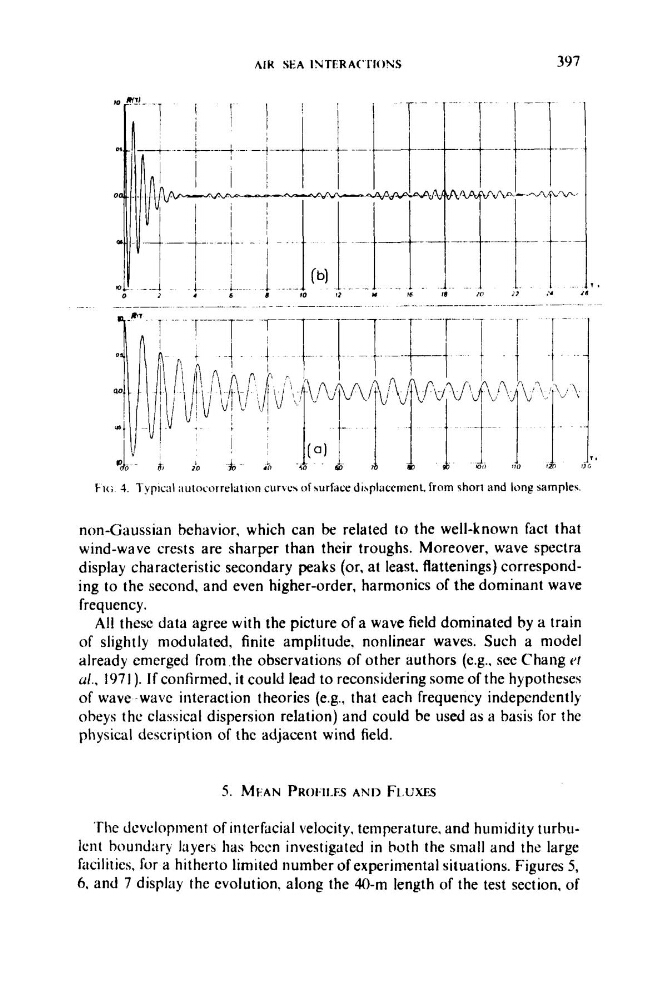
All these data agree with the picture of a wave field dominated by a train
of slightly modulated. finite amplitude. nonlinear waves. Such a model
already emerged from the observations of other authors ( e g . see Chaiig rt
d.. 1971). If confimied, it could lead to reconsidering some of the hypotheses
of wave -wave interaction theories (e.g.. that each frequency independently
obeys the classical dispersion relation) and could be used as a basis for the
physical description of the adjacent wind field.
5. MFAN PROIII.FS A N D FL.UW,ES
‘Thc dcvclopment of interfacial velocity, temperature, and humidity turhuIenl boundary Inyers has bcon investigated in both the sinall and the large
facilities, for a hitherto limited nuinber of experimental situations. Figures 5,
6. and 7 display the evolution. along the 40-m length of the test section, of
397
.
~
non-Gaussian behavior, which can be related to the well-known fact that
wind-wave crests are sharper than their troughs. Moreover, wave spectra
display characteristic secondary peaks (or, at least. flattenings) corresponding to the second. and even higher-order. harmonics of the dominant wave
frequency.
All these data agree with the picture of a wave field dominated by a train
of slightly modulated. finite amplitude. nonlinear waves. Such a model
already emerged from the observations of other authors ( e g . see Chaiig rt
d.. 1971). If confimied, it could lead to reconsidering some of the hypotheses
of wave -wave interaction theories (e.g.. that each frequency independently
obeys the classical dispersion relation) and could be used as a basis for the
physical description of the adjacent wind field.
5. MFAN PROIII.FS A N D FL.UW,ES
‘Thc dcvclopment of interfacial velocity, temperature, and humidity turhuIenl boundary Inyers has bcon investigated in both the sinall and the large
facilities, for a hitherto limited nuinber of experimental situations. Figures 5,
6. and 7 display the evolution. along the 40-m length of the test section, of