

I
D
P
U: 10.29 m/s
U: 12.87 m/s
U:IJ47 m/s
U - 18.01 m/s
U : 20,58 m/s
U : 5 0 2 m/s
u- 5.94 m/s
U : 699 m/s
U: 8.08 m/5
U : 907 m/s
01
I0
100
n/n.
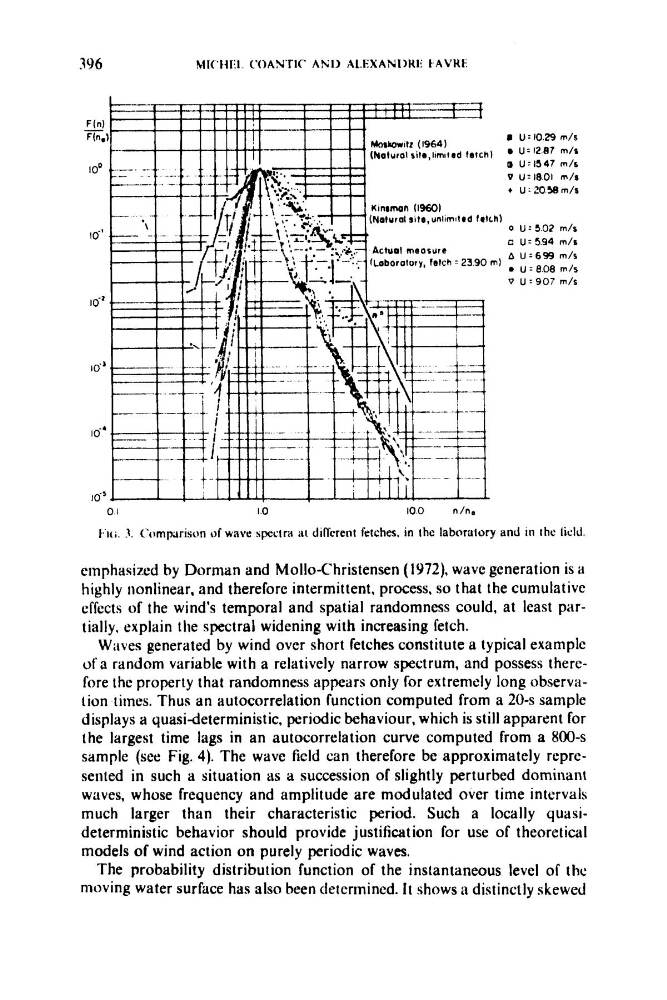
t i c ; , 3. Comparison of wave rpeclra at ditlcrent fetches. in the laboratory and ti1 the lield.
emphasized by Dorman and Mollo-Christensen (1972). wave generation is a
highly nonlinear, and therefore intermittent, process, so that the cumulative
effects of the wind's temporal and spatial randomness could, at least partially, explain the spectral widening with increasing fetch.
Waves generated by wind over short fetches constitute a typical example
o l a random variable with a relatively narrow spectrum, and possess therefore the property that randomness appears only for extremely long observalion times. Thus an autocorrelation function computed from a 20-s sample
displays a quasideterministic, periodic behaviour, which is still apparent for
the largest time lags in an autocorrelation curve computed from a 800-s
sample (see Fig. 4). The wave field can therefore be approximately represented in such a situation as a succession of slightly perturbed dominant
waves, whose frequency and amplitude are modulated over time intervals
much larger than their characteristic period. Such a locally quasideterministic behavior should provide justification for use of theoretical
models of wind action on purely periodic waves.
The probability distribution function of the instantaneous level of thc
moving water surface has also been determined. It shows a distinctly skewed
D
P
U: 10.29 m/s
U: 12.87 m/s
U:IJ47 m/s
U - 18.01 m/s
U : 20,58 m/s
U : 5 0 2 m/s
u- 5.94 m/s
U : 699 m/s
U: 8.08 m/5
U : 907 m/s
01
I0
100
n/n.
t i c ; , 3. Comparison of wave rpeclra at ditlcrent fetches. in the laboratory and ti1 the lield.
emphasized by Dorman and Mollo-Christensen (1972). wave generation is a
highly nonlinear, and therefore intermittent, process, so that the cumulative
effects of the wind's temporal and spatial randomness could, at least partially, explain the spectral widening with increasing fetch.
Waves generated by wind over short fetches constitute a typical example
o l a random variable with a relatively narrow spectrum, and possess therefore the property that randomness appears only for extremely long observalion times. Thus an autocorrelation function computed from a 20-s sample
displays a quasideterministic, periodic behaviour, which is still apparent for
the largest time lags in an autocorrelation curve computed from a 800-s
sample (see Fig. 4). The wave field can therefore be approximately represented in such a situation as a succession of slightly perturbed dominant
waves, whose frequency and amplitude are modulated over time intervals
much larger than their characteristic period. Such a locally quasideterministic behavior should provide justification for use of theoretical
models of wind action on purely periodic waves.
The probability distribution function of the instantaneous level of thc
moving water surface has also been determined. It shows a distinctly skewed