

IXFFUSION OF OCEANIC HEAT AND MOMENTUM
357
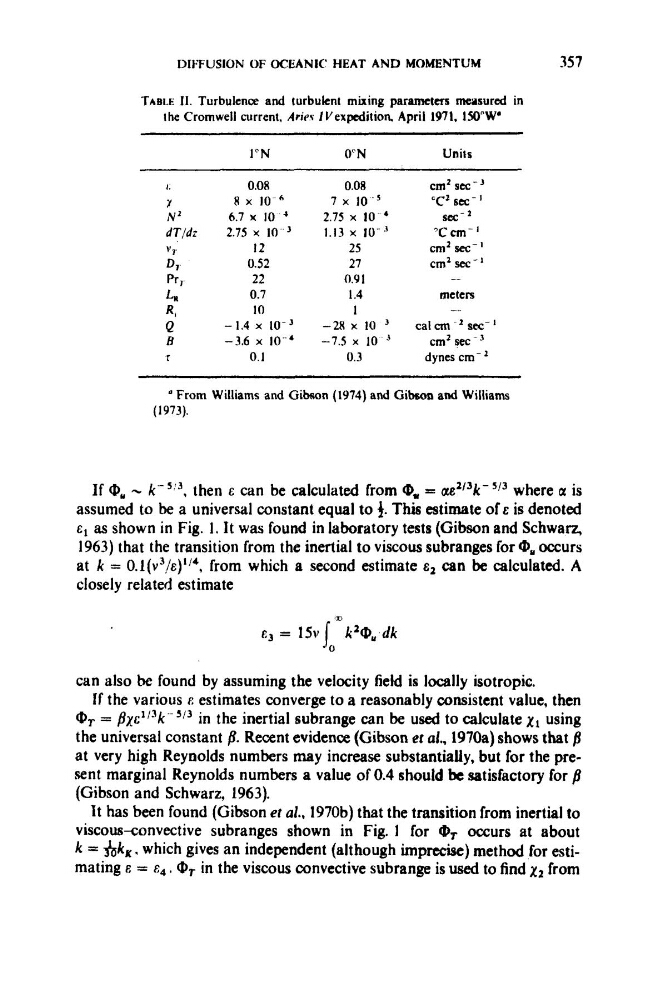
TABLE 11. Turbulence and turbuknt mixing parameters measured in
the Cromwell current, Aries 1Vexpedition. April 1971. 1SO"W'
1"N
0" N
Units
Y
N'
dT!d:
0.08
n x 10 6
6.7 x 10 *
2.75 x 10
I2
0.52
22
0.7
10
-3.6 x lo-.'
0.1
-1.4 x 1 0 - 3
0.08
7 x 1 0 . 5
2.75 x 10 '
1.13 x IO'."
25
27
0.9 I
I .4
1
-28 x 10
-7.5 x 10
0.3
meters
c a l c n - ' s w - '
dynes cm- *
cm2 sec
From Williams and Gibson (1974) and Gibson and Williams
(1973).
If O,, - k-5:3, then E can be calculated from a,, = a ~ ' / ' k - ~ / ~
where a is
assumed to be a universal constant equal to 4. This estimate of E is denoted
el as shown in Fig. 1. It was found in laboratory tests (Gibson and Schwarz,
1963) that the transition from the inertial to viscous subranges for 4,, occurs
at k = O.l(v'/~)'~~, from which a second estimate c2 can be calculated. A
closely related estimate
can also be found by assuming the velocity field is locally isotropic.
If the various E estimates converge to a reasonably consistent value, then
OT = B x E ~ / ~ ~ - - ~ / ~
in the inertial subrange can be used to calculate x1 using
the universal constant 8. Recent evidence (Gibson et al., 1970a) shows that fl
at very high Reynolds numbers m a y increase substantialiy, but for the present marginal Reynolds numbers a value of 0.4 should be satisfactory for p
(Gibson and Schwarz, 1963).
It has been found (Gibson er al., 1970b) that the transition from inertial to
viscous-convective subranges shown in Fig. 1 for QT occurs at about
k = &kK. which gives an independent (although imprecise) method for estimating E = c4 I Or in the viscous convective subrange is used to find x2 from
357
TABLE 11. Turbulence and turbuknt mixing parameters measured in
the Cromwell current, Aries 1Vexpedition. April 1971. 1SO"W'
1"N
0" N
Units
Y
N'
dT!d:
0.08
n x 10 6
6.7 x 10 *
2.75 x 10
I2
0.52
22
0.7
10
-3.6 x lo-.'
0.1
-1.4 x 1 0 - 3
0.08
7 x 1 0 . 5
2.75 x 10 '
1.13 x IO'."
25
27
0.9 I
I .4
1
-28 x 10
-7.5 x 10
0.3
meters
c a l c n - ' s w - '
dynes cm- *
cm2 sec
From Williams and Gibson (1974) and Gibson and Williams
(1973).
If O,, - k-5:3, then E can be calculated from a,, = a ~ ' / ' k - ~ / ~
where a is
assumed to be a universal constant equal to 4. This estimate of E is denoted
el as shown in Fig. 1. It was found in laboratory tests (Gibson and Schwarz,
1963) that the transition from the inertial to viscous subranges for 4,, occurs
at k = O.l(v'/~)'~~, from which a second estimate c2 can be calculated. A
closely related estimate
can also be found by assuming the velocity field is locally isotropic.
If the various E estimates converge to a reasonably consistent value, then
OT = B x E ~ / ~ ~ - - ~ / ~
in the inertial subrange can be used to calculate x1 using
the universal constant 8. Recent evidence (Gibson et al., 1970a) shows that fl
at very high Reynolds numbers m a y increase substantialiy, but for the present marginal Reynolds numbers a value of 0.4 should be satisfactory for p
(Gibson and Schwarz, 1963).
It has been found (Gibson er al., 1970b) that the transition from inertial to
viscous-convective subranges shown in Fig. 1 for QT occurs at about
k = &kK. which gives an independent (although imprecise) method for estimating E = c4 I Or in the viscous convective subrange is used to find x2 from