

246
A. I.EONAHD
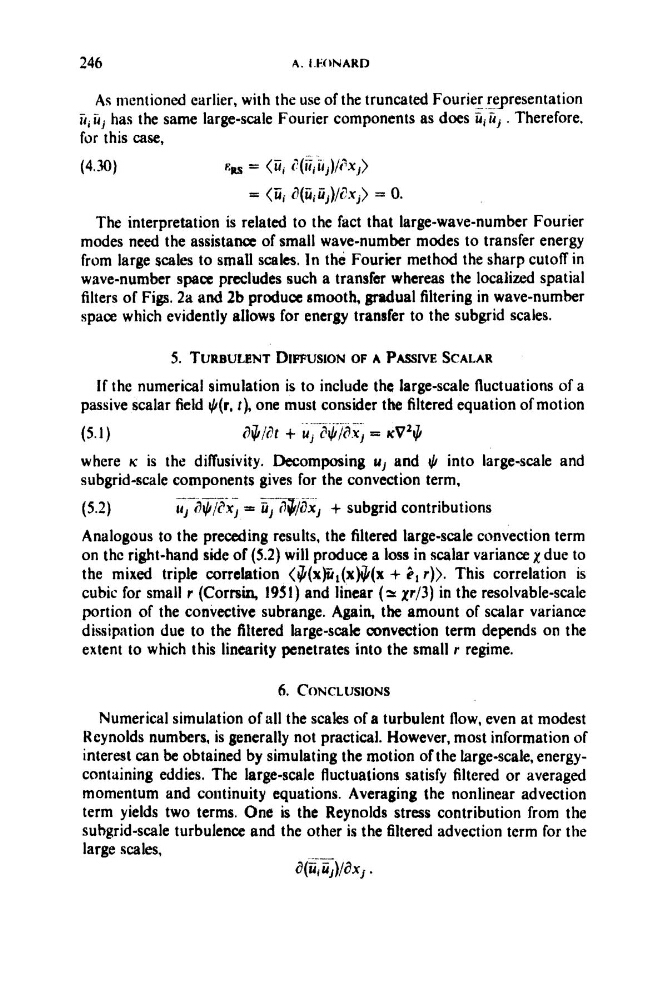
As mentioned earlier, with the use of the truncated Fourier representation
ii, uj has the same large-sale Fourier components as does iiij . Therefore.
for this case,
(4.30)
E~ = (ii, 8(iiiiij)/?.x,)
_ _
= (ii, a(iiiij)/c?.Y,) = 0.
The interpretation is related to the fact that large-wave-number Fourier
modes need the assistance of small wave-number modes to transfer energy
from large scales to small scales. In the Fourier method the sharp cutoff in
wave-number space precludes such a transfer whereas the localized spatial
filters of Figs. 2a and 2b produce smooth, gradual filtering in wave-number
space which evidently allows for energy transfer to the subgrid scales.
5. TURBULENT DIPFUSION OF A PASSIVE SCALAR
If the numerical simulation is to include the large-scale fluctuations of a
passive scalar field $(r, t ) , one must consider the filtered equation of motion
_ _
(5.1)
a$/& + u, s+/ax, = UV2$
where K is the diffusivity. Decomposing u, and $ into large-scale and
subgrid-scale components gives for the convection term,
(5.2)
id, d$/t?x, = GI d$axl + subgrid contributions
Analogous to the preceding results, the filtered large-scale convection term
on the right-hand side of (5.2) will produce a loss in scalar variance due to
the mixed triple correlation ($(xp,(x)$(x + T ) ) . This correlation IS
cubic for small r (Cormin, 1951) and linear (z ~ r / 3 ) in the resolvable-scale
portion of the convective subrange. Again, the amount of scalar variance
dissipntion due to the filtered large-scak convection term depends on the
extent to which this linearity penetrates into the small r regime.
-
6. CONCLUSIONS
Numerical simulation of all the scales of a turbulent flow, even at modest
Reynolds numbers, is generally not practical. However, most information of
interest can be obtained by simulating the motion of the large-scale, energycontaining eddies. The large-scale fluctuations satisfy filtered or averaged
momentum and continuity equations. Averaging the nonlinear advection
term yields two terms. One is the Reynolds stress contribution from the
suhgrid-scale turbulence and the other is the filtered advection term for the
large scales,
a(&i;)/aX, .
A. I.EONAHD
As mentioned earlier, with the use of the truncated Fourier representation
ii, uj has the same large-sale Fourier components as does iiij . Therefore.
for this case,
(4.30)
E~ = (ii, 8(iiiiij)/?.x,)
_ _
= (ii, a(iiiij)/c?.Y,) = 0.
The interpretation is related to the fact that large-wave-number Fourier
modes need the assistance of small wave-number modes to transfer energy
from large scales to small scales. In the Fourier method the sharp cutoff in
wave-number space precludes such a transfer whereas the localized spatial
filters of Figs. 2a and 2b produce smooth, gradual filtering in wave-number
space which evidently allows for energy transfer to the subgrid scales.
5. TURBULENT DIPFUSION OF A PASSIVE SCALAR
If the numerical simulation is to include the large-scale fluctuations of a
passive scalar field $(r, t ) , one must consider the filtered equation of motion
_ _
(5.1)
a$/& + u, s+/ax, = UV2$
where K is the diffusivity. Decomposing u, and $ into large-scale and
subgrid-scale components gives for the convection term,
(5.2)
id, d$/t?x, = GI d$axl + subgrid contributions
Analogous to the preceding results, the filtered large-scale convection term
on the right-hand side of (5.2) will produce a loss in scalar variance due to
the mixed triple correlation ($(xp,(x)$(x + T ) ) . This correlation IS
cubic for small r (Cormin, 1951) and linear (z ~ r / 3 ) in the resolvable-scale
portion of the convective subrange. Again, the amount of scalar variance
dissipntion due to the filtered large-scak convection term depends on the
extent to which this linearity penetrates into the small r regime.
-
6. CONCLUSIONS
Numerical simulation of all the scales of a turbulent flow, even at modest
Reynolds numbers, is generally not practical. However, most information of
interest can be obtained by simulating the motion of the large-scale, energycontaining eddies. The large-scale fluctuations satisfy filtered or averaged
momentum and continuity equations. Averaging the nonlinear advection
term yields two terms. One is the Reynolds stress contribution from the
suhgrid-scale turbulence and the other is the filtered advection term for the
large scales,
a(&i;)/aX, .