

ENERGY CASCADE IN LARGE-EDDY SIMULATIONS
245
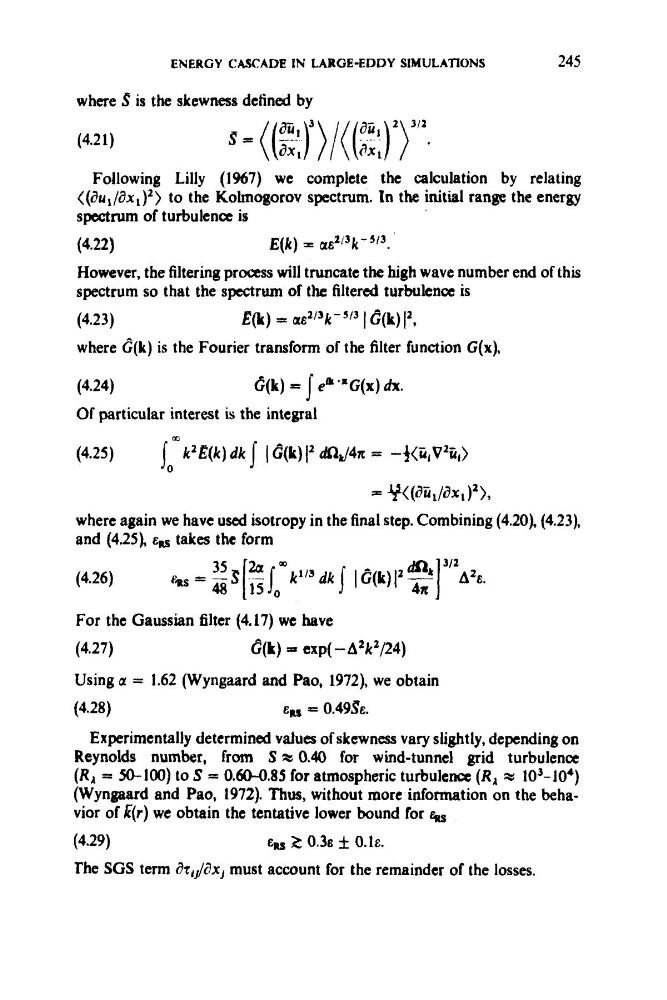
where S is the skewness defined by
(4.21)
Following Lilly (1967) we complete the calculation by relating
( ( d u , / 8 ~ , ) ~ )
to the Kolmogorov spectrum. In the initial range the energy
spectrum of turbulence is
(4.22)
E(k) = ~ & ~ ' ~ k - ~ ' ' .
However, the filtering process will truncate the high wave number end of this
spectrum so that the spectrum OT the filtered turbulence is
(4.23)
E(1) = ( ~ ~ ~ 1 ~ k - ~ / ~
I eck) It,
where e ( k ) is the Fourier transform of the filter function C(x),
(4.24)
e(k) = / ea "G(x) dx.
Of particular interest is the integral
where again we have used isotropy in the final step. Combining (4.20). (4.23),
and (4.25), takes the form
For the Gaussian filter (4.17) we have
(4.27)
d(k) - exp( -A2k2/24)
Using a = 1.62 (Wyngaard and Pao, 1972), we obtain
(4.28)
EW = 0.49SE.
Experimentally determined values of skewness vary slightly, depending on
Reynolds number, from S 5 0.40 for wind-tunnel grid turbulence
(R, = 50-100) to S = 0.60-0.85 for atmospheric turbulence (R, 2 103-104)
(Wynpard and Pao, 1972). Thus, without more information on the behavior of &) we obtain the tentative lower bound for
The SGS term dt,,/dx, must account for the remainder of the losses.
(4.29)
EW 2 0.3s f 0.1~.
245
where S is the skewness defined by
(4.21)
Following Lilly (1967) we complete the calculation by relating
( ( d u , / 8 ~ , ) ~ )
to the Kolmogorov spectrum. In the initial range the energy
spectrum of turbulence is
(4.22)
E(k) = ~ & ~ ' ~ k - ~ ' ' .
However, the filtering process will truncate the high wave number end of this
spectrum so that the spectrum OT the filtered turbulence is
(4.23)
E(1) = ( ~ ~ ~ 1 ~ k - ~ / ~
I eck) It,
where e ( k ) is the Fourier transform of the filter function C(x),
(4.24)
e(k) = / ea "G(x) dx.
Of particular interest is the integral
where again we have used isotropy in the final step. Combining (4.20). (4.23),
and (4.25), takes the form
For the Gaussian filter (4.17) we have
(4.27)
d(k) - exp( -A2k2/24)
Using a = 1.62 (Wyngaard and Pao, 1972), we obtain
(4.28)
EW = 0.49SE.
Experimentally determined values of skewness vary slightly, depending on
Reynolds number, from S 5 0.40 for wind-tunnel grid turbulence
(R, = 50-100) to S = 0.60-0.85 for atmospheric turbulence (R, 2 103-104)
(Wynpard and Pao, 1972). Thus, without more information on the behavior of &) we obtain the tentative lower bound for
The SGS term dt,,/dx, must account for the remainder of the losses.
(4.29)
EW 2 0.3s f 0.1~.