

ENERGY CASCADE IN LARGE-EDIN SIMULATIONS
24 1
approximation (3.10). would have remedied the situation. It is shown below
that the filtered term plays an important role in the energy extraction from
the large scales whereas the unfiltered term. a(Ui iij)/dx, is energy-conserving
up to finite-diffcrencing errors.
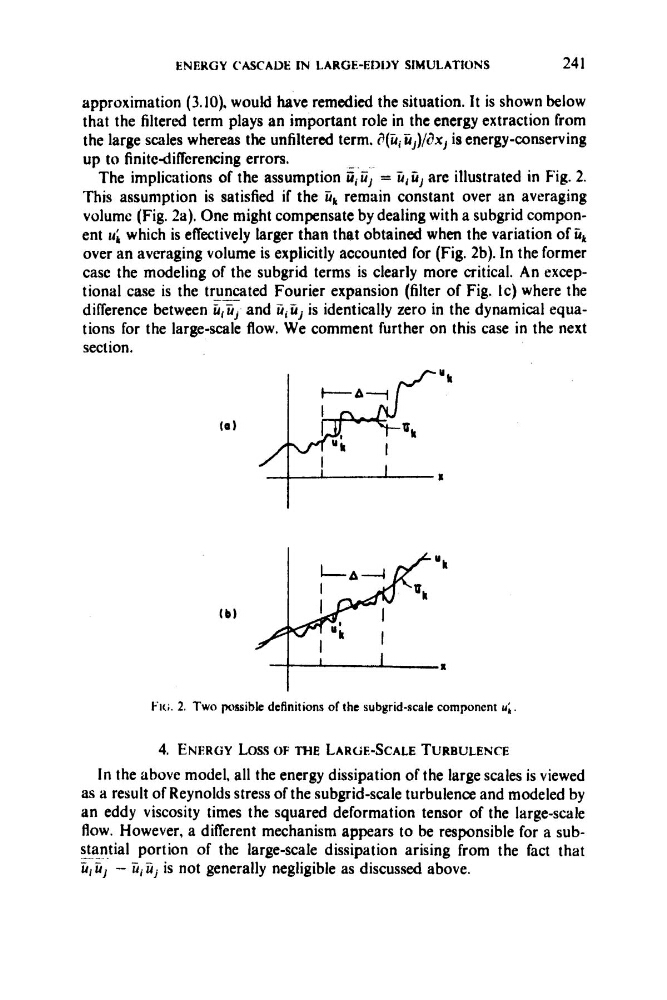
The implications of the assumption a, 6, = ii,ii, arc illustrated in Fig. 2.
This assumption is satisfied if the iik remain constant over an averaging
volume (Fig. 2a). One might compensate by dealing with a subgrid component u; which is effectively larger than that obtained when the variation of iik
over an averaging volume is explicitly accounted for (Fig. 2b). In the former
case the modeling of the subgrid terms is clearly more critical. An exceptional caqe is the truncated Fourier expansion (filter of Fig. Ic) where the
difference between u, %i and ii,ii, is identically zero in the dynamical equations for the large-scale flow. We comment further on this case in the next
section.
I .
FIG. 2. Two possible definitions of the subgrid-scale component u;
4. ENERGY Loss OF THE LARGE-SCALE TURBULENCE
I n the above model, all the energy dissipation of the large scales is viewed
as a result of Reynolds stress of the subgrid-scale turbulence and modeled by
an eddy viscosity times the squared deformation tensor of the large-scale
flow. However, a different mechanism appears to be responsible for a substantial portion of the large-scale dissipation arising from the fact that
U, G j - Ui iij is not generally negligible as discussed above.
24 1
approximation (3.10). would have remedied the situation. It is shown below
that the filtered term plays an important role in the energy extraction from
the large scales whereas the unfiltered term. a(Ui iij)/dx, is energy-conserving
up to finite-diffcrencing errors.
The implications of the assumption a, 6, = ii,ii, arc illustrated in Fig. 2.
This assumption is satisfied if the iik remain constant over an averaging
volume (Fig. 2a). One might compensate by dealing with a subgrid component u; which is effectively larger than that obtained when the variation of iik
over an averaging volume is explicitly accounted for (Fig. 2b). In the former
case the modeling of the subgrid terms is clearly more critical. An exceptional caqe is the truncated Fourier expansion (filter of Fig. Ic) where the
difference between u, %i and ii,ii, is identically zero in the dynamical equations for the large-scale flow. We comment further on this case in the next
section.
I .
FIG. 2. Two possible definitions of the subgrid-scale component u;
4. ENERGY Loss OF THE LARGE-SCALE TURBULENCE
I n the above model, all the energy dissipation of the large scales is viewed
as a result of Reynolds stress of the subgrid-scale turbulence and modeled by
an eddy viscosity times the squared deformation tensor of the large-scale
flow. However, a different mechanism appears to be responsible for a substantial portion of the large-scale dissipation arising from the fact that
U, G j - Ui iij is not generally negligible as discussed above.