

222
. a -
- 8 -
P. J. SI I I L I V A Y
61
I
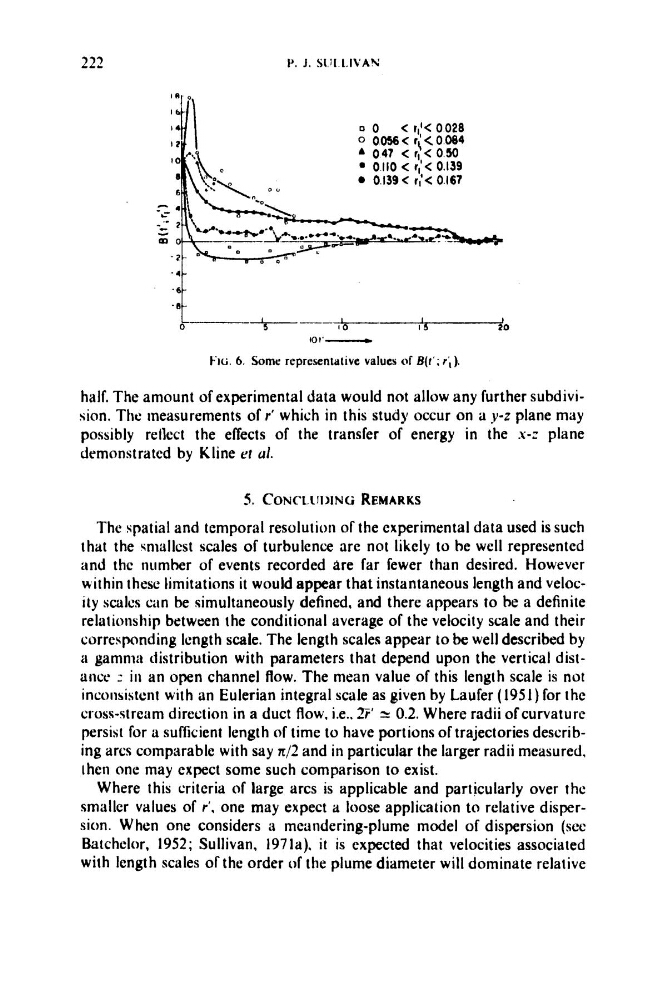
half, The amount of experimental data would not allow any further subdivision. The measurements of r' which in this study occur on a y-z plane may
possibly rellcct the effects of the transfer of energy in the s-z plane
demonstrated by Kline et ul.
5. CONCLUI)ING REMARKS
The spatial and temporal resolutioii of the experimental data used is such
that the I;niallcst scales of turbulence are not likely to be well represented
and the number of events recorded are far fewer than desired. However
within rhesc limitations it would appear that instantaneous length and velocity scales can be simultaneously defined, and there appears to be a definite
relationship between the conditional average of the velocity scale and their
corresponding length scale. The length scales appear to be well described by
it gamma distribution with parameters that depend upon the vertical distaiice 3 ia an open channel flow. The mean value of this length scale is not
incoiisistent with an Eulerian integral scale as given by Laufer (1951) for the
cross-weam direction in a duct flow. i.e., Z' 1: 0.2. Where radii of curvature
persist for a sufficient length of time to have portions of trajectories describing arcs comparable with say ~ / 2
and in particular the larger radii measured,
then one may expect some such comparison to exist.
Where this criteria of large arcs is applicable and particularly over thc
smaller values of r', one may expect a loose application to relative dispersion. When one considers a meandering-plume model of dispersion (see
Batchelor. 1952; Sullivan, 197 la). it is expected that velocities associated
with length scales of the order of the plume diameter will dominate relative
. a -
- 8 -
P. J. SI I I L I V A Y
61
I
half, The amount of experimental data would not allow any further subdivision. The measurements of r' which in this study occur on a y-z plane may
possibly rellcct the effects of the transfer of energy in the s-z plane
demonstrated by Kline et ul.
5. CONCLUI)ING REMARKS
The spatial and temporal resolutioii of the experimental data used is such
that the I;niallcst scales of turbulence are not likely to be well represented
and the number of events recorded are far fewer than desired. However
within rhesc limitations it would appear that instantaneous length and velocity scales can be simultaneously defined, and there appears to be a definite
relationship between the conditional average of the velocity scale and their
corresponding length scale. The length scales appear to be well described by
it gamma distribution with parameters that depend upon the vertical distaiice 3 ia an open channel flow. The mean value of this length scale is not
incoiisistent with an Eulerian integral scale as given by Laufer (1951) for the
cross-weam direction in a duct flow. i.e., Z' 1: 0.2. Where radii of curvature
persist for a sufficient length of time to have portions of trajectories describing arcs comparable with say ~ / 2
and in particular the larger radii measured,
then one may expect some such comparison to exist.
Where this criteria of large arcs is applicable and particularly over thc
smaller values of r', one may expect a loose application to relative dispersion. When one considers a meandering-plume model of dispersion (see
Batchelor. 1952; Sullivan, 197 la). it is expected that velocities associated
with length scales of the order of the plume diameter will dominate relative