

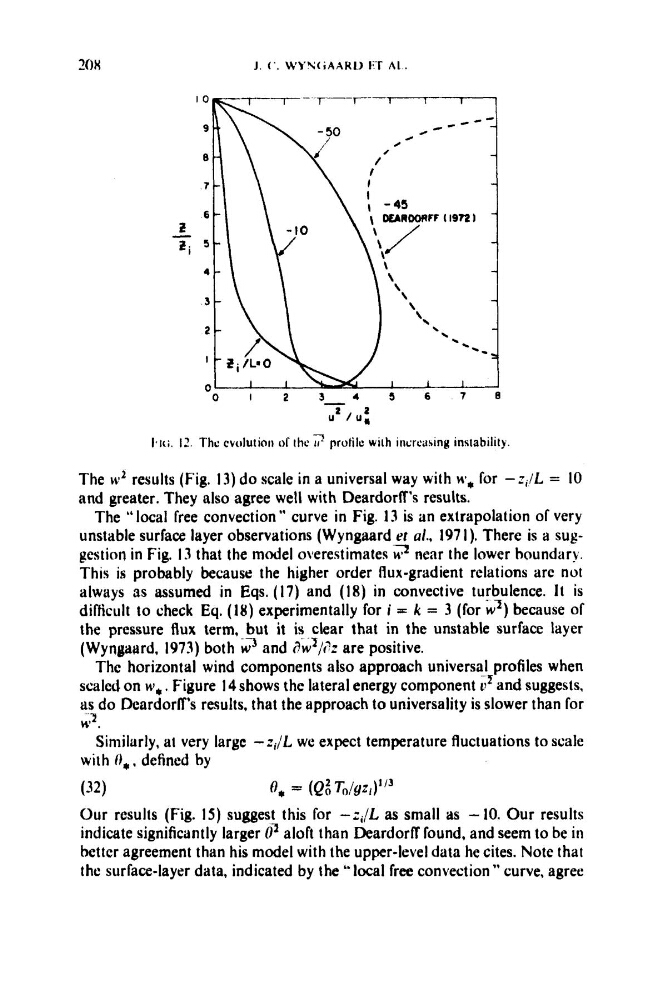
I*IC;. I?. Thc cvolutiori or thc 7 protilc with increasing instability.
The w 2 results (Fig. 13) do scale in a universal way with H'+ for -:,lL = 10
and greater. They also agree well with Deardorffs results.
The "local free convection" curve in Fig. 13 is iin extrapolation of very
unstable surface layer observations (Wyngaard et a/., 1971). There is a suppestion in Fig. 13 that the model overestimates 2 near the lower boundary.
This is probably because the higher order flux-gradient relations are not
always as assumed in Eqs. (17) and (18) in convective turbulence. It is
difficult to check Eq. (18) experimentally for i = k = 3 (for w') because of
the pressure flux term, but it is clear that in the unstable surface layer
(Wyngartrd, 1973) both 2 and 3wT/i2 are positive.
The horizontal wind components also approach universal profiles when
scaled. on w+ . Figure 14 shows the lateral energy component ir and suggests.
as do Deardorff's results, that the approach to universality is slower than for
d .
Similarly, at very largc - z i / L we expect temperature fluctuations to scale
with O , , defined by
(32)
0,
( Q f ; ' C o / ~ ~ i ) " ~
Our rcsults (Fig. 15) suggest this for - q / L as small as -10. Our results
indicate significantly larger (p aloft than DcardorfT found, and seem to be in
bctter agreement than his model with the upper-level data he cites. Note that
the surface-layer data, indicated by the "local free convection" curve, agree
The w 2 results (Fig. 13) do scale in a universal way with H'+ for -:,lL = 10
and greater. They also agree well with Deardorffs results.
The "local free convection" curve in Fig. 13 is iin extrapolation of very
unstable surface layer observations (Wyngaard et a/., 1971). There is a suppestion in Fig. 13 that the model overestimates 2 near the lower boundary.
This is probably because the higher order flux-gradient relations are not
always as assumed in Eqs. (17) and (18) in convective turbulence. It is
difficult to check Eq. (18) experimentally for i = k = 3 (for w') because of
the pressure flux term, but it is clear that in the unstable surface layer
(Wyngartrd, 1973) both 2 and 3wT/i2 are positive.
The horizontal wind components also approach universal profiles when
scaled. on w+ . Figure 14 shows the lateral energy component ir and suggests.
as do Deardorff's results, that the approach to universality is slower than for
d .
Similarly, at very largc - z i / L we expect temperature fluctuations to scale
with O , , defined by
(32)
0,
( Q f ; ' C o / ~ ~ i ) " ~
Our rcsults (Fig. 15) suggest this for - q / L as small as -10. Our results
indicate significantly larger (p aloft than DcardorfT found, and seem to be in
bctter agreement than his model with the upper-level data he cites. Note that
the surface-layer data, indicated by the "local free convection" curve, agree