

Eq. (15); (1 was zero in our first calculutions. and later we realized this wits
inappropriate and used LJ = <.
At z i / L = - 5 0 . these results show a simplc stole of affairs. From Eq. ( I )
we have
(30)
(71rM:!?: 2r l+Zi
- -,/'I; , V;If* Y 1 -u*,(fii
Presumably the very slight shift in wind direction, corresponding to 1,'
changing from 0 to 1; . occurs within the inversion. Equation ( I ) also shows
that U c LI, over most of the convective layer.
Another strong effect of upward heat transfer is the increase in turbulence
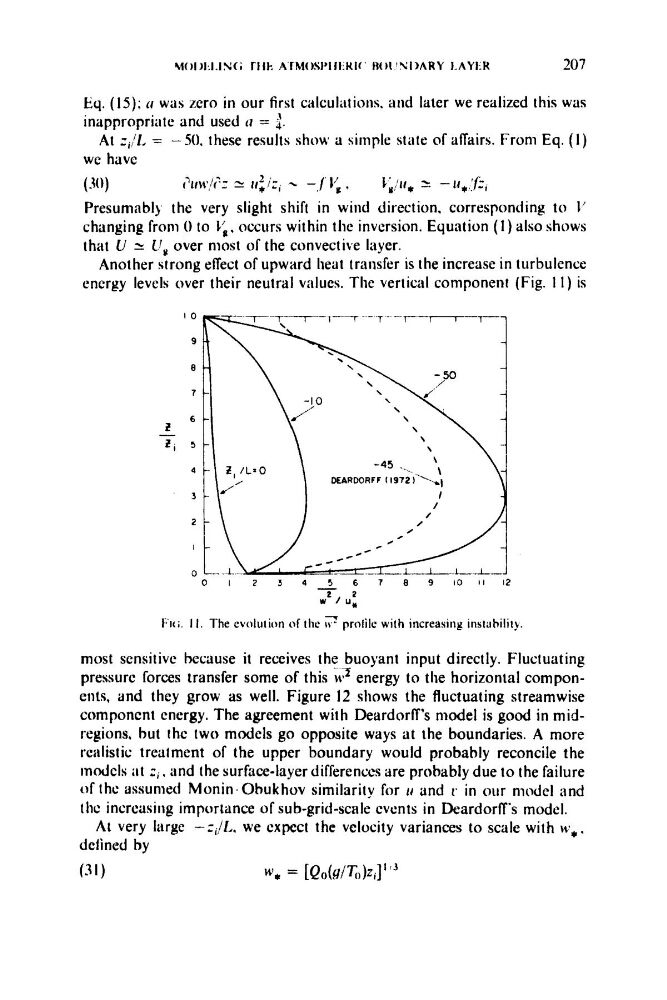
energy levels over their neutral values. The vertical component (Fig. 1 I ) is
I 0
9
a
7
0
0
I
2
3
4
5
6
7
8
9
1 0 1 1 1 2
2
2
w I u*
F'K;. I I . The evolulion of the 7 protile with increasing instuhilily.
most sensitive because it receives the buoyant input directly. Fluctuating
pressure forces transfer some of this ~7 energy to the horizontal components, and they grow as well. Figure 12 shows the fluctuating streamwise
component energy. The agreement with Deardorff's model is good in midregions. but the two models go opposite ways at the boundaries. A more
redistic treatment of the upper boundary would probably reconcile the
mdcls itt 2 , . m d the surface-layer differences are probably due to the failure
of thr assumed Monin-Ohukhov similarity for ti and I' in our nlodel and
thc increasing importance of sub-grid-scale cvcnts in DeardorU's model.
At very large - z , / L . we expect the velocity variances to scale with H'*.
dclined by
(31)
ht* = [ Q o ( ~ / ? ; , ) z ~ ] " ~
inappropriate and used LJ = <.
At z i / L = - 5 0 . these results show a simplc stole of affairs. From Eq. ( I )
we have
(30)
(71rM:!?: 2r l+Zi
- -,/'I; , V;If* Y 1 -u*,(fii
Presumably the very slight shift in wind direction, corresponding to 1,'
changing from 0 to 1; . occurs within the inversion. Equation ( I ) also shows
that U c LI, over most of the convective layer.
Another strong effect of upward heat transfer is the increase in turbulence
energy levels over their neutral values. The vertical component (Fig. 1 I ) is
I 0
9
a
7
0
0
I
2
3
4
5
6
7
8
9
1 0 1 1 1 2
2
2
w I u*
F'K;. I I . The evolulion of the 7 protile with increasing instuhilily.
most sensitive because it receives the buoyant input directly. Fluctuating
pressure forces transfer some of this ~7 energy to the horizontal components, and they grow as well. Figure 12 shows the fluctuating streamwise
component energy. The agreement with Deardorff's model is good in midregions. but the two models go opposite ways at the boundaries. A more
redistic treatment of the upper boundary would probably reconcile the
mdcls itt 2 , . m d the surface-layer differences are probably due to the failure
of thr assumed Monin-Ohukhov similarity for ti and I' in our nlodel and
thc increasing importance of sub-grid-scale cvcnts in DeardorU's model.
At very large - z , / L . we expect the velocity variances to scale with H'*.
dclined by
(31)
ht* = [ Q o ( ~ / ? ; , ) z ~ ] " ~