

1 X6
1. I . I ('MI I I ALI) li. litlAJt H-\OI RI
d
a
d
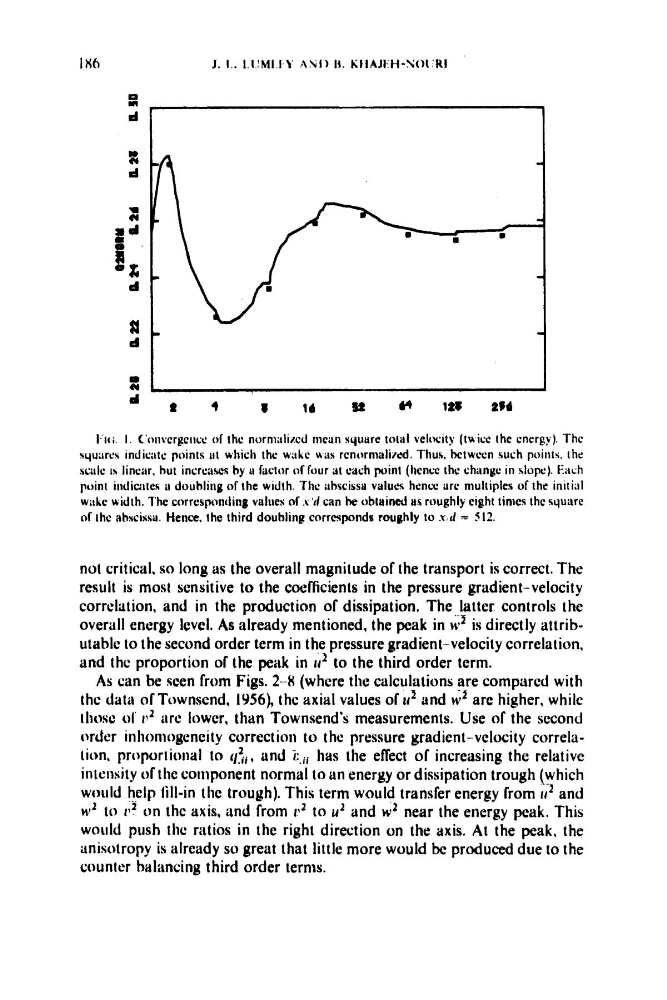
1;~;. I . C'unvcrgciics of the nornislir.cd ineitn square to~al velocity (twice the energy). The
squitrcs indicets points MI which the wake wiis renormalired. Thus. betwccn such points, the
scitlc is linear, hut incrcascs hy a factor of four at cach point (hence the chanyu in slope). fach
point iiitliwtcs ii doubling of the width. The abscissa valucs hence itre multiples of the initial
wiikc width. The corresponding values of s'd can he obtained as roughly eight h i e s the square
of Ihc ahscissa. Hencv. the third doubling cotreponds roughly to . ~ , d
= 512.
not critical, so long as the overall magnitude of the transport is correct. The
result is most sensitive to the coefficients in the pressure gradient-velocity
correlation, and in the production of dissipation, The latter controls the
overall energy levci. As already mentioned, the peak in w' is directly attributable to the second order term in the pressure gradient-velocity correlation.
and thc proportion of the peak in I$ to the third order term.
As can be seen from Figs. 2-8 (where the calculations are compared with
thc data of Townscnd. 1956), the axial values of 11' and w i arc higher, whilc
tliosc 01 1)' iire lower, than Townsend's measurements. Use of the second
order inhoiiwpncity correction to t he pressure gradient- velocity correlaLion, proporrioiial to qfi,. and i;.i, has the effect of increasing the relative
iriiciisily of the coiriponent normal to un energy or dissipation trough (which
would help W i n 1 tic trough). This term would transfer energy from I, ? and
w2 to t i 2 on thc axis. and from 19' to u2 and wz near the energy peak. This
woiild push the nitios in the right direction on the axis. At the peak, the
anisotropy is already so great that little more would be produced due to the
counter balancing third order terms.
1. I . I ('MI I I ALI) li. litlAJt H-\OI RI
d
a
d
1;~;. I . C'unvcrgciics of the nornislir.cd ineitn square to~al velocity (twice the energy). The
squitrcs indicets points MI which the wake wiis renormalired. Thus. betwccn such points, the
scitlc is linear, hut incrcascs hy a factor of four at cach point (hence the chanyu in slope). fach
point iiitliwtcs ii doubling of the width. The abscissa valucs hence itre multiples of the initial
wiikc width. The corresponding values of s'd can he obtained as roughly eight h i e s the square
of Ihc ahscissa. Hencv. the third doubling cotreponds roughly to . ~ , d
= 512.
not critical, so long as the overall magnitude of the transport is correct. The
result is most sensitive to the coefficients in the pressure gradient-velocity
correlation, and in the production of dissipation, The latter controls the
overall energy levci. As already mentioned, the peak in w' is directly attributable to the second order term in the pressure gradient-velocity correlation.
and thc proportion of the peak in I$ to the third order term.
As can be seen from Figs. 2-8 (where the calculations are compared with
thc data of Townscnd. 1956), the axial values of 11' and w i arc higher, whilc
tliosc 01 1)' iire lower, than Townsend's measurements. Use of the second
order inhoiiwpncity correction to t he pressure gradient- velocity correlaLion, proporrioiial to qfi,. and i;.i, has the effect of increasing the relative
iriiciisily of the coiriponent normal to un energy or dissipation trough (which
would help W i n 1 tic trough). This term would transfer energy from I, ? and
w2 to t i 2 on thc axis. and from 19' to u2 and wz near the energy peak. This
woiild push the nitios in the right direction on the axis. At the peak, the
anisotropy is already so great that little more would be produced due to the
counter balancing third order terms.