

MODELING OF T1’RHUl.F.NT TKAWSPORT
I75
be made lrorn S,, only by a quadratic form. Note that the terms are the saine
order as the others retained in the equations because the time scale (v/E)’
cancels one of the factors in the magnitude (i:/v)”’: i.e.. as the Reynolds
number increases, the magnitude of each term grows. but the difference
shrinks at the same rate.
In Lumley (197O), a similar analysis was carried out, though less physical
and more formal; consequently, although the order of the term obtained
there was correct, the fact that it should be reversible was missed. The
general conclusion obtained there. regarding the continual growth of the
length scale in a homogeneous flow is correct, however. so long as a # 1. as
may be easily verified using (4) in the analysis there.
As in Lumley (1970). one of the coefficients may be identified by reference
to homogeneous decay; we find that
( 5 )
h = 2
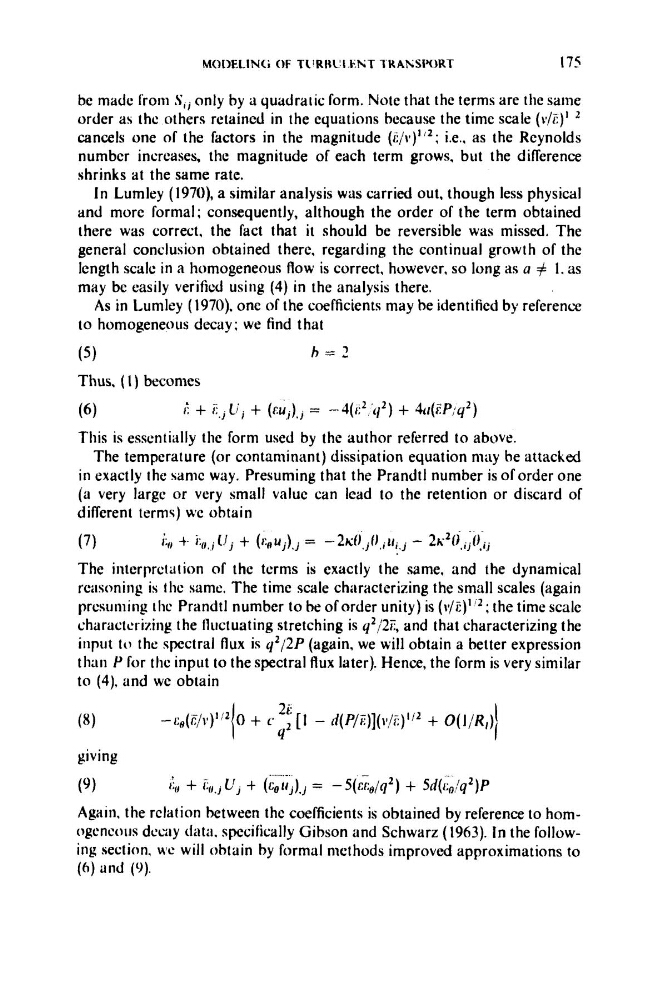
Thus, ( I ) becomes
This is esscntially the form used by the author referred to above.
The temperature (or contaminant) dissipation equation may he attacked
in exactly the sanic way. Presuming that the Prandtl number is of order one
(a very largc or vcry small valuc can lead to the retention or discard of
different terms) u’c obtain
. .. .
(7)
i:, +- L ( , , , ~ ( J ~
+ ( E , , u ~ ) . ~
= - 2 1 d j , ~ o , ~ ~ ! , ~
- ~ K ~ o , ~ ~ o ~ ~ ~
The interprctation of the terms is exactly the same, and the dynamical
reasoning is thc same. The time scale characterizing the small scales (again
prcsuminp tlic Prandtl number to be oforder unity) is (v/E)’~’; the time scale
charactcrixing the Iluctuating stretching is y2/2E, and that characterizing the
input to the spectral flux is q2/2P (again, we will obtain a better expression
than P for the input to the spectral flux later). Hence, the form is very similar
to (4), and we obtain
giving
-
( 9 )
cf,., L‘, -t (Co-!;, ), ,
= - 5(CCo/q2) 4- 5d(ti!qz)P
Again. the relation between the coefficients is obtained by reference to homogcncous decay data. specifically Gibson and Schwarz (1963). In the following section, MV will obtain by formal methods improved approximations to
(ti) and ( 9 ) .
I75
be made lrorn S,, only by a quadratic form. Note that the terms are the saine
order as the others retained in the equations because the time scale (v/E)’
cancels one of the factors in the magnitude (i:/v)”’: i.e.. as the Reynolds
number increases, the magnitude of each term grows. but the difference
shrinks at the same rate.
In Lumley (197O), a similar analysis was carried out, though less physical
and more formal; consequently, although the order of the term obtained
there was correct, the fact that it should be reversible was missed. The
general conclusion obtained there. regarding the continual growth of the
length scale in a homogeneous flow is correct, however. so long as a # 1. as
may be easily verified using (4) in the analysis there.
As in Lumley (1970). one of the coefficients may be identified by reference
to homogeneous decay; we find that
( 5 )
h = 2
Thus, ( I ) becomes
This is esscntially the form used by the author referred to above.
The temperature (or contaminant) dissipation equation may he attacked
in exactly the sanic way. Presuming that the Prandtl number is of order one
(a very largc or vcry small valuc can lead to the retention or discard of
different terms) u’c obtain
. .. .
(7)
i:, +- L ( , , , ~ ( J ~
+ ( E , , u ~ ) . ~
= - 2 1 d j , ~ o , ~ ~ ! , ~
- ~ K ~ o , ~ ~ o ~ ~ ~
The interprctation of the terms is exactly the same, and the dynamical
reasoning is thc same. The time scale characterizing the small scales (again
prcsuminp tlic Prandtl number to be oforder unity) is (v/E)’~’; the time scale
charactcrixing the Iluctuating stretching is y2/2E, and that characterizing the
input to the spectral flux is q2/2P (again, we will obtain a better expression
than P for the input to the spectral flux later). Hence, the form is very similar
to (4), and we obtain
giving
-
( 9 )
cf,., L‘, -t (Co-!;, ), ,
= - 5(CCo/q2) 4- 5d(ti!qz)P
Again. the relation between the coefficients is obtained by reference to homogcncous decay data. specifically Gibson and Schwarz (1963). In the following section, MV will obtain by formal methods improved approximations to
(ti) and ( 9 ) .