

Nl'MEHI('A1. SIHUI.AI'ION OF LAGHAGGIAN QLlANTITlES
161
model shear field. However, the point is as ye1 unsettled inasmuch as theoretical conclusions (Peskin, 1965; Kraichnan. 1964) indicate that the reverse
may be true. This problem needs more detailed study.
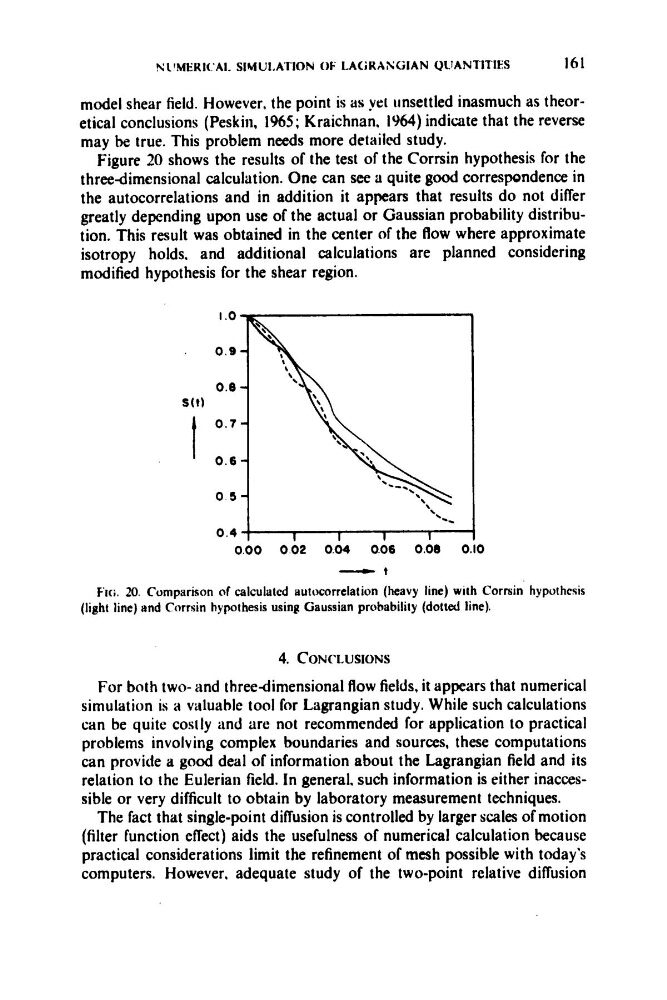
Figure 20 shows the results of the test of the Corrsin hypothesis for the
threedimensional calculation. One can see a quite good correspondence in
the autocorrelations and in addition it appears that results do not differ
greatly depending upon use of the actual or Gaussian probability distribution. This result was obtained in the center of the flow where approximate
isotropy holds. and additional calculations are planned considering
modified hypothesis for the shear region.
-' .
0 . 4 I
1
1
1
1
0.00 0 02 0.04 0.06 0.00
C
- t
0
FIG. 20. Comparison of calculutcd autocorrelation (heavy line) with Corrsin hypothesis
(light line) and Corrsin hypothesis using Gaussian probability (dotted line).
4. CONCLUSIONS
For both two- and threedimensional flow fields, it appears that numerical
simulation is a vduable tool lor Lagrangian study. While such calculations
can be quite costly and are not recommended for application to practical
problems involving complex boundaries and sources, these computations
can provide a good deal of information about the Lagrangian field and its
relation to the Eulerian field. In general. such information is either inaccessible or very difficult to obtain by laboratory measurement techniques.
The fact that single-point diffusion is controlled by larger scales of motion
(filter function effect) aids the usefulness of numerical calculation because
practical considerations limit the refinement of mesh possible with today's
computers. However, adequate study of the two-point relative diffusion
161
model shear field. However, the point is as ye1 unsettled inasmuch as theoretical conclusions (Peskin, 1965; Kraichnan. 1964) indicate that the reverse
may be true. This problem needs more detailed study.
Figure 20 shows the results of the test of the Corrsin hypothesis for the
threedimensional calculation. One can see a quite good correspondence in
the autocorrelations and in addition it appears that results do not differ
greatly depending upon use of the actual or Gaussian probability distribution. This result was obtained in the center of the flow where approximate
isotropy holds. and additional calculations are planned considering
modified hypothesis for the shear region.
-' .
0 . 4 I
1
1
1
1
0.00 0 02 0.04 0.06 0.00
C
- t
0
FIG. 20. Comparison of calculutcd autocorrelation (heavy line) with Corrsin hypothesis
(light line) and Corrsin hypothesis using Gaussian probability (dotted line).
4. CONCLUSIONS
For both two- and threedimensional flow fields, it appears that numerical
simulation is a vduable tool lor Lagrangian study. While such calculations
can be quite costly and are not recommended for application to practical
problems involving complex boundaries and sources, these computations
can provide a good deal of information about the Lagrangian field and its
relation to the Eulerian field. In general. such information is either inaccessible or very difficult to obtain by laboratory measurement techniques.
The fact that single-point diffusion is controlled by larger scales of motion
(filter function effect) aids the usefulness of numerical calculation because
practical considerations limit the refinement of mesh possible with today's
computers. However, adequate study of the two-point relative diffusion