

160
RICHARD L. PESKIN
general for isotropic flow the heavy particle diffusivity should not exceed the
fluid point diffusivity (Peskin, 1971). However, effects such as wall slip can
modify these conclusions (Depew and Kramer, 1973). Any attempt to use
numerical simulation to verify theoretical conclusions must consider the
problem of achieving steady state. In the presently reported calculations the
ratio of particle to fluid point diffusivities approaches theexpected value given
a long enough computation time.
3.3. The Eulerian-Lugrangiun Problem
As previously mentioned one purpose of this calculation was to treat the
Eulerian-Lagrangian problem for three-dimensional turbulent calculation.
To this end, the Eulerian space-time correlations were computed and the
Corrsin hypothesis was invoked to estimate the Lagrangian autocorrelation
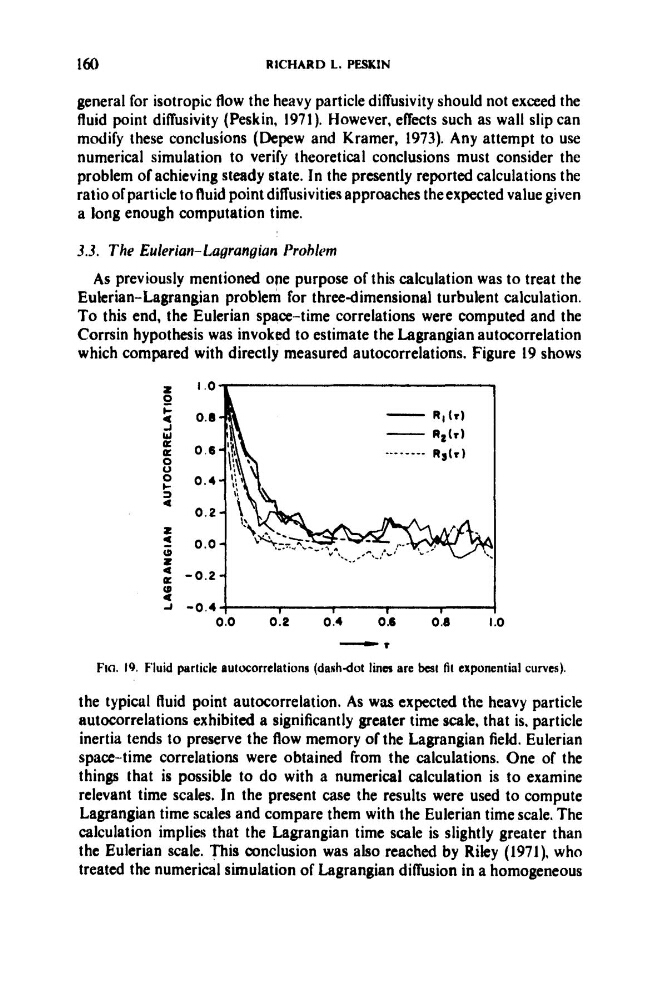
which compared with directly measured autocorrelations. Figure 19 shows
2 - 0 . 2
2
a - 0 . 4
0.0
0.2
0.4
0.6
0.8
--I
0
FIG. 19. Fluid particle autocorrelations (darhdot lines are best fit exponential curves).
the typical fluid point autocorrelation. As was expected the heavy particle
autocorrelations exhibited a significantly greater time scale, that is. particle
inertia tends to preserve the flow memory of the Lagrangian field. Eulerian
space-time correlations were obtained from the calculations. One of the
things that is possible to do with a numerical calculation is to examine
relevant time scales. In the present case the results were used to compute
Lagrangian time scales and compare them with the Eulerian time scale. The
calculation implies that the Lagrangian time scale is slightly greater than
the Eulerian scale. This conclusion was also reached by Riley (1971), who
treated the numerical simulation of Lagrangian diffusion in a homogeneous
RICHARD L. PESKIN
general for isotropic flow the heavy particle diffusivity should not exceed the
fluid point diffusivity (Peskin, 1971). However, effects such as wall slip can
modify these conclusions (Depew and Kramer, 1973). Any attempt to use
numerical simulation to verify theoretical conclusions must consider the
problem of achieving steady state. In the presently reported calculations the
ratio of particle to fluid point diffusivities approaches theexpected value given
a long enough computation time.
3.3. The Eulerian-Lugrangiun Problem
As previously mentioned one purpose of this calculation was to treat the
Eulerian-Lagrangian problem for three-dimensional turbulent calculation.
To this end, the Eulerian space-time correlations were computed and the
Corrsin hypothesis was invoked to estimate the Lagrangian autocorrelation
which compared with directly measured autocorrelations. Figure 19 shows
2 - 0 . 2
2
a - 0 . 4
0.0
0.2
0.4
0.6
0.8
--I
0
FIG. 19. Fluid particle autocorrelations (darhdot lines are best fit exponential curves).
the typical fluid point autocorrelation. As was expected the heavy particle
autocorrelations exhibited a significantly greater time scale, that is. particle
inertia tends to preserve the flow memory of the Lagrangian field. Eulerian
space-time correlations were obtained from the calculations. One of the
things that is possible to do with a numerical calculation is to examine
relevant time scales. In the present case the results were used to compute
Lagrangian time scales and compare them with the Eulerian time scale. The
calculation implies that the Lagrangian time scale is slightly greater than
the Eulerian scale. This conclusion was also reached by Riley (1971), who
treated the numerical simulation of Lagrangian diffusion in a homogeneous