

I34
ROHEHI H. L.ON
( 8 )
; ) :
- = ( t / ! T ' '2)qL+(<), IdL = (TIZ2/:)p4(<).
6, = 7 ' " q 5 ( C )
cxii~lple.
w hcrc
(9)
< = =,'In, , I , = T 3 2; y
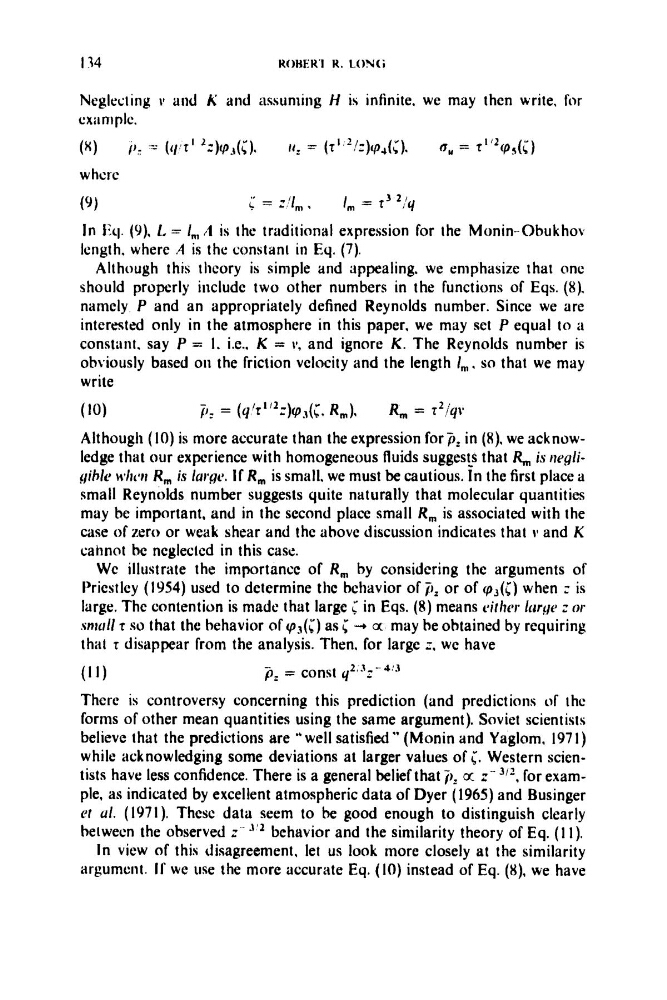
In f7q. (9). L = In, A is the traditional expression for the Monin-Obukhov
length, where .A is the constant in Eq. (7).
Although this tlicory is simple and appealing. we eniphasize that one
should properly iiicludc two other numbers in the functions of Eqs. (8).
namely P and an appropriately defined Reynolds number. Since we are
interested only in the atmosphere in this paper. we may set P equal to a
constiitlt. say P = 1. i.e.. K = v, and ignore K. The Reynolds number is
obviously based on the friction velocity and the length 1,. so that we may
write
(10)
7) : = (4,'r'''1)q3([, R,,,), R, = T2jqv
Although (10) is more accurate than the expression for p , in (8). we acknowledge that our expcrience with homogeneous fluids suggests that R,,, is negligible w h t R , i s lurgc. If R, is small. we must be cautious. In the first place a
small Reynolds number suggests quite naturally that molecular quantities
may he important, and in thc second place small R, is associated with the
case of zero or weak shear and thc above discussion indicates that 11 and K
cahnot he negleclcd in this case.
We illustritte the importance of R , by considering the arguments of
Priestlcy (1954) used to determine the bchavior of 71, or of (p&) when : is
large. The contention is madc that large < in Eqs. (8) means tilhcr / w g e 2 or
snlcill7 so that the behavior of q,(;') as ;' -+ a' may be obtained by requiring
that 7 disappear from the analysis. Then. for large z. we have
( 1 1 )
p , = const y z , 3 Z c 4 ' 3
There is controversy concerning this prediction (and predictions of thc
forms of other mean quantities using the same argument). Soviet scientists
believe that the predictions are "well satisfied" (Monin and Yaglom. 1971)
while acknowledging some deviations at larger values of i. Western scientists have less confidence. There is a general belief that 7) : crc z - 312, for example, as indicated by excellent atmospheric data of Dyer (1965) and Businger
ct ul. (1971). These data seem to be good enough to distinguish clearly
hetwecn the observed z - . *"* bchavior and the similarity theory of Eq. ( 1 1).
In view of this disaereenient. let us look more closely at the similarity
argument. If we use the more accurate Eq. (10) instead of Eq. (8). we have
ROHEHI H. L.ON
( 8 )
; ) :
- = ( t / ! T ' '2)qL+(<), IdL = (TIZ2/:)p4(<).
6, = 7 ' " q 5 ( C )
cxii~lple.
w hcrc
(9)
< = =,'In, , I , = T 3 2; y
In f7q. (9). L = In, A is the traditional expression for the Monin-Obukhov
length, where .A is the constant in Eq. (7).
Although this tlicory is simple and appealing. we eniphasize that one
should properly iiicludc two other numbers in the functions of Eqs. (8).
namely P and an appropriately defined Reynolds number. Since we are
interested only in the atmosphere in this paper. we may set P equal to a
constiitlt. say P = 1. i.e.. K = v, and ignore K. The Reynolds number is
obviously based on the friction velocity and the length 1,. so that we may
write
(10)
7) : = (4,'r'''1)q3([, R,,,), R, = T2jqv
Although (10) is more accurate than the expression for p , in (8). we acknowledge that our expcrience with homogeneous fluids suggests that R,,, is negligible w h t R , i s lurgc. If R, is small. we must be cautious. In the first place a
small Reynolds number suggests quite naturally that molecular quantities
may he important, and in thc second place small R, is associated with the
case of zero or weak shear and thc above discussion indicates that 11 and K
cahnot he negleclcd in this case.
We illustritte the importance of R , by considering the arguments of
Priestlcy (1954) used to determine the bchavior of 71, or of (p&) when : is
large. The contention is madc that large < in Eqs. (8) means tilhcr / w g e 2 or
snlcill7 so that the behavior of q,(;') as ;' -+ a' may be obtained by requiring
that 7 disappear from the analysis. Then. for large z. we have
( 1 1 )
p , = const y z , 3 Z c 4 ' 3
There is controversy concerning this prediction (and predictions of thc
forms of other mean quantities using the same argument). Soviet scientists
believe that the predictions are "well satisfied" (Monin and Yaglom. 1971)
while acknowledging some deviations at larger values of i. Western scientists have less confidence. There is a general belief that 7) : crc z - 312, for example, as indicated by excellent atmospheric data of Dyer (1965) and Businger
ct ul. (1971). These data seem to be good enough to distinguish clearly
hetwecn the observed z - . *"* bchavior and the similarity theory of Eq. ( 1 1).
In view of this disaereenient. let us look more closely at the similarity
argument. If we use the more accurate Eq. (10) instead of Eq. (8). we have