

SIJWFA(‘I.: IAYEW IN UNSTABLE CXINDITIONS
133
influenced by the molecular coefficients even at the very high Rayleigh numbcrs characteristic of the atmosphere. Since the heat transport is by the
eddies, they too are directly influenced by the molecular coefficients.
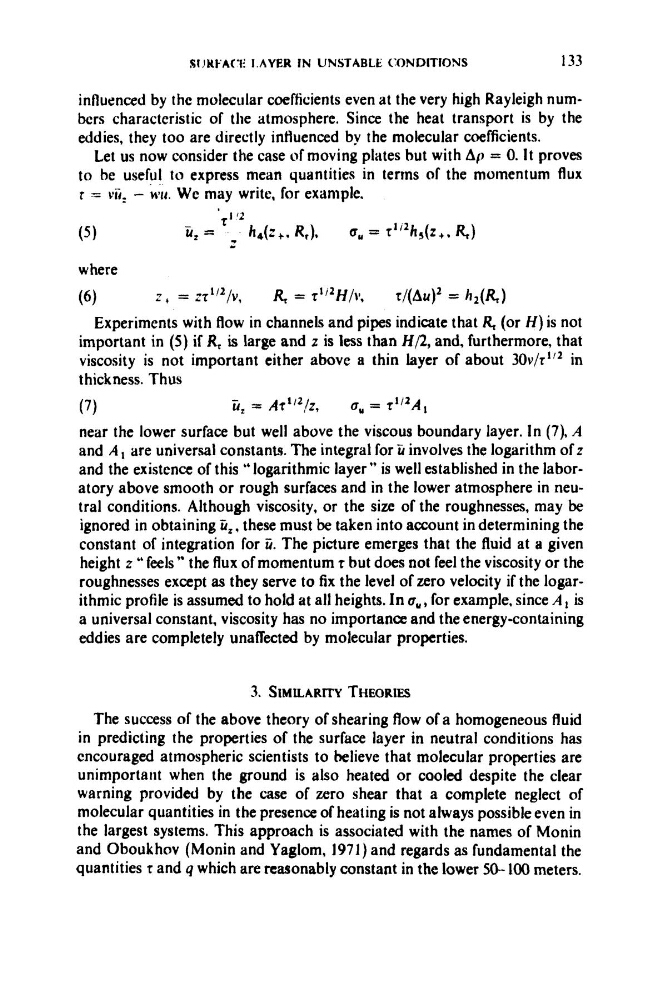
Let us now consider the case of moving plates but with Ap = 0. It proves
to be useful to express mean quantities in terms of the momentum flux
r T vii, - n w Wc may write, for example.
where
( 6 )
z , = :7“’/v,
R, = T*/’H/v, ~/(AU)’ = h 2 ( & )
Experiments with flow in channels and pipes indicate that R, (or H) is not
important in ( 5 ) if R, is large and z is less than N/2, and, furthermore, that
viscosity is not important either above a thin layer of about 30v/r”’ in
thickness. Thus
(7)
U, = Ar’12/z,
o,, = T * ‘ ’ A ~
near the lower surface but well above the viscous boundary layer. In (7) A
and A , are universal constants. The integral for U involves the logarithm of I
and the existence of this “logarithmic layer” is well established in the laboratory above smooth or rough surfaces and in the lower atmosphere in neutral conditions. Although viscosity, or the size of the roughnesses, may be
ignored in obtaining Uz, these must be taken into account in determining the
constant of integration for ii. The picture emerges that the fluid at a given
height z “feels” the flux ofmomentum r but does not feel the viscosity or the
roughnesses except as they serve to fix the level of zero velocity if the logarithmic profile is assumed to hold at all heights. In nu, for example, since A , is
a universal constant, viscosity has no importance and the energy-containing
eddies are completely unafTected by molecular properties.
3. SIMILARITY THEORIES
The success of the above theory of shearing flow of a homogeneous fluid
in predicting the properties of the surface layer in neutral conditions has
cncouraged atmospheric scientists to believe that molecular properties are
unimportant when the ground is also heated or cooled despite the clear
warning provided by the case of zero shear that a complete neglect of
molecular quantities in the presence of healing is not always possible even in
the largest systems. This approach is associated with the names of Monin
and Oboukhov (Monin and Yaglom, 1971) and regards as fundamental the
quantities T and q which are reasonably constant in the lower 50- 100 meters.
133
influenced by the molecular coefficients even at the very high Rayleigh numbcrs characteristic of the atmosphere. Since the heat transport is by the
eddies, they too are directly influenced by the molecular coefficients.
Let us now consider the case of moving plates but with Ap = 0. It proves
to be useful to express mean quantities in terms of the momentum flux
r T vii, - n w Wc may write, for example.
where
( 6 )
z , = :7“’/v,
R, = T*/’H/v, ~/(AU)’ = h 2 ( & )
Experiments with flow in channels and pipes indicate that R, (or H) is not
important in ( 5 ) if R, is large and z is less than N/2, and, furthermore, that
viscosity is not important either above a thin layer of about 30v/r”’ in
thickness. Thus
(7)
U, = Ar’12/z,
o,, = T * ‘ ’ A ~
near the lower surface but well above the viscous boundary layer. In (7) A
and A , are universal constants. The integral for U involves the logarithm of I
and the existence of this “logarithmic layer” is well established in the laboratory above smooth or rough surfaces and in the lower atmosphere in neutral conditions. Although viscosity, or the size of the roughnesses, may be
ignored in obtaining Uz, these must be taken into account in determining the
constant of integration for ii. The picture emerges that the fluid at a given
height z “feels” the flux ofmomentum r but does not feel the viscosity or the
roughnesses except as they serve to fix the level of zero velocity if the logarithmic profile is assumed to hold at all heights. In nu, for example, since A , is
a universal constant, viscosity has no importance and the energy-containing
eddies are completely unafTected by molecular properties.
3. SIMILARITY THEORIES
The success of the above theory of shearing flow of a homogeneous fluid
in predicting the properties of the surface layer in neutral conditions has
cncouraged atmospheric scientists to believe that molecular properties are
unimportant when the ground is also heated or cooled despite the clear
warning provided by the case of zero shear that a complete neglect of
molecular quantities in the presence of healing is not always possible even in
the largest systems. This approach is associated with the names of Monin
and Oboukhov (Monin and Yaglom, 1971) and regards as fundamental the
quantities T and q which are reasonably constant in the lower 50- 100 meters.