

HEAT 1'RANSFER AND 'TURIi~!I.ENF MIXING LAYERS
95
i.e.. the dissipative structure of the temperature %ld is, in contrast to the
large scale structure, a function not only of q but also of x.
The following definitions for the mean values (averaging time T usually
120 8 ) were used:
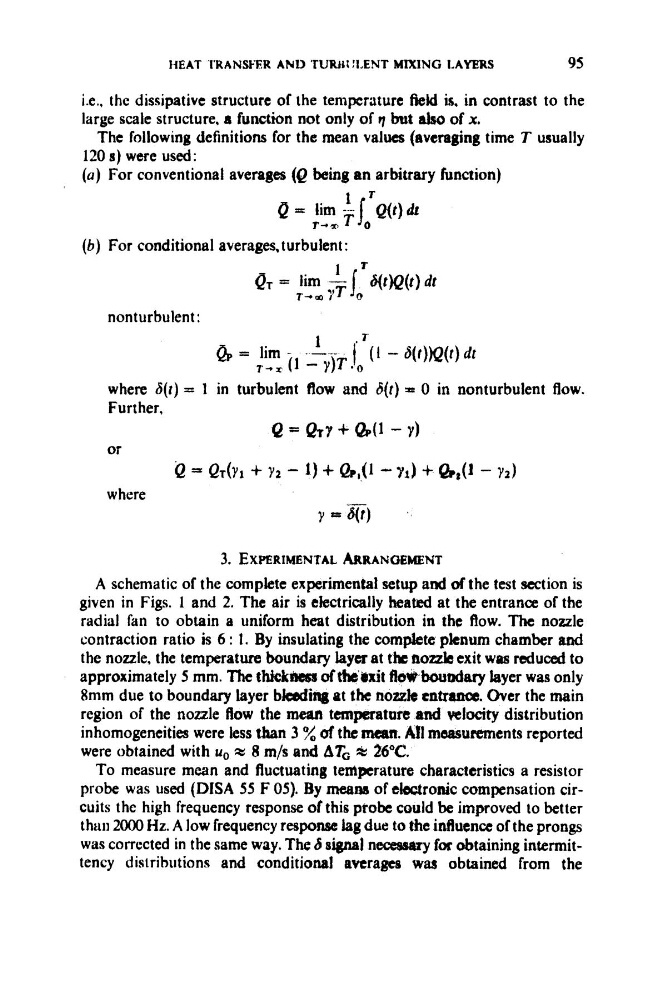
( a ) For conventional averages (Q being an arbitrary function)
l r
Q = lim TI,
r+m
(b) For conditional averages, turbulent:
l T
QT = iim -- f s(t)Q(t) dr
T-rn7'T 0
nonturbulent :
where 6(t) = 1 in turbulent flow and 6(r) = 0 in nonturbulent flow.
Further,
or
where
Q = Q T . p + Q f 4 - 7 )
Q = QT(YI + YZ - 1) + QP,(~ -. UII + - YZ)
y = &(r)
3. EXPERIMENTAL kRANOEMENT
A schematic of the complete experimental setup and o f the test section is
given in Figs. 1 and 2. The air is electrically heated at the entrance of the
radial fan to obtain a uniform heat distribution in the flow. The nozzle
contraction ratio is 6 : 1. By insulating the complete pknum chamber and
the nozzle, the temperature boundary layer at thc nozzle exit wm reduced to
approximately 5 mm. The thiclrabsa oftheaxit flew boundary layer was only
8mm due to boundary layer bksding at the nozzle entrance. Over the main
region of the nozzle flow the mean temperature and velocity distribution
inhomogeneities were less than 3 % of the mean. A11 measurements reported
were obtained with uo = 8 m/s and AT, E 26°C.
To measure mean and fluctuating temperature characteristics a resistor
probe was used (DISA 55 F 05). By means of clbctronic compensation circuits the high frequency response of this probe could be improved to better
thuii 2000 Hz. A low frequency response la8 due to the influence of the prongs
was corrected in the same way. The S signal neoessary for obtaining intermittency distributions and conditional averages was obtained from the
95
i.e.. the dissipative structure of the temperature %ld is, in contrast to the
large scale structure, a function not only of q but also of x.
The following definitions for the mean values (averaging time T usually
120 8 ) were used:
( a ) For conventional averages (Q being an arbitrary function)
l r
Q = lim TI,
r+m
(b) For conditional averages, turbulent:
l T
QT = iim -- f s(t)Q(t) dr
T-rn7'T 0
nonturbulent :
where 6(t) = 1 in turbulent flow and 6(r) = 0 in nonturbulent flow.
Further,
or
where
Q = Q T . p + Q f 4 - 7 )
Q = QT(YI + YZ - 1) + QP,(~ -. UII + - YZ)
y = &(r)
3. EXPERIMENTAL kRANOEMENT
A schematic of the complete experimental setup and o f the test section is
given in Figs. 1 and 2. The air is electrically heated at the entrance of the
radial fan to obtain a uniform heat distribution in the flow. The nozzle
contraction ratio is 6 : 1. By insulating the complete pknum chamber and
the nozzle, the temperature boundary layer at thc nozzle exit wm reduced to
approximately 5 mm. The thiclrabsa oftheaxit flew boundary layer was only
8mm due to boundary layer bksding at the nozzle entrance. Over the main
region of the nozzle flow the mean temperature and velocity distribution
inhomogeneities were less than 3 % of the mean. A11 measurements reported
were obtained with uo = 8 m/s and AT, E 26°C.
To measure mean and fluctuating temperature characteristics a resistor
probe was used (DISA 55 F 05). By means of clbctronic compensation circuits the high frequency response of this probe could be improved to better
thuii 2000 Hz. A low frequency response la8 due to the influence of the prongs
was corrected in the same way. The S signal neoessary for obtaining intermittency distributions and conditional averages was obtained from the