

94
HEINRICH E. FIEI)LliK
and for interprctution of the structure of the temperaturc field tlic method of
conditional sampling, us introduced by Kibens and Koviisznay (1969) was
applied.
2. BASIC Ey1r~'noss AND Di'tmimoxs
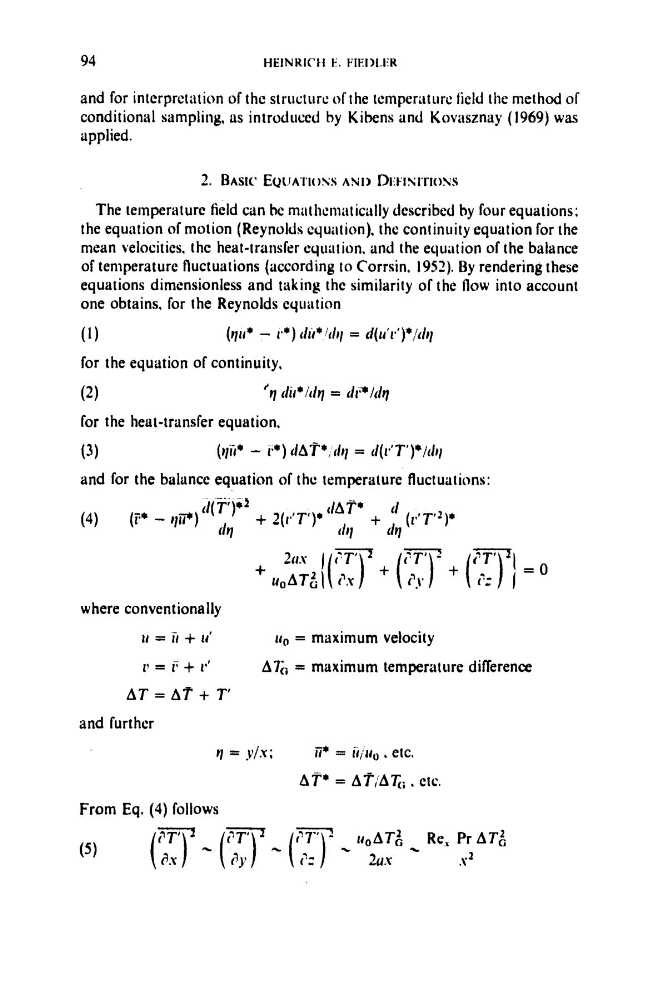
The temperature field can be mathcmatically described by four equations;
the equation of motion (Reynolds cquiition). thc continuity equation for the
mean velocities, the heat-transfer equation. and the equiition of the balance
of temperature fluctuations (according to Corrsin. 1952). By rendering these
equations dimensionless and taking the similarity of the flow into account
one obtains. for the Reynolds equiition
(1)
(2)
(qu* - r * ) du* 'd,/ = f f ( 1 4 ' l ~ ' ) * / ~ / , ~
for the equation of continuity,
q rlir*i(/q = dr*/tlq
r'
for the heat-transfer equation.
(3)
(,lir* - I**) d A P , d11 = d(t*'T')*/dr/
and for the balance equation of thc temperature fluctuations:
where conventionally
14 = li + 1 0
= i; + [*'
A T = A T + T
ir0 = maximum velocity
A7;; = maximum temperature dimerence
and furthcr
q = 4'l.u;
is* = iriuo . etc.
AT* = ATiAT;. CIC.
From Eq. (4) follows
HEINRICH E. FIEI)LliK
and for interprctution of the structure of the temperaturc field tlic method of
conditional sampling, us introduced by Kibens and Koviisznay (1969) was
applied.
2. BASIC Ey1r~'noss AND Di'tmimoxs
The temperature field can be mathcmatically described by four equations;
the equation of motion (Reynolds cquiition). thc continuity equation for the
mean velocities, the heat-transfer equation. and the equiition of the balance
of temperature fluctuations (according to Corrsin. 1952). By rendering these
equations dimensionless and taking the similarity of the flow into account
one obtains. for the Reynolds equiition
(1)
(2)
(qu* - r * ) du* 'd,/ = f f ( 1 4 ' l ~ ' ) * / ~ / , ~
for the equation of continuity,
q rlir*i(/q = dr*/tlq
r'
for the heat-transfer equation.
(3)
(,lir* - I**) d A P , d11 = d(t*'T')*/dr/
and for the balance equation of thc temperature fluctuations:
where conventionally
14 = li + 1 0
= i; + [*'
A T = A T + T
ir0 = maximum velocity
A7;; = maximum temperature dimerence
and furthcr
q = 4'l.u;
is* = iriuo . etc.
AT* = ATiAT;. CIC.
From Eq. (4) follows