

3.6
3.4
3.2
3.0
2.8
1
2
3
4
Catch /10 tons
6
Mean Trophic Level
1950
1994
1965 1970 1975 1980 1985
18
16
14
12
20
2.0
2.5
3.0
Diversity (exp H)
Diversity (exp H)
Gulf of Thailand
Georges Bank
a
b
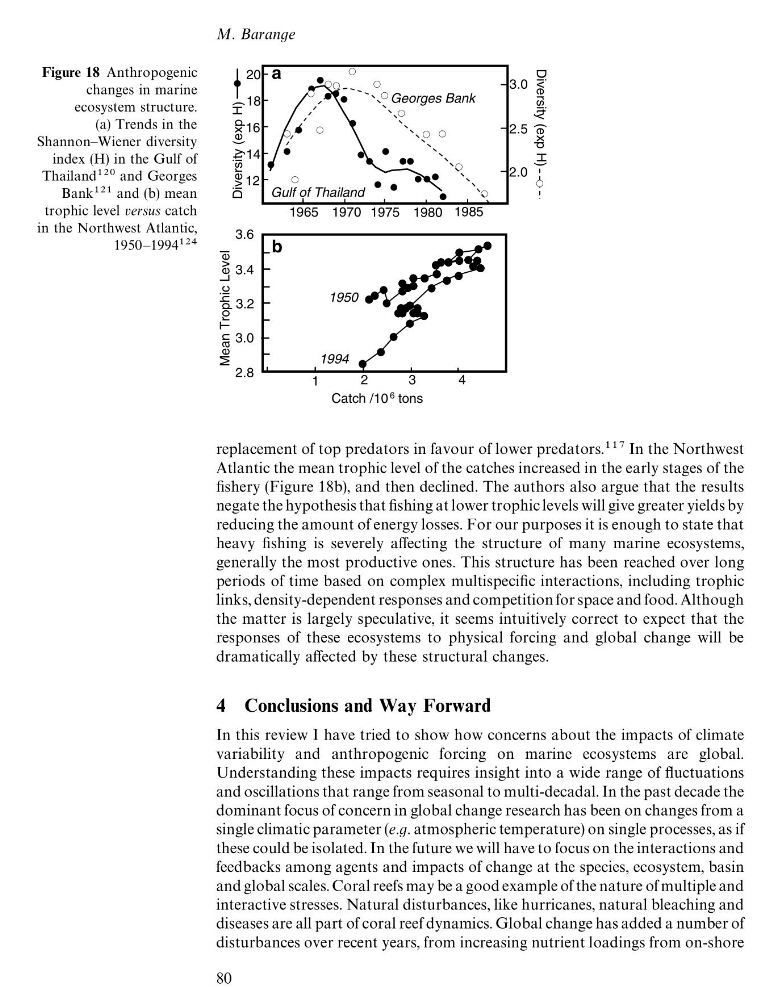
Figure 18 Anthropogenic
changes in marine
ecosystem structure.
(a) Trends in the
Shannon—Wiener diversity
index (H) in the Gulf of
Thailand and Georges
Bank and (b) mean
trophic level versus catch
in the Northwest Atlantic,
1950—1994
replacement of top predators in favour of lower predators. In the Northwest
Atlantic the mean trophic level of the catches increased in the early stages of the
fishery (Figure 18b), and then declined. The authors also argue that the results
negate the hypothesis that fishing at lower trophic levels will give greater yields by
reducing the amount of energy losses. For our purposes it is enough to state that
heavy fishing is severely affecting the structure of many marine ecosystems,
generally the most productive ones. This structure has been reached over long
periods of time based on complex multispecific interactions, including trophic
links, density-dependent responses and competition for space and food. Although
the matter is largely speculative, it seems intuitively correct to expect that the
responses of these ecosystems to physical forcing and global change will be
dramatically affected by these structural changes.
4 Conclusions and Way Forward
In this review I have tried to show how concerns about the impacts of climate
variability and anthropogenic forcing on marine ecosystems are global.
Understanding these impacts requires insight into a wide range of fluctuations
and oscillations that range from seasonal to multi-decadal. In the past decade the
dominant focus of concern in global change research has been on changes from a
single climatic parameter (e.g. atmospheric temperature) on single processes, as if
these could be isolated. In the future we will have to focus on the interactions and
feedbacks among agents and impacts of change at the species, ecosystem, basin
and global scales. Coral reefs may be a good example of the nature of multiple and
interactive stresses. Natural disturbances, like hurricanes, natural bleaching and
diseases are all part of coral reef dynamics. Global change has added a number of
disturbances over recent years, from increasing nutrient loadings from on-shore
M. Barange
80
3.4
3.2
3.0
2.8
1
2
3
4
Catch /10 tons
6
Mean Trophic Level
1950
1994
1965 1970 1975 1980 1985
18
16
14
12
20
2.0
2.5
3.0
Diversity (exp H)
Diversity (exp H)
Gulf of Thailand
Georges Bank
a
b
Figure 18 Anthropogenic
changes in marine
ecosystem structure.
(a) Trends in the
Shannon—Wiener diversity
index (H) in the Gulf of
Thailand and Georges
Bank and (b) mean
trophic level versus catch
in the Northwest Atlantic,
1950—1994
replacement of top predators in favour of lower predators. In the Northwest
Atlantic the mean trophic level of the catches increased in the early stages of the
fishery (Figure 18b), and then declined. The authors also argue that the results
negate the hypothesis that fishing at lower trophic levels will give greater yields by
reducing the amount of energy losses. For our purposes it is enough to state that
heavy fishing is severely affecting the structure of many marine ecosystems,
generally the most productive ones. This structure has been reached over long
periods of time based on complex multispecific interactions, including trophic
links, density-dependent responses and competition for space and food. Although
the matter is largely speculative, it seems intuitively correct to expect that the
responses of these ecosystems to physical forcing and global change will be
dramatically affected by these structural changes.
4 Conclusions and Way Forward
In this review I have tried to show how concerns about the impacts of climate
variability and anthropogenic forcing on marine ecosystems are global.
Understanding these impacts requires insight into a wide range of fluctuations
and oscillations that range from seasonal to multi-decadal. In the past decade the
dominant focus of concern in global change research has been on changes from a
single climatic parameter (e.g. atmospheric temperature) on single processes, as if
these could be isolated. In the future we will have to focus on the interactions and
feedbacks among agents and impacts of change at the species, ecosystem, basin
and global scales. Coral reefs may be a good example of the nature of multiple and
interactive stresses. Natural disturbances, like hurricanes, natural bleaching and
diseases are all part of coral reef dynamics. Global change has added a number of
disturbances over recent years, from increasing nutrient loadings from on-shore
M. Barange
80