

Gulf Stream Index
Log copepod abundance
Log zooplankton abundance
Lake Windemere (inverted)
-2
-1
0
1
2
1970
198
Year
0
1990
2000
0.6
0.7
0.8
0.9
1.0
Central North Sea
0.2
0.1
0.0
-0.1
-0.2
-0.3
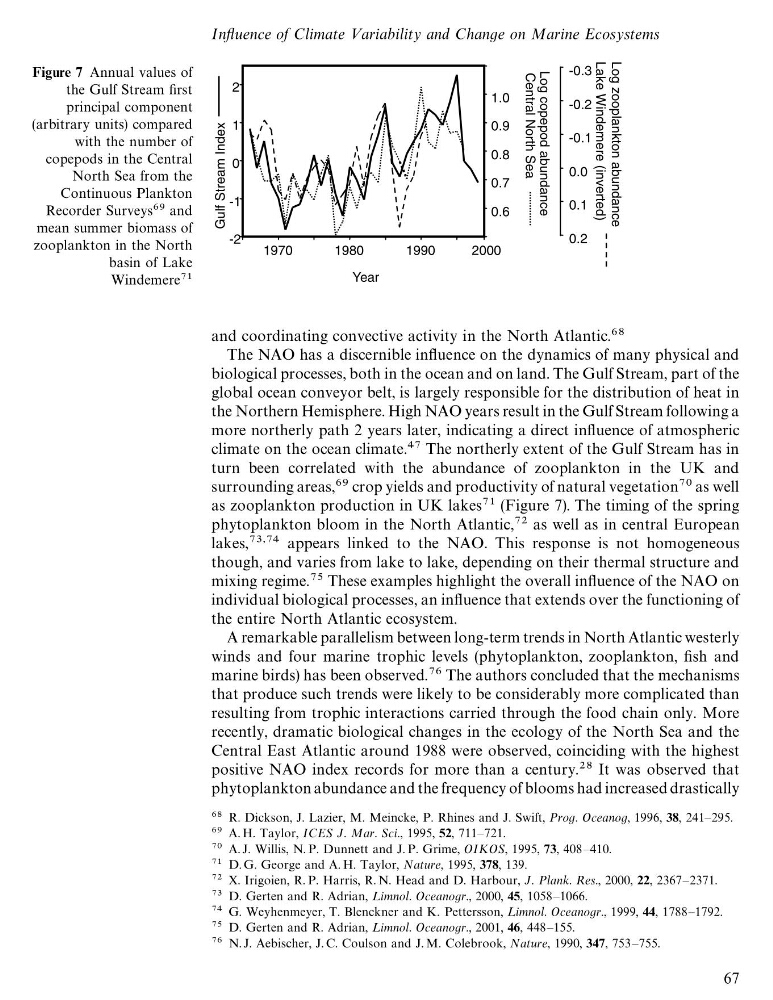
Figure 7 Annual values of
the Gulf Stream first
principal component
(arbitrary units) compared
with the number of
copepods in the Central
North Sea from the
Continuous Plankton
Recorder Surveys and
mean summer biomass of
zooplankton in the North
basin of Lake
Windemere
and coordinating convective activity in the North Atlantic.
The NAO has a discernible influence on the dynamics of many physical and
biological processes, both in the ocean and on land. The Gulf Stream, part of the
global ocean conveyor belt, is largely responsible for the distribution of heat in
the Northern Hemisphere. High NAO years result in the Gulf Stream following a
more northerly path 2 years later, indicating a direct influence of atmospheric
climate on the ocean climate. The northerly extent of the Gulf Stream has in
turn been correlated with the abundance of zooplankton in the UK and
surrounding areas, crop yields and productivity of natural vegetation as well
as zooplankton production in UK lakes (Figure 7). The timing of the spring
phytoplankton bloom in the North Atlantic, as well as in central European
lakes, appears linked to the NAO. This response is not homogeneous
though, and varies from lake to lake, depending on their thermal structure and
mixing regime. These examples highlight the overall influence of the NAO on
individual biological processes, an influence that extends over the functioning of
the entire North Atlantic ecosystem.
A remarkable parallelism between long-term trends in North Atlantic westerly
winds and four marine trophic levels (phytoplankton, zooplankton, fish and
marine birds) has been observed. The authors concluded that the mechanisms
that produce such trends were likely to be considerably more complicated than
resulting from trophic interactions carried through the food chain only. More
recently, dramatic biological changes in the ecology of the North Sea and the
Central East Atlantic around 1988 were observed, coinciding with the highest
positive NAO index records for more than a century. It was observed that
phytoplankton abundance and the frequency of blooms had increased drastically
R. Dickson, J. Lazier, M. Meincke, P. Rhines and J. Swift, Prog. Oceanog, 1996, 38, 241—295.
A. H. Taylor, ICES J. Mar. Sci., 1995, 52, 711—721.
A. J. Willis, N. P. Dunnett and J. P. Grime, OIKOS, 1995, 73, 408—410.
D. G. George and A. H. Taylor, Nature, 1995, 378, 139.
X. Irigoien, R. P. Harris, R. N. Head and D. Harbour, J. Plank. Res., 2000, 22, 2367—2371.
D. Gerten and R. Adrian, Limnol. Oceanogr., 2000, 45, 1058—1066.
G. Weyhenmeyer, T. Blenckner and K. Pettersson, Limnol. Oceanogr., 1999, 44, 1788—1792.
D. Gerten and R. Adrian, Limnol. Oceanogr., 2001, 46, 448—155.
N. J. Aebischer, J. C. Coulson and J. M. Colebrook, Nature, 1990, 347, 753—755.
Influence of Climate Variability and Change on Marine Ecosystems
67
Log copepod abundance
Log zooplankton abundance
Lake Windemere (inverted)
-2
-1
0
1
2
1970
198
Year
0
1990
2000
0.6
0.7
0.8
0.9
1.0
Central North Sea
0.2
0.1
0.0
-0.1
-0.2
-0.3
Figure 7 Annual values of
the Gulf Stream first
principal component
(arbitrary units) compared
with the number of
copepods in the Central
North Sea from the
Continuous Plankton
Recorder Surveys and
mean summer biomass of
zooplankton in the North
basin of Lake
Windemere
and coordinating convective activity in the North Atlantic.
The NAO has a discernible influence on the dynamics of many physical and
biological processes, both in the ocean and on land. The Gulf Stream, part of the
global ocean conveyor belt, is largely responsible for the distribution of heat in
the Northern Hemisphere. High NAO years result in the Gulf Stream following a
more northerly path 2 years later, indicating a direct influence of atmospheric
climate on the ocean climate. The northerly extent of the Gulf Stream has in
turn been correlated with the abundance of zooplankton in the UK and
surrounding areas, crop yields and productivity of natural vegetation as well
as zooplankton production in UK lakes (Figure 7). The timing of the spring
phytoplankton bloom in the North Atlantic, as well as in central European
lakes, appears linked to the NAO. This response is not homogeneous
though, and varies from lake to lake, depending on their thermal structure and
mixing regime. These examples highlight the overall influence of the NAO on
individual biological processes, an influence that extends over the functioning of
the entire North Atlantic ecosystem.
A remarkable parallelism between long-term trends in North Atlantic westerly
winds and four marine trophic levels (phytoplankton, zooplankton, fish and
marine birds) has been observed. The authors concluded that the mechanisms
that produce such trends were likely to be considerably more complicated than
resulting from trophic interactions carried through the food chain only. More
recently, dramatic biological changes in the ecology of the North Sea and the
Central East Atlantic around 1988 were observed, coinciding with the highest
positive NAO index records for more than a century. It was observed that
phytoplankton abundance and the frequency of blooms had increased drastically
R. Dickson, J. Lazier, M. Meincke, P. Rhines and J. Swift, Prog. Oceanog, 1996, 38, 241—295.
A. H. Taylor, ICES J. Mar. Sci., 1995, 52, 711—721.
A. J. Willis, N. P. Dunnett and J. P. Grime, OIKOS, 1995, 73, 408—410.
D. G. George and A. H. Taylor, Nature, 1995, 378, 139.
X. Irigoien, R. P. Harris, R. N. Head and D. Harbour, J. Plank. Res., 2000, 22, 2367—2371.
D. Gerten and R. Adrian, Limnol. Oceanogr., 2000, 45, 1058—1066.
G. Weyhenmeyer, T. Blenckner and K. Pettersson, Limnol. Oceanogr., 1999, 44, 1788—1792.
D. Gerten and R. Adrian, Limnol. Oceanogr., 2001, 46, 448—155.
N. J. Aebischer, J. C. Coulson and J. M. Colebrook, Nature, 1990, 347, 753—755.
Influence of Climate Variability and Change on Marine Ecosystems
67