

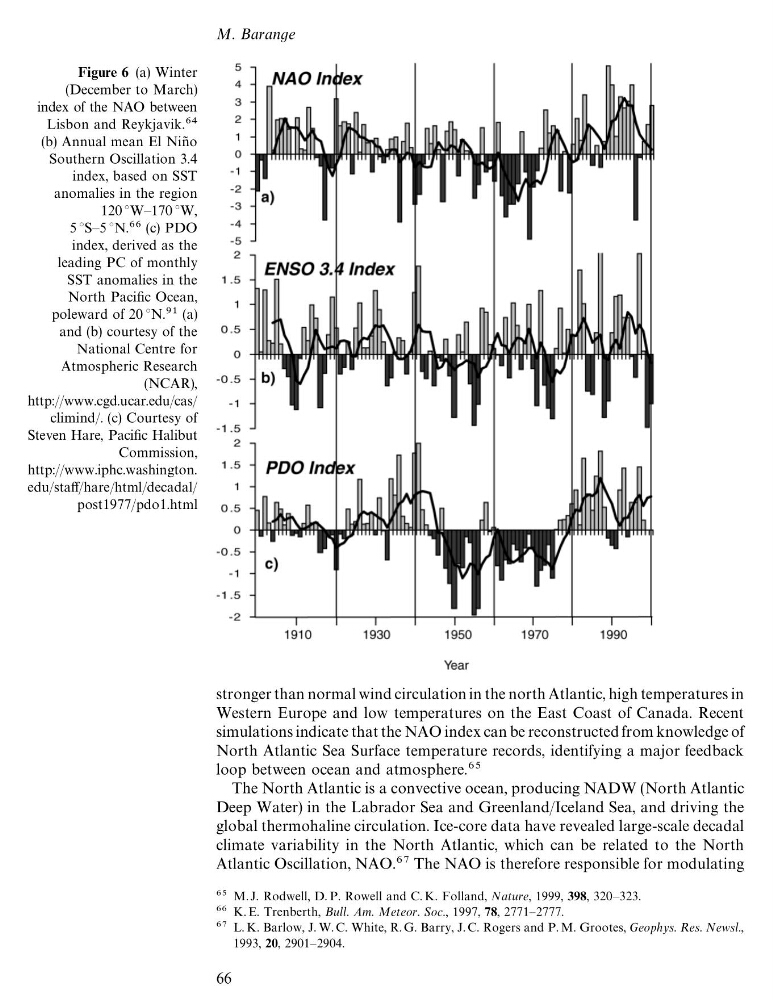
Figure 6 (a) Winter
(December to March)
index of the NAO between
Lisbon and Reykjavik.
(b) Annual mean El Nin o
Southern Oscillation 3.4
index, based on SST
anomalies in the region
120 °W—170 °W,
5 °S—5 °N. (c) PDO
index, derived as the
leading PC of monthly
SST anomalies in the
North Pacific Ocean,
poleward of 20 °N. (a)
and (b) courtesy of the
National Centre for
Atmospheric Research
(NCAR),
http://www.cgd.ucar.edu/cas/
climind/. (c) Courtesy of
Steven Hare, Pacific Halibut
Commission,
http://www.iphc.washington.
edu/staff/hare/html/decadal/
post1977/pdo1.html
stronger than normal wind circulation in the north Atlantic, high temperatures in
Western Europe and low temperatures on the East Coast of Canada. Recent
simulations indicate that the NAO index can be reconstructed from knowledge of
North Atlantic Sea Surface temperature records, identifying a major feedback
loop between ocean and atmosphere.
The North Atlantic is a convective ocean, producing NADW (North Atlantic
Deep Water) in the Labrador Sea and Greenland/Iceland Sea, and driving the
global thermohaline circulation. Ice-core data have revealed large-scale decadal
climate variability in the North Atlantic, which can be related to the North
Atlantic Oscillation, NAO. The NAO is therefore responsible for modulating
M. J. Rodwell, D. P. Rowell and C. K. Folland, Nature, 1999, 398, 320—323.
K. E. Trenberth, Bull. Am. Meteor. Soc., 1997, 78, 2771—2777.
L. K. Barlow, J. W. C. White, R. G. Barry, J. C. Rogers and P. M. Grootes, Geophys. Res. Newsl.,
1993, 20, 2901—2904.
M. Barange
66
(December to March)
index of the NAO between
Lisbon and Reykjavik.
(b) Annual mean El Nin o
Southern Oscillation 3.4
index, based on SST
anomalies in the region
120 °W—170 °W,
5 °S—5 °N. (c) PDO
index, derived as the
leading PC of monthly
SST anomalies in the
North Pacific Ocean,
poleward of 20 °N. (a)
and (b) courtesy of the
National Centre for
Atmospheric Research
(NCAR),
http://www.cgd.ucar.edu/cas/
climind/. (c) Courtesy of
Steven Hare, Pacific Halibut
Commission,
http://www.iphc.washington.
edu/staff/hare/html/decadal/
post1977/pdo1.html
stronger than normal wind circulation in the north Atlantic, high temperatures in
Western Europe and low temperatures on the East Coast of Canada. Recent
simulations indicate that the NAO index can be reconstructed from knowledge of
North Atlantic Sea Surface temperature records, identifying a major feedback
loop between ocean and atmosphere.
The North Atlantic is a convective ocean, producing NADW (North Atlantic
Deep Water) in the Labrador Sea and Greenland/Iceland Sea, and driving the
global thermohaline circulation. Ice-core data have revealed large-scale decadal
climate variability in the North Atlantic, which can be related to the North
Atlantic Oscillation, NAO. The NAO is therefore responsible for modulating
M. J. Rodwell, D. P. Rowell and C. K. Folland, Nature, 1999, 398, 320—323.
K. E. Trenberth, Bull. Am. Meteor. Soc., 1997, 78, 2771—2777.
L. K. Barlow, J. W. C. White, R. G. Barry, J. C. Rogers and P. M. Grootes, Geophys. Res. Newsl.,
1993, 20, 2901—2904.
M. Barange
66