

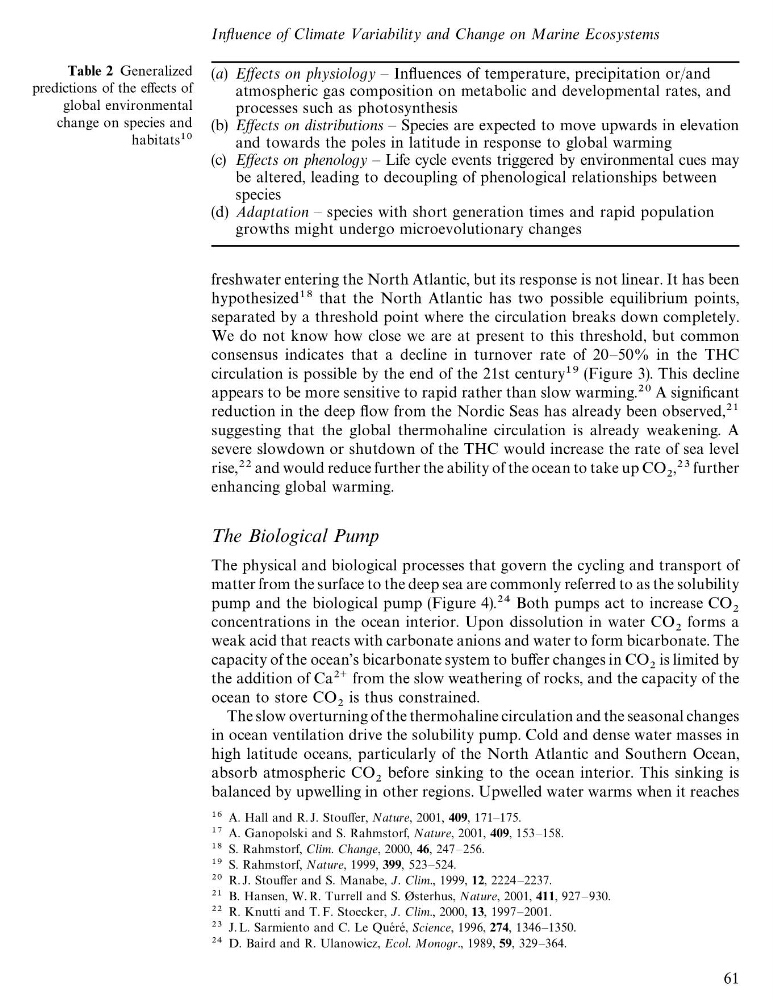
Table 2 Generalized
predictions of the effects of
global environmental
change on species and
habitats
(a) Effects on physiology — Influences of temperature, precipitation or/and
atmospheric gas composition on metabolic and developmental rates, and
processes such as photosynthesis
(b) Effects on distributions — Species are expected to move upwards in elevation
and towards the poles in latitude in response to global warming
(c) Effects on phenology — Life cycle events triggered by environmental cues may
be altered, leading to decoupling of phenological relationships between
species
(d) Adaptation — species with short generation times and rapid population
growths might undergo microevolutionary changes
freshwater entering the North Atlantic, but its response is not linear. It has been
hypothesized that the North Atlantic has two possible equilibrium points,
separated by a threshold point where the circulation breaks down completely.
We do not know how close we are at present to this threshold, but common
consensus indicates that a decline in turnover rate of 20—50% in the THC
circulation is possible by the end of the 21st century (Figure 3). This decline
appears to be more sensitive to rapid rather than slow warming. A significant
reduction in the deep flow from the Nordic Seas has already been observed,
suggesting that the global thermohaline circulation is already weakening. A
severe slowdown or shutdown of the THC would increase the rate of sea level
rise, and would reduce further the ability of the ocean to take up CO
, further
enhancing global warming.
The Biological Pump
The physical and biological processes that govern the cycling and transport of
matter from the surface to the deep sea are commonly referred to as the solubility
pump and the biological pump (Figure 4). Both pumps act to increase CO
concentrations in the ocean interior. Upon dissolution in water CO
forms a
weak acid that reacts with carbonate anions and water to form bicarbonate. The
capacity of the ocean’s bicarbonate system to buffer changes in CO
is limited by
the addition of Ca> from the slow weathering of rocks, and the capacity of the
ocean to store CO
is thus constrained.
The slow overturning of the thermohaline circulation and the seasonal changes
in ocean ventilation drive the solubility pump. Cold and dense water masses in
high latitude oceans, particularly of the North Atlantic and Southern Ocean,
absorb atmospheric CO
before sinking to the ocean interior. This sinking is
balanced by upwelling in other regions. Upwelled water warms when it reaches
A. Hall and R. J. Stouffer, Nature, 2001, 409, 171—175.
A. Ganopolski and S. Rahmstorf, Nature, 2001, 409, 153—158.
S. Rahmstorf, Clim. Change, 2000, 46, 247—256.
S. Rahmstorf, Nature, 1999, 399, 523—524.
R. J. Stouffer and S. Manabe, J. Clim., 1999, 12, 2224—2237.
B. Hansen, W. R. Turrell and S. Østerhus, Nature, 2001, 411, 927—930.
R. Knutti and T. F. Stoecker, J. Clim., 2000, 13, 1997—2001.
J. L. Sarmiento and C. Le Que´ re´ , Science, 1996, 274, 1346—1350.
D. Baird and R. Ulanowicz, Ecol. Monogr., 1989, 59, 329—364.
Influence of Climate Variability and Change on Marine Ecosystems
61
predictions of the effects of
global environmental
change on species and
habitats
(a) Effects on physiology — Influences of temperature, precipitation or/and
atmospheric gas composition on metabolic and developmental rates, and
processes such as photosynthesis
(b) Effects on distributions — Species are expected to move upwards in elevation
and towards the poles in latitude in response to global warming
(c) Effects on phenology — Life cycle events triggered by environmental cues may
be altered, leading to decoupling of phenological relationships between
species
(d) Adaptation — species with short generation times and rapid population
growths might undergo microevolutionary changes
freshwater entering the North Atlantic, but its response is not linear. It has been
hypothesized that the North Atlantic has two possible equilibrium points,
separated by a threshold point where the circulation breaks down completely.
We do not know how close we are at present to this threshold, but common
consensus indicates that a decline in turnover rate of 20—50% in the THC
circulation is possible by the end of the 21st century (Figure 3). This decline
appears to be more sensitive to rapid rather than slow warming. A significant
reduction in the deep flow from the Nordic Seas has already been observed,
suggesting that the global thermohaline circulation is already weakening. A
severe slowdown or shutdown of the THC would increase the rate of sea level
rise, and would reduce further the ability of the ocean to take up CO
, further
enhancing global warming.
The Biological Pump
The physical and biological processes that govern the cycling and transport of
matter from the surface to the deep sea are commonly referred to as the solubility
pump and the biological pump (Figure 4). Both pumps act to increase CO
concentrations in the ocean interior. Upon dissolution in water CO
forms a
weak acid that reacts with carbonate anions and water to form bicarbonate. The
capacity of the ocean’s bicarbonate system to buffer changes in CO
is limited by
the addition of Ca> from the slow weathering of rocks, and the capacity of the
ocean to store CO
is thus constrained.
The slow overturning of the thermohaline circulation and the seasonal changes
in ocean ventilation drive the solubility pump. Cold and dense water masses in
high latitude oceans, particularly of the North Atlantic and Southern Ocean,
absorb atmospheric CO
before sinking to the ocean interior. This sinking is
balanced by upwelling in other regions. Upwelled water warms when it reaches
A. Hall and R. J. Stouffer, Nature, 2001, 409, 171—175.
A. Ganopolski and S. Rahmstorf, Nature, 2001, 409, 153—158.
S. Rahmstorf, Clim. Change, 2000, 46, 247—256.
S. Rahmstorf, Nature, 1999, 399, 523—524.
R. J. Stouffer and S. Manabe, J. Clim., 1999, 12, 2224—2237.
B. Hansen, W. R. Turrell and S. Østerhus, Nature, 2001, 411, 927—930.
R. Knutti and T. F. Stoecker, J. Clim., 2000, 13, 1997—2001.
J. L. Sarmiento and C. Le Que´ re´ , Science, 1996, 274, 1346—1350.
D. Baird and R. Ulanowicz, Ecol. Monogr., 1989, 59, 329—364.
Influence of Climate Variability and Change on Marine Ecosystems
61