

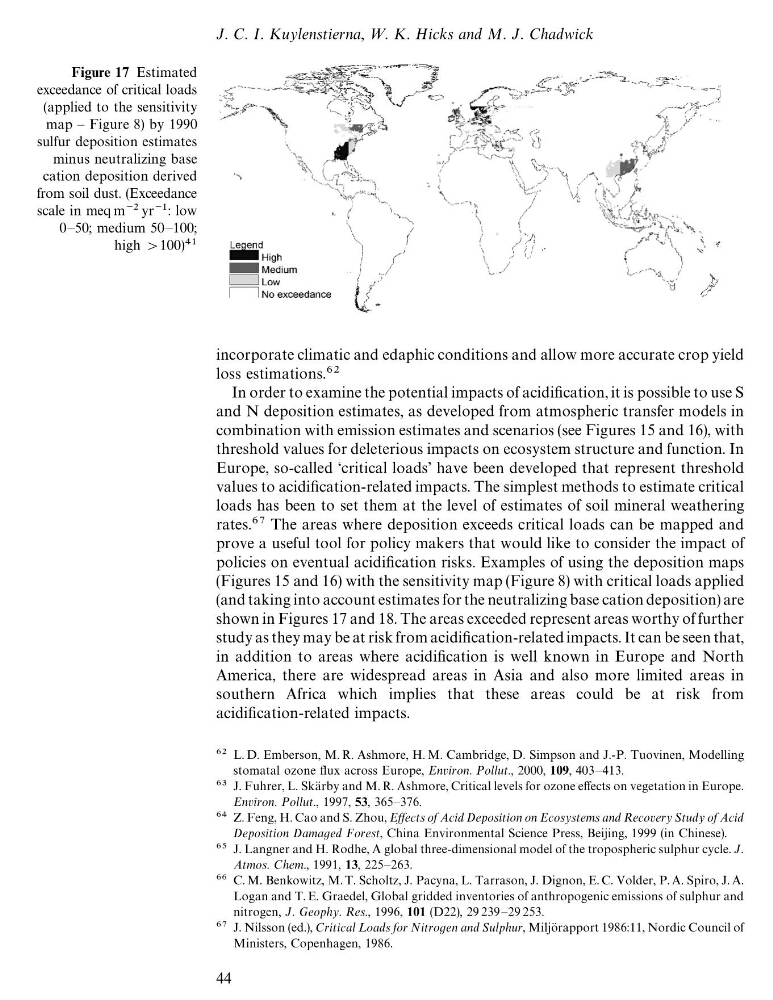
Figure 17 Estimated
exceedance of critical loads
(applied to the sensitivity
map — Figure 8) by 1990
sulfur deposition estimates
minus neutralizing base
cation deposition derived
from soil dust. (Exceedance
scale in meq m\ yr\: low
0—50; medium 50—100;
high 9100)
incorporate climatic and edaphic conditions and allow more accurate crop yield
loss estimations.
In order to examine the potential impacts of acidification, it is possible to use S
and N deposition estimates, as developed from atmospheric transfer models in
combination with emission estimates and scenarios (see Figures 15 and 16), with
threshold values for deleterious impacts on ecosystem structure and function. In
Europe, so-called ‘critical loads’ have been developed that represent threshold
values to acidification-related impacts. The simplest methods to estimate critical
loads has been to set them at the level of estimates of soil mineral weathering
rates. The areas where deposition exceeds critical loads can be mapped and
prove a useful tool for policy makers that would like to consider the impact of
policies on eventual acidification risks. Examples of using the deposition maps
(Figures 15 and 16) with the sensitivity map (Figure 8) with critical loads applied
(and taking into account estimates for the neutralizing base cation deposition) are
shown in Figures 17 and 18. The areas exceeded represent areas worthy of further
study as they may be at risk from acidification-related impacts. It can be seen that,
in addition to areas where acidification is well known in Europe and North
America, there are widespread areas in Asia and also more limited areas in
southern Africa which implies that these areas could be at risk from
acidification-related impacts.
L. D. Emberson, M. R. Ashmore, H. M. Cambridge, D. Simpson and J.-P. Tuovinen, Modelling
stomatal ozone flux across Europe, Environ. Pollut., 2000, 109, 403—413.
J. Fuhrer, L. Ska¨ rby and M. R. Ashmore, Critical levels for ozone effects on vegetation in Europe.
Environ. Pollut., 1997, 53, 365—376.
Z. Feng, H. Cao and S. Zhou, Effects of Acid Deposition on Ecosystems and Recovery Study of Acid
Deposition Damaged Forest, China Environmental Science Press, Beijing, 1999 (in Chinese).
J. Langner and H. Rodhe, A global three-dimensional model of the tropospheric sulphur cycle. J.
Atmos. Chem., 1991, 13, 225—263.
C. M. Benkowitz, M. T. Scholtz, J. Pacyna, L. Tarrason, J. Dignon, E. C. Volder, P. A. Spiro, J. A.
Logan and T. E. Graedel, Global gridded inventories of anthropogenic emissions of sulphur and
nitrogen, J. Geophy. Res., 1996, 101 (D22), 29 239—29 253.
J. Nilsson (ed.), Critical Loads for Nitrogen and Sulphur, Miljo¨ rapport 1986:11, Nordic Council of
Ministers, Copenhagen, 1986.
J. C. I. Kuylenstierna, W. K. Hicks and M. J. Chadwick
44
exceedance of critical loads
(applied to the sensitivity
map — Figure 8) by 1990
sulfur deposition estimates
minus neutralizing base
cation deposition derived
from soil dust. (Exceedance
scale in meq m\ yr\: low
0—50; medium 50—100;
high 9100)
incorporate climatic and edaphic conditions and allow more accurate crop yield
loss estimations.
In order to examine the potential impacts of acidification, it is possible to use S
and N deposition estimates, as developed from atmospheric transfer models in
combination with emission estimates and scenarios (see Figures 15 and 16), with
threshold values for deleterious impacts on ecosystem structure and function. In
Europe, so-called ‘critical loads’ have been developed that represent threshold
values to acidification-related impacts. The simplest methods to estimate critical
loads has been to set them at the level of estimates of soil mineral weathering
rates. The areas where deposition exceeds critical loads can be mapped and
prove a useful tool for policy makers that would like to consider the impact of
policies on eventual acidification risks. Examples of using the deposition maps
(Figures 15 and 16) with the sensitivity map (Figure 8) with critical loads applied
(and taking into account estimates for the neutralizing base cation deposition) are
shown in Figures 17 and 18. The areas exceeded represent areas worthy of further
study as they may be at risk from acidification-related impacts. It can be seen that,
in addition to areas where acidification is well known in Europe and North
America, there are widespread areas in Asia and also more limited areas in
southern Africa which implies that these areas could be at risk from
acidification-related impacts.
L. D. Emberson, M. R. Ashmore, H. M. Cambridge, D. Simpson and J.-P. Tuovinen, Modelling
stomatal ozone flux across Europe, Environ. Pollut., 2000, 109, 403—413.
J. Fuhrer, L. Ska¨ rby and M. R. Ashmore, Critical levels for ozone effects on vegetation in Europe.
Environ. Pollut., 1997, 53, 365—376.
Z. Feng, H. Cao and S. Zhou, Effects of Acid Deposition on Ecosystems and Recovery Study of Acid
Deposition Damaged Forest, China Environmental Science Press, Beijing, 1999 (in Chinese).
J. Langner and H. Rodhe, A global three-dimensional model of the tropospheric sulphur cycle. J.
Atmos. Chem., 1991, 13, 225—263.
C. M. Benkowitz, M. T. Scholtz, J. Pacyna, L. Tarrason, J. Dignon, E. C. Volder, P. A. Spiro, J. A.
Logan and T. E. Graedel, Global gridded inventories of anthropogenic emissions of sulphur and
nitrogen, J. Geophy. Res., 1996, 101 (D22), 29 239—29 253.
J. Nilsson (ed.), Critical Loads for Nitrogen and Sulphur, Miljo¨ rapport 1986:11, Nordic Council of
Ministers, Copenhagen, 1986.
J. C. I. Kuylenstierna, W. K. Hicks and M. J. Chadwick
44