

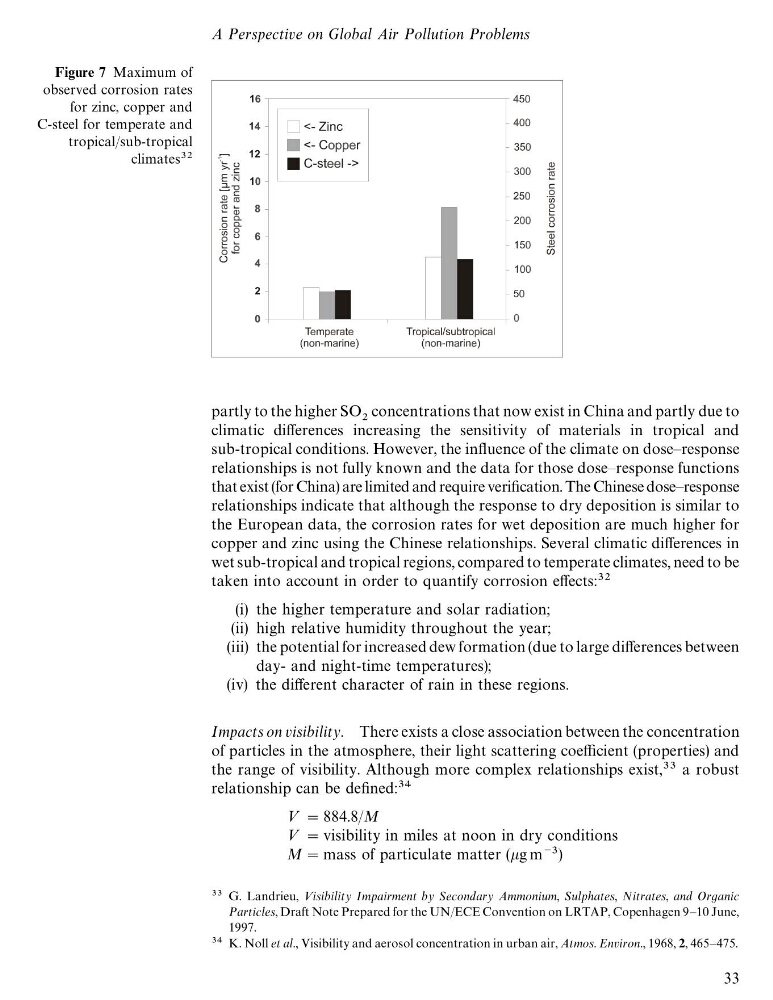
Figure 7 Maximum of
observed corrosion rates
for zinc, copper and
C-steel for temperate and
tropical/sub-tropical
climates
partly to the higher SO
concentrations that now exist in China and partly due to
climatic differences increasing the sensitivity of materials in tropical and
sub-tropical conditions. However, the influence of the climate on dose—response
relationships is not fully known and the data for those dose—response functions
that exist (for China) are limited and require verification. The Chinese dose—response
relationships indicate that although the response to dry deposition is similar to
the European data, the corrosion rates for wet deposition are much higher for
copper and zinc using the Chinese relationships. Several climatic differences in
wet sub-tropical and tropical regions, compared to temperate climates, need to be
taken into account in order to quantify corrosion effects:
(i) the higher temperature and solar radiation;
(ii) high relative humidity throughout the year;
(iii) the potential for increased dew formation (due to large differences between
day- and night-time temperatures);
(iv) the different character of rain in these regions.
Impacts on visibility. There exists a close association between the concentration
of particles in the atmosphere, their light scattering coefficient (properties) and
the range of visibility. Although more complex relationships exist, a robust
relationship can be defined:
V : 884.8/M
V : visibility in miles at noon in dry conditions
M : mass of particulate matter (g m\)
G. Landrieu, Visibility Impairment by Secondary Ammonium, Sulphates, Nitrates, and Organic
Particles, Draft Note Prepared for the UN/ECE Convention on LRTAP, Copenhagen 9—10 June,
1997.
K. Noll et al., Visibility and aerosol concentration in urban air, Atmos. Environ., 1968, 2, 465—475.
A Perspective on Global Air Pollution Problems
33
observed corrosion rates
for zinc, copper and
C-steel for temperate and
tropical/sub-tropical
climates
partly to the higher SO
concentrations that now exist in China and partly due to
climatic differences increasing the sensitivity of materials in tropical and
sub-tropical conditions. However, the influence of the climate on dose—response
relationships is not fully known and the data for those dose—response functions
that exist (for China) are limited and require verification. The Chinese dose—response
relationships indicate that although the response to dry deposition is similar to
the European data, the corrosion rates for wet deposition are much higher for
copper and zinc using the Chinese relationships. Several climatic differences in
wet sub-tropical and tropical regions, compared to temperate climates, need to be
taken into account in order to quantify corrosion effects:
(i) the higher temperature and solar radiation;
(ii) high relative humidity throughout the year;
(iii) the potential for increased dew formation (due to large differences between
day- and night-time temperatures);
(iv) the different character of rain in these regions.
Impacts on visibility. There exists a close association between the concentration
of particles in the atmosphere, their light scattering coefficient (properties) and
the range of visibility. Although more complex relationships exist, a robust
relationship can be defined:
V : 884.8/M
V : visibility in miles at noon in dry conditions
M : mass of particulate matter (g m\)
G. Landrieu, Visibility Impairment by Secondary Ammonium, Sulphates, Nitrates, and Organic
Particles, Draft Note Prepared for the UN/ECE Convention on LRTAP, Copenhagen 9—10 June,
1997.
K. Noll et al., Visibility and aerosol concentration in urban air, Atmos. Environ., 1968, 2, 465—475.
A Perspective on Global Air Pollution Problems
33