

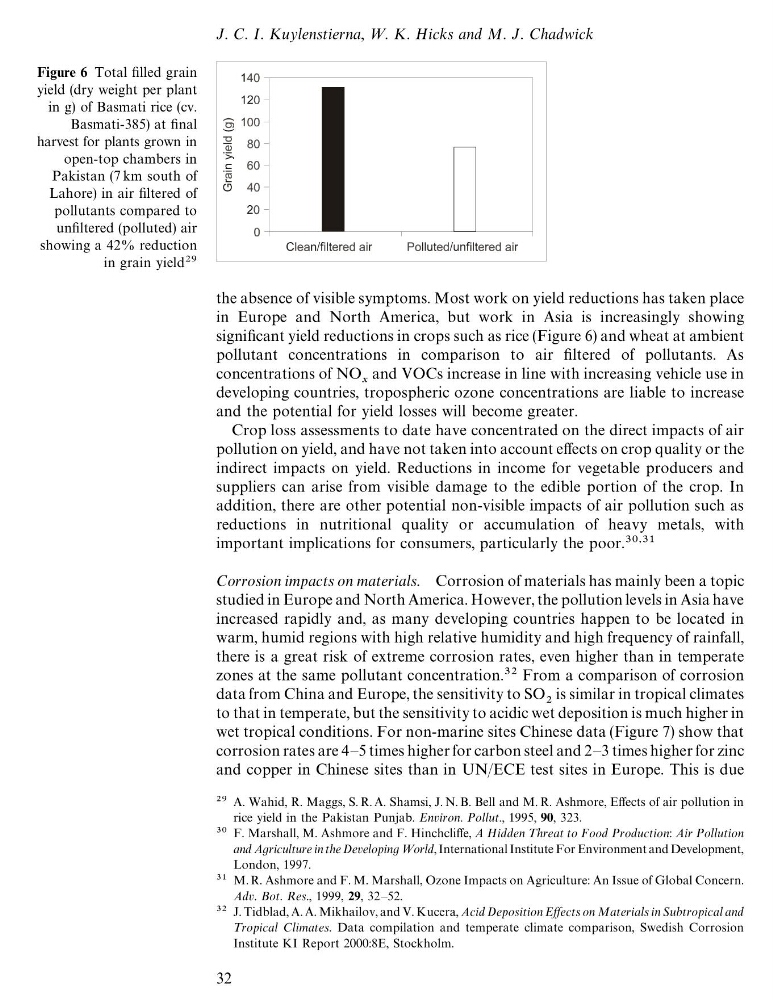
Figure 6 Total filled grain
yield (dry weight per plant
in g) of Basmati rice (cv.
Basmati-385) at final
harvest for plants grown in
open-top chambers in
Pakistan (7 km south of
Lahore) in air filtered of
pollutants compared to
unfiltered (polluted) air
showing a 42% reduction
in grain yield
the absence of visible symptoms. Most work on yield reductions has taken place
in Europe and North America, but work in Asia is increasingly showing
significant yield reductions in crops such as rice (Figure 6) and wheat at ambient
pollutant concentrations in comparison to air filtered of pollutants. As
concentrations of NO
V
and VOCs increase in line with increasing vehicle use in
developing countries, tropospheric ozone concentrations are liable to increase
and the potential for yield losses will become greater.
Crop loss assessments to date have concentrated on the direct impacts of air
pollution on yield, and have not taken into account effects on crop quality or the
indirect impacts on yield. Reductions in income for vegetable producers and
suppliers can arise from visible damage to the edible portion of the crop. In
addition, there are other potential non-visible impacts of air pollution such as
reductions in nutritional quality or accumulation of heavy metals, with
important implications for consumers, particularly the poor.
Corrosion impacts on materials. Corrosion of materials has mainly been a topic
studied in Europe and North America. However, the pollution levels in Asia have
increased rapidly and, as many developing countries happen to be located in
warm, humid regions with high relative humidity and high frequency of rainfall,
there is a great risk of extreme corrosion rates, even higher than in temperate
zones at the same pollutant concentration. From a comparison of corrosion
data from China and Europe, the sensitivity to SO
is similar in tropical climates
to that in temperate, but the sensitivity to acidic wet deposition is much higher in
wet tropical conditions. For non-marine sites Chinese data (Figure 7) show that
corrosion rates are 4—5 times higher for carbon steel and 2—3 times higher for zinc
and copper in Chinese sites than in UN/ECE test sites in Europe. This is due
A. Wahid, R. Maggs, S. R. A. Shamsi, J. N. B. Bell and M. R. Ashmore, Effects of air pollution in
rice yield in the Pakistan Punjab. Environ. Pollut., 1995, 90, 323.
F. Marshall, M. Ashmore and F. Hinchcliffe, A Hidden Threat to Food Production: Air Pollution
and Agriculture in the Developing World, International Institute For Environment and Development,
London, 1997.
M. R. Ashmore and F. M. Marshall, Ozone Impacts on Agriculture: An Issue of Global Concern.
Adv. Bot. Res., 1999, 29, 32—52.
J. Tidblad, A. A. Mikhailov, and V. Kucera, Acid Deposition Effects on Materials in Subtropical and
Tropical Climates. Data compilation and temperate climate comparison, Swedish Corrosion
Institute KI Report 2000:8E, Stockholm.
J. C. I. Kuylenstierna, W. K. Hicks and M. J. Chadwick
32
yield (dry weight per plant
in g) of Basmati rice (cv.
Basmati-385) at final
harvest for plants grown in
open-top chambers in
Pakistan (7 km south of
Lahore) in air filtered of
pollutants compared to
unfiltered (polluted) air
showing a 42% reduction
in grain yield
the absence of visible symptoms. Most work on yield reductions has taken place
in Europe and North America, but work in Asia is increasingly showing
significant yield reductions in crops such as rice (Figure 6) and wheat at ambient
pollutant concentrations in comparison to air filtered of pollutants. As
concentrations of NO
V
and VOCs increase in line with increasing vehicle use in
developing countries, tropospheric ozone concentrations are liable to increase
and the potential for yield losses will become greater.
Crop loss assessments to date have concentrated on the direct impacts of air
pollution on yield, and have not taken into account effects on crop quality or the
indirect impacts on yield. Reductions in income for vegetable producers and
suppliers can arise from visible damage to the edible portion of the crop. In
addition, there are other potential non-visible impacts of air pollution such as
reductions in nutritional quality or accumulation of heavy metals, with
important implications for consumers, particularly the poor.
Corrosion impacts on materials. Corrosion of materials has mainly been a topic
studied in Europe and North America. However, the pollution levels in Asia have
increased rapidly and, as many developing countries happen to be located in
warm, humid regions with high relative humidity and high frequency of rainfall,
there is a great risk of extreme corrosion rates, even higher than in temperate
zones at the same pollutant concentration. From a comparison of corrosion
data from China and Europe, the sensitivity to SO
is similar in tropical climates
to that in temperate, but the sensitivity to acidic wet deposition is much higher in
wet tropical conditions. For non-marine sites Chinese data (Figure 7) show that
corrosion rates are 4—5 times higher for carbon steel and 2—3 times higher for zinc
and copper in Chinese sites than in UN/ECE test sites in Europe. This is due
A. Wahid, R. Maggs, S. R. A. Shamsi, J. N. B. Bell and M. R. Ashmore, Effects of air pollution in
rice yield in the Pakistan Punjab. Environ. Pollut., 1995, 90, 323.
F. Marshall, M. Ashmore and F. Hinchcliffe, A Hidden Threat to Food Production: Air Pollution
and Agriculture in the Developing World, International Institute For Environment and Development,
London, 1997.
M. R. Ashmore and F. M. Marshall, Ozone Impacts on Agriculture: An Issue of Global Concern.
Adv. Bot. Res., 1999, 29, 32—52.
J. Tidblad, A. A. Mikhailov, and V. Kucera, Acid Deposition Effects on Materials in Subtropical and
Tropical Climates. Data compilation and temperate climate comparison, Swedish Corrosion
Institute KI Report 2000:8E, Stockholm.
J. C. I. Kuylenstierna, W. K. Hicks and M. J. Chadwick
32