

-15
-10
-5
0
5
10
15
GISS
GFDL
UKMO
% Change
Global Developed Developing
-15
-10
-5
0
5
10
15
GISS
GFDL
:: KMO
% Cha: ge
Global Developed Developing
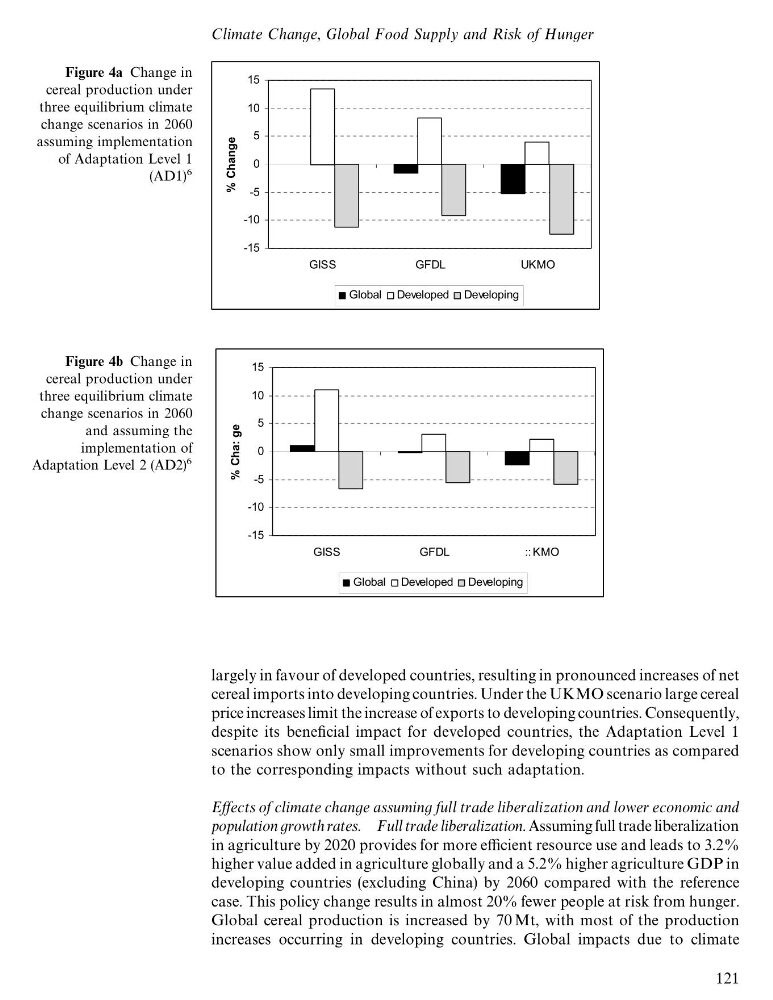
Figure 4a Change in
cereal production under
three equilibrium climate
change scenarios in 2060
assuming implementation
of Adaptation Level 1
(AD1)
Figure 4b Change in
cereal production under
three equilibrium climate
change scenarios in 2060
and assuming the
implementation of
Adaptation Level 2 (AD2)
largely in favour of developed countries, resulting in pronounced increases of net
cereal imports into developing countries. Under the UKMO scenario large cereal
price increases limit the increase of exports to developing countries. Consequently,
despite its beneficial impact for developed countries, the Adaptation Level 1
scenarios show only small improvements for developing countries as compared
to the corresponding impacts without such adaptation.
Effects of climate change assuming full trade liberalization and lower economic and
population growth rates. Full trade liberalization. Assuming full trade liberalization
in agriculture by 2020 provides for more efficient resource use and leads to 3.2%
higher value added in agriculture globally and a 5.2% higher agriculture GDP in
developing countries (excluding China) by 2060 compared with the reference
case. This policy change results in almost 20% fewer people at risk from hunger.
Global cereal production is increased by 70 Mt, with most of the production
increases occurring in developing countries. Global impacts due to climate
Climate Change, Global Food Supply and Risk of Hunger
121
-10
-5
0
5
10
15
GISS
GFDL
UKMO
% Change
Global Developed Developing
-15
-10
-5
0
5
10
15
GISS
GFDL
:: KMO
% Cha: ge
Global Developed Developing
Figure 4a Change in
cereal production under
three equilibrium climate
change scenarios in 2060
assuming implementation
of Adaptation Level 1
(AD1)
Figure 4b Change in
cereal production under
three equilibrium climate
change scenarios in 2060
and assuming the
implementation of
Adaptation Level 2 (AD2)
largely in favour of developed countries, resulting in pronounced increases of net
cereal imports into developing countries. Under the UKMO scenario large cereal
price increases limit the increase of exports to developing countries. Consequently,
despite its beneficial impact for developed countries, the Adaptation Level 1
scenarios show only small improvements for developing countries as compared
to the corresponding impacts without such adaptation.
Effects of climate change assuming full trade liberalization and lower economic and
population growth rates. Full trade liberalization. Assuming full trade liberalization
in agriculture by 2020 provides for more efficient resource use and leads to 3.2%
higher value added in agriculture globally and a 5.2% higher agriculture GDP in
developing countries (excluding China) by 2060 compared with the reference
case. This policy change results in almost 20% fewer people at risk from hunger.
Global cereal production is increased by 70 Mt, with most of the production
increases occurring in developing countries. Global impacts due to climate
Climate Change, Global Food Supply and Risk of Hunger
121