

COUNTRY A
WORLD MARKETS
International prices
to satisfy:
• commodity balances
• financial transfer balance
COUNTRY B
COUNTRY E
COUNTRY D
COUNTRY C
EXCHANGE
EQUILIBRIUM
Prices, consumption, stocks, net
exports to satisfy:
• Budget constraint
• Market clearance
• Trade balance
• Trade quota
GOVERNMENT POLICIES
Target price, tariffs, taxes, quota, etc.
PRODUCTION
Non-agriculture
production
Agriculture
production
Production inputs:
• Land
• Fertilizer
• Labour
• Others
• Capital
International commodity prices PW
Net trade EA
PW
PW
PW
PW
EC
ED
EE
EB
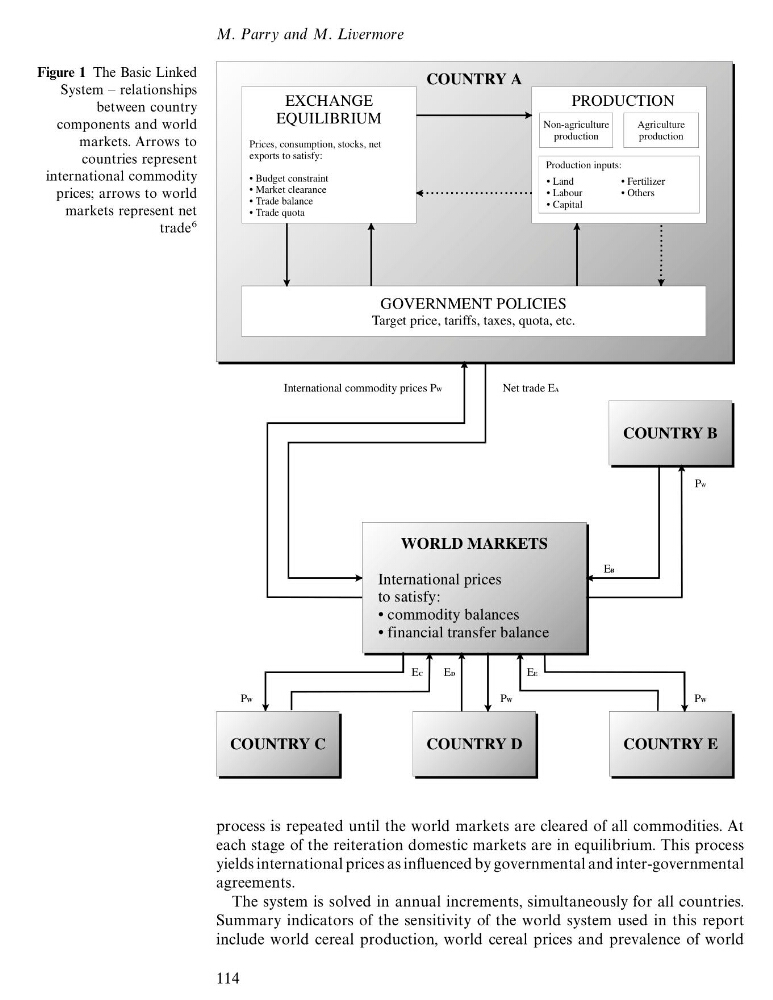
Figure 1 The Basic Linked
System — relationships
between country
components and world
markets. Arrows to
countries represent
international commodity
prices; arrows to world
markets represent net
trade
process is repeated until the world markets are cleared of all commodities. At
each stage of the reiteration domestic markets are in equilibrium. This process
yields international prices as influenced by governmental and inter-governmental
agreements.
The system is solved in annual increments, simultaneously for all countries.
Summary indicators of the sensitivity of the world system used in this report
include world cereal production, world cereal prices and prevalence of world
M. Parry and M. Livermore
114
WORLD MARKETS
International prices
to satisfy:
• commodity balances
• financial transfer balance
COUNTRY B
COUNTRY E
COUNTRY D
COUNTRY C
EXCHANGE
EQUILIBRIUM
Prices, consumption, stocks, net
exports to satisfy:
• Budget constraint
• Market clearance
• Trade balance
• Trade quota
GOVERNMENT POLICIES
Target price, tariffs, taxes, quota, etc.
PRODUCTION
Non-agriculture
production
Agriculture
production
Production inputs:
• Land
• Fertilizer
• Labour
• Others
• Capital
International commodity prices PW
Net trade EA
PW
PW
PW
PW
EC
ED
EE
EB
Figure 1 The Basic Linked
System — relationships
between country
components and world
markets. Arrows to
countries represent
international commodity
prices; arrows to world
markets represent net
trade
process is repeated until the world markets are cleared of all commodities. At
each stage of the reiteration domestic markets are in equilibrium. This process
yields international prices as influenced by governmental and inter-governmental
agreements.
The system is solved in annual increments, simultaneously for all countries.
Summary indicators of the sensitivity of the world system used in this report
include world cereal production, world cereal prices and prevalence of world
M. Parry and M. Livermore
114