

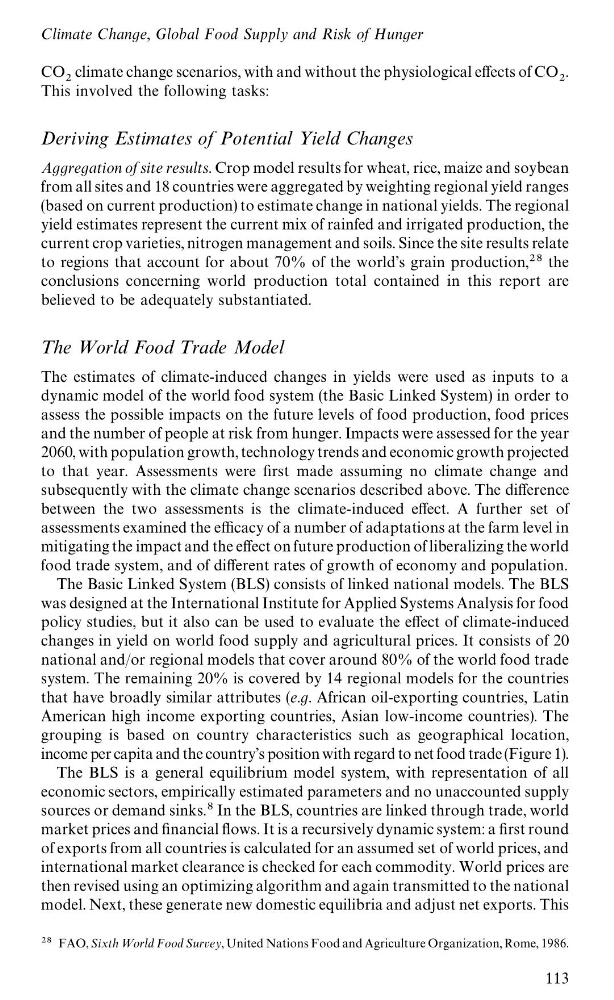
CO
climate change scenarios, with and without the physiological effects of CO
.
This involved the following tasks:
Deriving Estimates of Potential Yield Changes
Aggregation of site results. Crop model results for wheat, rice, maize and soybean
from all sites and 18 countries were aggregated by weighting regional yield ranges
(based on current production) to estimate change in national yields. The regional
yield estimates represent the current mix of rainfed and irrigated production, the
current crop varieties, nitrogen management and soils. Since the site results relate
to regions that account for about 70% of the world’s grain production, the
conclusions concerning world production total contained in this report are
believed to be adequately substantiated.
The World Food Trade Model
The estimates of climate-induced changes in yields were used as inputs to a
dynamic model of the world food system (the Basic Linked System) in order to
assess the possible impacts on the future levels of food production, food prices
and the number of people at risk from hunger. Impacts were assessed for the year
2060, with population growth, technology trends and economic growth projected
to that year. Assessments were first made assuming no climate change and
subsequently with the climate change scenarios described above. The difference
between the two assessments is the climate-induced effect. A further set of
assessments examined the efficacy of a number of adaptations at the farm level in
mitigating the impact and the effect on future production of liberalizing the world
food trade system, and of different rates of growth of economy and population.
The Basic Linked System (BLS) consists of linked national models. The BLS
was designed at the International Institute for Applied Systems Analysis for food
policy studies, but it also can be used to evaluate the effect of climate-induced
changes in yield on world food supply and agricultural prices. It consists of 20
national and/or regional models that cover around 80% of the world food trade
system. The remaining 20% is covered by 14 regional models for the countries
that have broadly similar attributes (e.g. African oil-exporting countries, Latin
American high income exporting countries, Asian low-income countries). The
grouping is based on country characteristics such as geographical location,
income per capita and the country’s position with regard to net food trade (Figure 1).
The BLS is a general equilibrium model system, with representation of all
economic sectors, empirically estimated parameters and no unaccounted supply
sources or demand sinks. In the BLS, countries are linked through trade, world
market prices and financial flows. It is a recursively dynamic system: a first round
of exports from all countries is calculated for an assumed set of world prices, and
international market clearance is checked for each commodity. World prices are
then revised using an optimizing algorithm and again transmitted to the national
model. Next, these generate new domestic equilibria and adjust net exports. This
FAO, Sixth World Food Survey, United Nations Food and Agriculture Organization, Rome, 1986.
Climate Change, Global Food Supply and Risk of Hunger
113
climate change scenarios, with and without the physiological effects of CO
.
This involved the following tasks:
Deriving Estimates of Potential Yield Changes
Aggregation of site results. Crop model results for wheat, rice, maize and soybean
from all sites and 18 countries were aggregated by weighting regional yield ranges
(based on current production) to estimate change in national yields. The regional
yield estimates represent the current mix of rainfed and irrigated production, the
current crop varieties, nitrogen management and soils. Since the site results relate
to regions that account for about 70% of the world’s grain production, the
conclusions concerning world production total contained in this report are
believed to be adequately substantiated.
The World Food Trade Model
The estimates of climate-induced changes in yields were used as inputs to a
dynamic model of the world food system (the Basic Linked System) in order to
assess the possible impacts on the future levels of food production, food prices
and the number of people at risk from hunger. Impacts were assessed for the year
2060, with population growth, technology trends and economic growth projected
to that year. Assessments were first made assuming no climate change and
subsequently with the climate change scenarios described above. The difference
between the two assessments is the climate-induced effect. A further set of
assessments examined the efficacy of a number of adaptations at the farm level in
mitigating the impact and the effect on future production of liberalizing the world
food trade system, and of different rates of growth of economy and population.
The Basic Linked System (BLS) consists of linked national models. The BLS
was designed at the International Institute for Applied Systems Analysis for food
policy studies, but it also can be used to evaluate the effect of climate-induced
changes in yield on world food supply and agricultural prices. It consists of 20
national and/or regional models that cover around 80% of the world food trade
system. The remaining 20% is covered by 14 regional models for the countries
that have broadly similar attributes (e.g. African oil-exporting countries, Latin
American high income exporting countries, Asian low-income countries). The
grouping is based on country characteristics such as geographical location,
income per capita and the country’s position with regard to net food trade (Figure 1).
The BLS is a general equilibrium model system, with representation of all
economic sectors, empirically estimated parameters and no unaccounted supply
sources or demand sinks. In the BLS, countries are linked through trade, world
market prices and financial flows. It is a recursively dynamic system: a first round
of exports from all countries is calculated for an assumed set of world prices, and
international market clearance is checked for each commodity. World prices are
then revised using an optimizing algorithm and again transmitted to the national
model. Next, these generate new domestic equilibria and adjust net exports. This
FAO, Sixth World Food Survey, United Nations Food and Agriculture Organization, Rome, 1986.
Climate Change, Global Food Supply and Risk of Hunger
113