

The term ore is used to denote those
useful metallic minerals that can be mined
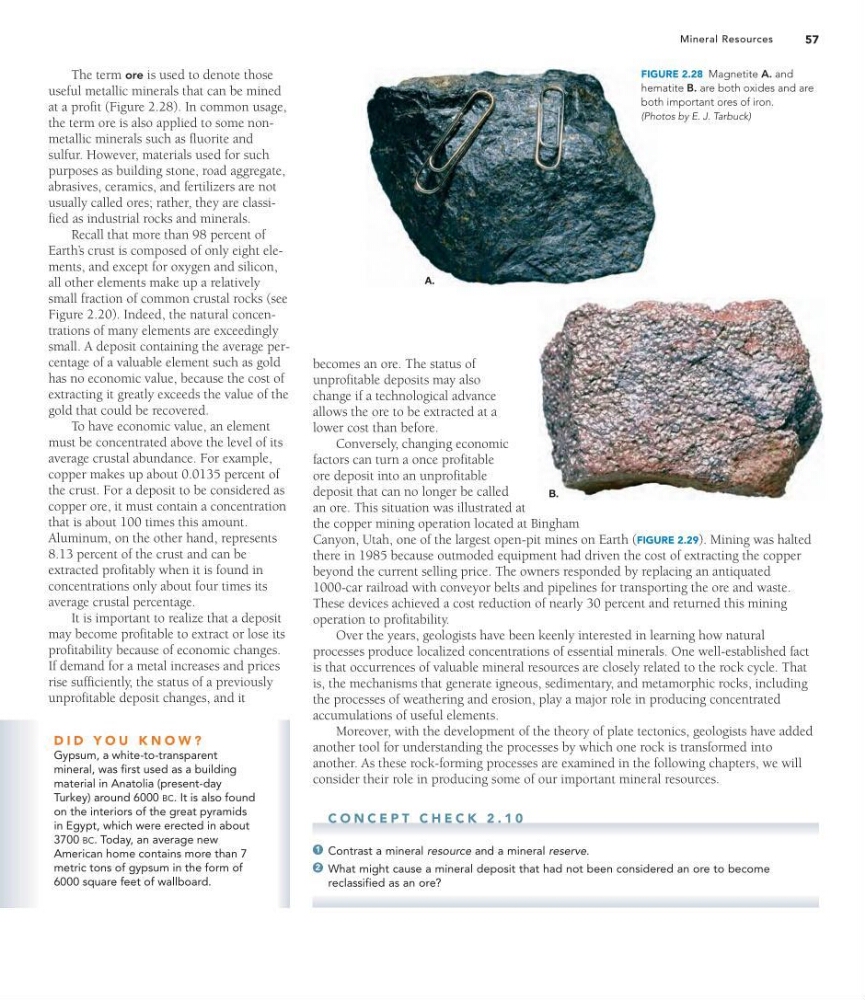
at a profit (Figure 2.28). In common usage,
the term ore is also applied to some nonmetallic minerals such as fluorite and
sulfur. However, materials used for such
purposes as building stone, road aggregate,
abrasives, ceramics, and fertilizers are not
usually called ores; rather, they are classified as industrial rocks and minerals.
Recall that more than 98 percent of
Earth’ s crust is composed of only eight elements, and except for oxygen and silicon,
all other elements make up a relatively
small fraction of common crustal rocks (see
Figure 2.20). Indeed, the natural concentrations of many elements are exceedingly
small. A deposit containing the average percentage of a valuable element such as gold
has no economic value, because the cost of
extracting it greatly exceeds the value of the
gold that could be recovered.
To have economic value, an element
must be concentrated above the level of its
average crustal abundance. For example,
copper makes up about 0.0135 percent of
the crust. For a deposit to be considered as
copper ore, it must contain a concentration
that is about 100 times this amount.
Aluminum, on the other hand, represents
8.13 percent of the crust and can be
extracted profitably when it is found in
concentrations only about four times its
average crustal percentage.
It is important to realize that a deposit
may become profitable to extract or lose its
profitability because of economic changes.
If demand for a metal increases and prices
rise sufficiently, the status of a previously
unprofitable deposit changes, and it
57
Mineral Resources
A.
B.
D I D Y O U K N O W ?
Gypsum, a white-to-transparent
mineral, was first used as a building
material in Anatolia (present-day
Turkey) around 6000 BC. It is also found
on the interiors of the great pyramids
in Egypt, which were erected in about
3700 BC. Today, an average new
American home contains more than 7
metric tons of gypsum in the form of
6000 square feet of wallboard.
becomes an ore. The status of
unprofitable deposits may also
change if a technological advance
allows the ore to be extracted at a
lower cost than before.
Conversely, changing economic
factors can turn a once profitable
ore deposit into an unprofitable
deposit that can no longer be called
an ore. This situation was illustrated at
the copper mining operation located at Bingham
Canyon, Utah, one of the largest open-pit mines on Earth (FIGURE 2.29). Mining was halted
there in 1985 because outmoded equipment had driven the cost of extracting the copper
beyond the current selling price. The owners responded by replacing an antiquated
1000-car railroad with conveyor belts and pipelines for transporting the ore and waste.
These devices achieved a cost reduction of nearly 30 percent and returned this mining
operation to profitability.
Over the years, geologists have been keenly interested in learning how natural
processes produce localized concentrations of essential minerals. One well-established fact
is that occurrences of valuable mineral resources are closely related to the rock cycle. That
is, the mechanisms that generate igneous, sedimentary, and metamorphic rocks, including
the processes of weathering and erosion, play a major role in producing concentrated
accumulations of useful elements.
Moreover, with the development of the theory of plate tectonics, geologists have added
another tool for understanding the processes by which one rock is transformed into
another. As these rock-forming processes are examined in the following chapters, we will
consider their role in producing some of our important mineral resources.
C O N C E P T C H E C K 2 . 1 0
Contrast a mineral resource and a mineral reserve.
What might cause a mineral deposit that had not been considered an ore to become
reclassified as an ore?
2
1
FIGURE 2.28 Magnetite A. and
hematite B. are both oxides and are
both important ores of iron.
(Photos by E. J. Tarbuck)
useful metallic minerals that can be mined
at a profit (Figure 2.28). In common usage,
the term ore is also applied to some nonmetallic minerals such as fluorite and
sulfur. However, materials used for such
purposes as building stone, road aggregate,
abrasives, ceramics, and fertilizers are not
usually called ores; rather, they are classified as industrial rocks and minerals.
Recall that more than 98 percent of
Earth’ s crust is composed of only eight elements, and except for oxygen and silicon,
all other elements make up a relatively
small fraction of common crustal rocks (see
Figure 2.20). Indeed, the natural concentrations of many elements are exceedingly
small. A deposit containing the average percentage of a valuable element such as gold
has no economic value, because the cost of
extracting it greatly exceeds the value of the
gold that could be recovered.
To have economic value, an element
must be concentrated above the level of its
average crustal abundance. For example,
copper makes up about 0.0135 percent of
the crust. For a deposit to be considered as
copper ore, it must contain a concentration
that is about 100 times this amount.
Aluminum, on the other hand, represents
8.13 percent of the crust and can be
extracted profitably when it is found in
concentrations only about four times its
average crustal percentage.
It is important to realize that a deposit
may become profitable to extract or lose its
profitability because of economic changes.
If demand for a metal increases and prices
rise sufficiently, the status of a previously
unprofitable deposit changes, and it
57
Mineral Resources
A.
B.
D I D Y O U K N O W ?
Gypsum, a white-to-transparent
mineral, was first used as a building
material in Anatolia (present-day
Turkey) around 6000 BC. It is also found
on the interiors of the great pyramids
in Egypt, which were erected in about
3700 BC. Today, an average new
American home contains more than 7
metric tons of gypsum in the form of
6000 square feet of wallboard.
becomes an ore. The status of
unprofitable deposits may also
change if a technological advance
allows the ore to be extracted at a
lower cost than before.
Conversely, changing economic
factors can turn a once profitable
ore deposit into an unprofitable
deposit that can no longer be called
an ore. This situation was illustrated at
the copper mining operation located at Bingham
Canyon, Utah, one of the largest open-pit mines on Earth (FIGURE 2.29). Mining was halted
there in 1985 because outmoded equipment had driven the cost of extracting the copper
beyond the current selling price. The owners responded by replacing an antiquated
1000-car railroad with conveyor belts and pipelines for transporting the ore and waste.
These devices achieved a cost reduction of nearly 30 percent and returned this mining
operation to profitability.
Over the years, geologists have been keenly interested in learning how natural
processes produce localized concentrations of essential minerals. One well-established fact
is that occurrences of valuable mineral resources are closely related to the rock cycle. That
is, the mechanisms that generate igneous, sedimentary, and metamorphic rocks, including
the processes of weathering and erosion, play a major role in producing concentrated
accumulations of useful elements.
Moreover, with the development of the theory of plate tectonics, geologists have added
another tool for understanding the processes by which one rock is transformed into
another. As these rock-forming processes are examined in the following chapters, we will
consider their role in producing some of our important mineral resources.
C O N C E P T C H E C K 2 . 1 0
Contrast a mineral resource and a mineral reserve.
What might cause a mineral deposit that had not been considered an ore to become
reclassified as an ore?
2
1
FIGURE 2.28 Magnetite A. and
hematite B. are both oxides and are
both important ores of iron.
(Photos by E. J. Tarbuck)