

CHAPTER 2 Matter and Minerals
56
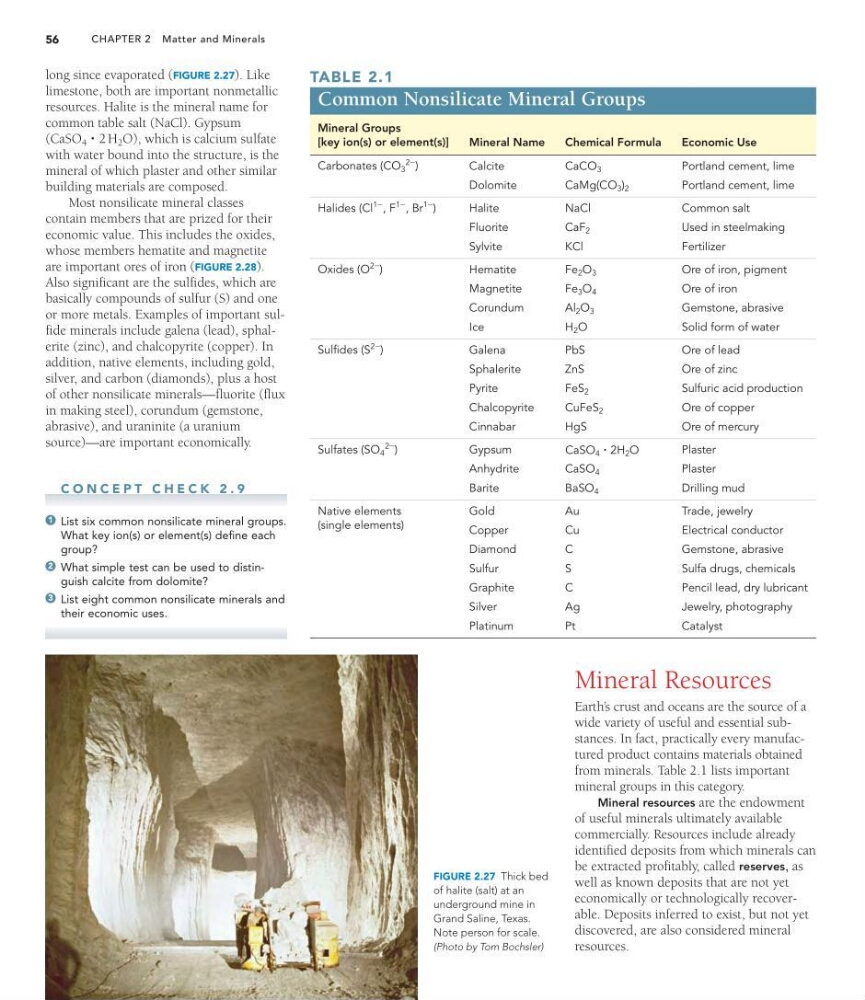
long since evaporated (FIGURE 2.27). Like
limestone, both are important nonmetallic
resources. Halite is the mineral name for
common table salt (NaCl). Gypsum
(
), which is calcium sulfate
with water bound into the structure, is the
mineral of which plaster and other similar
building materials are composed.
Most nonsilicate mineral classes
contain members that are prized for their
economic value. This includes the oxides,
whose members hematite and magnetite
are important ores of iron (FIGURE 2.28).
Also significant are the sulfides, which are
basically compounds of sulfur (S) and one
or more metals. Examples of important sulfide minerals include galena (lead), sphalerite (zinc), and chalcopyrite (copper). In
addition, native elements, including gold,
silver, and carbon (diamonds), plus a host
of other nonsilicate minerals—fluorite (flux
in making steel), corundum (gemstone,
abrasive), and uraninite (a uranium
source)—are important economically.
C O N C E P T C H E C K 2 . 9
List six common nonsilicate mineral groups.
What key ion(s) or element(s) define each
group?
What simple test can be used to distinguish calcite from dolomite?
List eight common nonsilicate minerals and
their economic uses.
3
2
1
CaSO 4 # 2 H 2 O
FIGURE 2.27 Thick bed
of halite (salt) at an
underground mine in
Grand Saline, Texas.
Note person for scale.
(Photo by Tom Bochsler)
TABLE 2.1
Common Nonsilicate Mineral Groups
Mineral Groups
[key ion(s) or element(s)]
Mineral Name
Chemical Formula
Economic Use
Carbonates (
)
CO 3
2Calcite
CaCO 3
Portland cement, lime
Dolomite
CaMg(CO 3 ) 2
Portland cement, lime
Halides (
,
,
)
Br
1F
1Cl
1Halite
NaCl
Common salt
Fluorite
CaF 2
Used in steelmaking
Sylvite
KCl
Fertilizer
Oxides (
)
O
2Hematite
Fe 2 O 3
Ore of iron, pigment
Magnetite
Fe 3 O 4
Ore of iron
Corundum
Al 2 O 3
Gemstone, abrasive
Ice
H 2 O
Solid form of water
Sulfides ( )
S
2Galena
PbS
Ore of lead
Sphalerite
ZnS
Ore of zinc
Pyrite
FeS 2
Sulfuric acid production
Chalcopyrite
CuFeS 2
Ore of copper
Cinnabar
HgS
Ore of mercury
Sulfates (
)
SO 4
2Gypsum
CaSO 4 # 2H 2 O
Plaster
Anhydrite
CaSO 4
Plaster
Barite
BaSO 4
Drilling mud
Native elements
(single elements)
Gold
Au
Trade, jewelry
Copper
Cu
Electrical conductor
Diamond
C
Gemstone, abrasive
Sulfur
S
Sulfa drugs, chemicals
Graphite
C
Pencil lead, dry lubricant
Silver
Ag
Jewelry, photography
Platinum
Pt
Catalyst
Mineral Resources
Earth’ s crust and oceans are the source of a
wide variety of useful and essential substances. In fact, practically every manufactured product contains materials obtained
from minerals. Table 2.1 lists important
mineral groups in this category.
Mineral resources are the endowment
of useful minerals ultimately available
commercially. Resources include already
identified deposits from which minerals can
be extracted profitably, called reserves, as
well as known deposits that are not yet
economically or technologically recoverable. Deposits inferred to exist, but not yet
discovered, are also considered mineral
resources.
56
long since evaporated (FIGURE 2.27). Like
limestone, both are important nonmetallic
resources. Halite is the mineral name for
common table salt (NaCl). Gypsum
(
), which is calcium sulfate
with water bound into the structure, is the
mineral of which plaster and other similar
building materials are composed.
Most nonsilicate mineral classes
contain members that are prized for their
economic value. This includes the oxides,
whose members hematite and magnetite
are important ores of iron (FIGURE 2.28).
Also significant are the sulfides, which are
basically compounds of sulfur (S) and one
or more metals. Examples of important sulfide minerals include galena (lead), sphalerite (zinc), and chalcopyrite (copper). In
addition, native elements, including gold,
silver, and carbon (diamonds), plus a host
of other nonsilicate minerals—fluorite (flux
in making steel), corundum (gemstone,
abrasive), and uraninite (a uranium
source)—are important economically.
C O N C E P T C H E C K 2 . 9
List six common nonsilicate mineral groups.
What key ion(s) or element(s) define each
group?
What simple test can be used to distinguish calcite from dolomite?
List eight common nonsilicate minerals and
their economic uses.
3
2
1
CaSO 4 # 2 H 2 O
FIGURE 2.27 Thick bed
of halite (salt) at an
underground mine in
Grand Saline, Texas.
Note person for scale.
(Photo by Tom Bochsler)
TABLE 2.1
Common Nonsilicate Mineral Groups
Mineral Groups
[key ion(s) or element(s)]
Mineral Name
Chemical Formula
Economic Use
Carbonates (
)
CO 3
2Calcite
CaCO 3
Portland cement, lime
Dolomite
CaMg(CO 3 ) 2
Portland cement, lime
Halides (
,
,
)
Br
1F
1Cl
1Halite
NaCl
Common salt
Fluorite
CaF 2
Used in steelmaking
Sylvite
KCl
Fertilizer
Oxides (
)
O
2Hematite
Fe 2 O 3
Ore of iron, pigment
Magnetite
Fe 3 O 4
Ore of iron
Corundum
Al 2 O 3
Gemstone, abrasive
Ice
H 2 O
Solid form of water
Sulfides ( )
S
2Galena
PbS
Ore of lead
Sphalerite
ZnS
Ore of zinc
Pyrite
FeS 2
Sulfuric acid production
Chalcopyrite
CuFeS 2
Ore of copper
Cinnabar
HgS
Ore of mercury
Sulfates (
)
SO 4
2Gypsum
CaSO 4 # 2H 2 O
Plaster
Anhydrite
CaSO 4
Plaster
Barite
BaSO 4
Drilling mud
Native elements
(single elements)
Gold
Au
Trade, jewelry
Copper
Cu
Electrical conductor
Diamond
C
Gemstone, abrasive
Sulfur
S
Sulfa drugs, chemicals
Graphite
C
Pencil lead, dry lubricant
Silver
Ag
Jewelry, photography
Platinum
Pt
Catalyst
Mineral Resources
Earth’ s crust and oceans are the source of a
wide variety of useful and essential substances. In fact, practically every manufactured product contains materials obtained
from minerals. Table 2.1 lists important
mineral groups in this category.
Mineral resources are the endowment
of useful minerals ultimately available
commercially. Resources include already
identified deposits from which minerals can
be extracted profitably, called reserves, as
well as known deposits that are not yet
economically or technologically recoverable. Deposits inferred to exist, but not yet
discovered, are also considered mineral
resources.