

CHAPTER 2 Matter and Minerals
54
color and has a pearly luster (see Figure 2.15). Like other micas, muscovite has excellent
cleavage in one direction. In thin sheets, muscovite is clear, a property that accounts for its
use as window “glass” during the Middle Ages. Because muscovite is very shiny, it can
often be identified by the sparkle it gives a rock. If you have ever looked closely at beach
sand, you may have seen the glimmering brilliance of the mica flakes scattered among the
other sand grains.
D I D Y O U K N O W ?
Although wood pulp is the main
ingredient for making newsprint, many
higher grades of paper contain large
quantities of clay minerals. In fact, each
page of this textbook consists of about
25 percent clay (the mineral kaolinite).
If all the clay in this book rolled into a
ball, it would be slightly smaller than a
tennis ball.
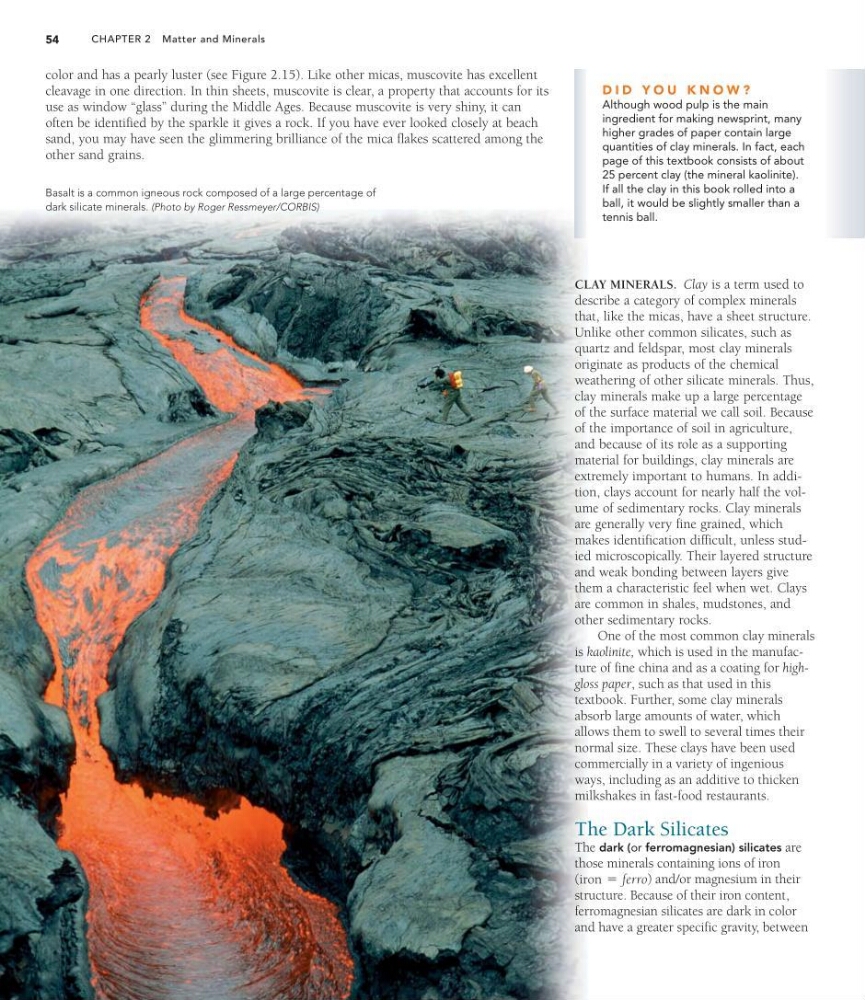
Basalt is a common igneous rock composed of a large percentage of
dark silicate minerals. (Photo by Roger Ressmeyer/CORBIS)
CLAY MINERALS. Clay is a term used to
describe a category of complex minerals
that, like the micas, have a sheet structure.
Unlike other common silicates, such as
quartz and feldspar, most clay minerals
originate as products of the chemical
weathering of other silicate minerals. Thus,
clay minerals make up a large percentage
of the surface material we call soil. Because
of the importance of soil in agriculture,
and because of its role as a supporting
material for buildings, clay minerals are
extremely important to humans. In addition, clays account for nearly half the volume of sedimentary rocks. Clay minerals
are generally very fine grained, which
makes identification difficult, unless studied microscopically. Their layered structure
and weak bonding between layers give
them a characteristic feel when wet. Clays
are common in shales, mudstones, and
other sedimentary rocks.
One of the most common clay minerals
is kaolinite, which is used in the manufacture of fine china and as a coating for highgloss paper, such as that used in this
textbook. Further, some clay minerals
absorb large amounts of water, which
allows them to swell to several times their
normal size. These clays have been used
commercially in a variety of ingenious
ways, including as an additive to thicken
milkshakes in fast-food restaurants.
The Dark Silicates
The dark (or ferromagnesian) silicates are
those minerals containing ions of iron
(
) and/or magnesium in their
structure. Because of their iron content,
ferromagnesian silicates are dark in color
and have a greater specific gravity, between
iron = ferro
54
color and has a pearly luster (see Figure 2.15). Like other micas, muscovite has excellent
cleavage in one direction. In thin sheets, muscovite is clear, a property that accounts for its
use as window “glass” during the Middle Ages. Because muscovite is very shiny, it can
often be identified by the sparkle it gives a rock. If you have ever looked closely at beach
sand, you may have seen the glimmering brilliance of the mica flakes scattered among the
other sand grains.
D I D Y O U K N O W ?
Although wood pulp is the main
ingredient for making newsprint, many
higher grades of paper contain large
quantities of clay minerals. In fact, each
page of this textbook consists of about
25 percent clay (the mineral kaolinite).
If all the clay in this book rolled into a
ball, it would be slightly smaller than a
tennis ball.
Basalt is a common igneous rock composed of a large percentage of
dark silicate minerals. (Photo by Roger Ressmeyer/CORBIS)
CLAY MINERALS. Clay is a term used to
describe a category of complex minerals
that, like the micas, have a sheet structure.
Unlike other common silicates, such as
quartz and feldspar, most clay minerals
originate as products of the chemical
weathering of other silicate minerals. Thus,
clay minerals make up a large percentage
of the surface material we call soil. Because
of the importance of soil in agriculture,
and because of its role as a supporting
material for buildings, clay minerals are
extremely important to humans. In addition, clays account for nearly half the volume of sedimentary rocks. Clay minerals
are generally very fine grained, which
makes identification difficult, unless studied microscopically. Their layered structure
and weak bonding between layers give
them a characteristic feel when wet. Clays
are common in shales, mudstones, and
other sedimentary rocks.
One of the most common clay minerals
is kaolinite, which is used in the manufacture of fine china and as a coating for highgloss paper, such as that used in this
textbook. Further, some clay minerals
absorb large amounts of water, which
allows them to swell to several times their
normal size. These clays have been used
commercially in a variety of ingenious
ways, including as an additive to thicken
milkshakes in fast-food restaurants.
The Dark Silicates
The dark (or ferromagnesian) silicates are
those minerals containing ions of iron
(
) and/or magnesium in their
structure. Because of their iron content,
ferromagnesian silicates are dark in color
and have a greater specific gravity, between
iron = ferro