

53
Common Silicate Minerals
minerals are produced. For example, the
silicate mineral olivine crystallizes at high
temperatures, whereas quartz crystallizes at
much lower temperatures.
In addition, some silicate minerals
form at Earth’ s surface from the weathered
products of other silicate minerals. Still
others are formed under the extreme
pressures associated with mountain building. Each silicate mineral, therefore, has a
structure and a chemical composition that
indicate the conditions under which it formed.
By carefully examining the mineral constituents of rocks, geologists can usually
determine the circumstances under which
the rocks formed.
We will now examine some of the most
common silicate minerals, which we divide
into two major groups on the basis of their
chemical makeup.
The Light Silicates
The light (or nonferromagnesian) silicates
are generally light in color and have a specific gravity of about 2.7, which is considerably less than the dark (ferromagnesian)
silicates. These differences are mainly
attributable to the presence or absence of
iron and magnesium. The light silicates
contain varying amounts of aluminum,
potassium, calcium, and sodium rather than
iron and magnesium.
FELDSPAR GROUP. Feldspar, the most
common mineral group, can form under a
wide range of temperatures and pressures,
which partially accounts for its abundance
(FIGURE 2.25). All feldspars have similar
physical properties. They have two planes
of cleavage meeting at or near 90-degree
angles, are relatively hard (6 on the Mohs
scale), and have a luster that ranges from
D I D Y O U K N O W ?
Most “scoopable” kitty litters sold on
the market today contain a naturally
occurring material called bentonite.
Bentonite is largely composed of
highly absorbent clay minerals that
swell and clump up in the presence of
moisture. This allows kitty waste to be
isolated and scooped out, leaving
behind clean litter.
Plagioclase
feldspars
39%
Potassium
feldspars
12%
Quartz
12%
Pyroxenes
11%
Amphiboles
5%
Micas
5%
Clays
5%
Other silicates
3%
Nonsilicates
8%
glassy to pearly. As one component in a rock, feldspar crystals
can be identified by their rectangular shape and rather smooth
shiny faces (see Figure 2.24).
Two different feldspar structures exist. One group of feldspar
minerals contains potassium ions
in its structure and is therefore
referred to as potassium feldspar.
(Orthoclase and microcline are common
members of the potassium feldspar group.) The
other group, called plagioclase feldspar, contains both
sodium and calcium ions that freely substitute for
one another depending on the environment during
crystalization.
Potassium feldspar is usually light cream,
salmon pink, or occasionally bluish-green in color.
The plagioclase feldspars, on the other hand, range
in color from white to medium gray. However, color
should not be used to distinguish these groups. The
only way to distinguish the feldspars physically is to
look for a multitude of fine parallel lines, called striations. Striations are found on some
cleavage planes of plagioclase feldspar but are not present on potassium feldspar
(FIGURE 2.26).
QUARTZ. Quartz is the only common silicate mineral consisting entirely of silicon and
oxygen. As such, the term silica is applied to quartz, which has the chemical formula SiO 2 .
Because the structure of quartz contains a ratio of two oxygen ions (
) for every silicon
ion (
), no other positive ions are needed to attain neutrality.
In quartz, a three-dimensional framework is developed through the complete sharing
of oxygen by adjacent silicon atoms. Thus, all of the bonds in quartz are of the strong
silicon–oxygen type. Consequently, quartz is hard, resistant to weathering, and does not have cleavage. When
broken, quartz generally exhibits conchoidal fracture (see
Figure 2.17). When pure, quartz is clear and, if allowed to
grow without interference, will develop hexagonal crystals
that develop pyramid-shaped ends. However, like most
other clear minerals, quartz is often
colored by inclusions of various
ions (impurities) and forms
without developing good crystal
faces. The most common
varieties of quartz are milky
(white), smoky (gray), rose
(pink), amethyst (purple),
and rock crystal (clear) (see
Figure 2.10).
MUSCOVITE. Muscovite is
a common member of the
mica family. It is light in
Si
4+
O
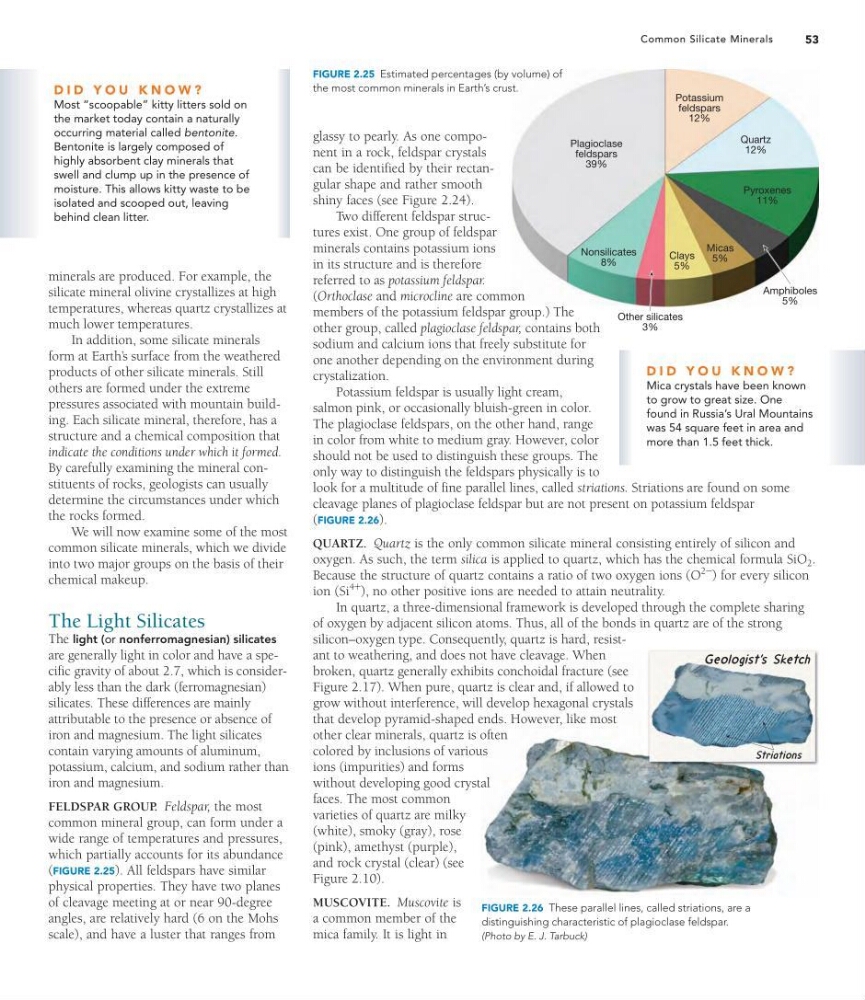
2FIGURE 2.25 Estimated percentages (by volume) of
the most common minerals in Earth’s crust.
D I D Y O U K N O W ?
Mica crystals have been known
to grow to great size. One
found in Russia’s Ural Mountains
was 54 square feet in area and
more than 1.5 feet thick.
FIGURE 2.26 These parallel lines, called striations, are a
distinguishing characteristic of plagioclase feldspar.
(Photo by E. J. Tarbuck)
Common Silicate Minerals
minerals are produced. For example, the
silicate mineral olivine crystallizes at high
temperatures, whereas quartz crystallizes at
much lower temperatures.
In addition, some silicate minerals
form at Earth’ s surface from the weathered
products of other silicate minerals. Still
others are formed under the extreme
pressures associated with mountain building. Each silicate mineral, therefore, has a
structure and a chemical composition that
indicate the conditions under which it formed.
By carefully examining the mineral constituents of rocks, geologists can usually
determine the circumstances under which
the rocks formed.
We will now examine some of the most
common silicate minerals, which we divide
into two major groups on the basis of their
chemical makeup.
The Light Silicates
The light (or nonferromagnesian) silicates
are generally light in color and have a specific gravity of about 2.7, which is considerably less than the dark (ferromagnesian)
silicates. These differences are mainly
attributable to the presence or absence of
iron and magnesium. The light silicates
contain varying amounts of aluminum,
potassium, calcium, and sodium rather than
iron and magnesium.
FELDSPAR GROUP. Feldspar, the most
common mineral group, can form under a
wide range of temperatures and pressures,
which partially accounts for its abundance
(FIGURE 2.25). All feldspars have similar
physical properties. They have two planes
of cleavage meeting at or near 90-degree
angles, are relatively hard (6 on the Mohs
scale), and have a luster that ranges from
D I D Y O U K N O W ?
Most “scoopable” kitty litters sold on
the market today contain a naturally
occurring material called bentonite.
Bentonite is largely composed of
highly absorbent clay minerals that
swell and clump up in the presence of
moisture. This allows kitty waste to be
isolated and scooped out, leaving
behind clean litter.
Plagioclase
feldspars
39%
Potassium
feldspars
12%
Quartz
12%
Pyroxenes
11%
Amphiboles
5%
Micas
5%
Clays
5%
Other silicates
3%
Nonsilicates
8%
glassy to pearly. As one component in a rock, feldspar crystals
can be identified by their rectangular shape and rather smooth
shiny faces (see Figure 2.24).
Two different feldspar structures exist. One group of feldspar
minerals contains potassium ions
in its structure and is therefore
referred to as potassium feldspar.
(Orthoclase and microcline are common
members of the potassium feldspar group.) The
other group, called plagioclase feldspar, contains both
sodium and calcium ions that freely substitute for
one another depending on the environment during
crystalization.
Potassium feldspar is usually light cream,
salmon pink, or occasionally bluish-green in color.
The plagioclase feldspars, on the other hand, range
in color from white to medium gray. However, color
should not be used to distinguish these groups. The
only way to distinguish the feldspars physically is to
look for a multitude of fine parallel lines, called striations. Striations are found on some
cleavage planes of plagioclase feldspar but are not present on potassium feldspar
(FIGURE 2.26).
QUARTZ. Quartz is the only common silicate mineral consisting entirely of silicon and
oxygen. As such, the term silica is applied to quartz, which has the chemical formula SiO 2 .
Because the structure of quartz contains a ratio of two oxygen ions (
) for every silicon
ion (
), no other positive ions are needed to attain neutrality.
In quartz, a three-dimensional framework is developed through the complete sharing
of oxygen by adjacent silicon atoms. Thus, all of the bonds in quartz are of the strong
silicon–oxygen type. Consequently, quartz is hard, resistant to weathering, and does not have cleavage. When
broken, quartz generally exhibits conchoidal fracture (see
Figure 2.17). When pure, quartz is clear and, if allowed to
grow without interference, will develop hexagonal crystals
that develop pyramid-shaped ends. However, like most
other clear minerals, quartz is often
colored by inclusions of various
ions (impurities) and forms
without developing good crystal
faces. The most common
varieties of quartz are milky
(white), smoky (gray), rose
(pink), amethyst (purple),
and rock crystal (clear) (see
Figure 2.10).
MUSCOVITE. Muscovite is
a common member of the
mica family. It is light in
Si
4+
O
2FIGURE 2.25 Estimated percentages (by volume) of
the most common minerals in Earth’s crust.
D I D Y O U K N O W ?
Mica crystals have been known
to grow to great size. One
found in Russia’s Ural Mountains
was 54 square feet in area and
more than 1.5 feet thick.
FIGURE 2.26 These parallel lines, called striations, are a
distinguishing characteristic of plagioclase feldspar.
(Photo by E. J. Tarbuck)