

CHAPTER 1 An Introduction to Geology
30
▲ ▲ ▲
▲ ▲ ▲ ▲ ▲
▲ ▲ ▲
▲
▲
▲
▲ ▲
▲ ▲ ▲ ▲
▲ ▲
▲ ▲
▲
▲
▲
▲ ▲
▲
▲
▲
▲ ▲
▲
▲
▲
▲
▲
▲
▲ ▲
▲
▲
▲
▲
▲
▲
▲
▲
▲
▲
▲
▲ ▲
▲
▲
▲
▲
▲
▲
▲
▲
▲
▲
▲ ▲
▲ ▲
▲
▲
▲
▲
▲
▲
▲
North American
plate
Juan de Fuca
plate
Pacific plate
Nazca
plate
Cocos
plate
Antarctic plate
Scotia plate
South American
plate
Caribbean
plate
Eurasian plate
African plate
M id
- A t la n t ic R id g e
Ea st P a c if ic
R i s e
Arabian
plate
Asthenosphere
Oceanic
lithosphere
Melting
Oceanic
crust
Trench
Continental
lithosphere
Continental
volcanic arc
Subductin g o c e a n ic li t h o s p h e r e
East
African
Rift
Sou thw es t I n d ia n
R id g e
E m p e ro r- H a w a ii a n
C h a in
Kermadec
Arc
Tonga
Arc
Aleutian Arc
A n
d e s M o u
n ta ins
R o c k y M
o
u n t a in s
A p p a la c h ia n
M
t s .
A lp s
Canadian Shield
Basin
and
Range
San Andreas
Fault
Galapagos
Ridge
Chile Ridge
Antilles
Arc
Iceland
▲ ▲
B. Convergent boundary
A. Divergent boundary
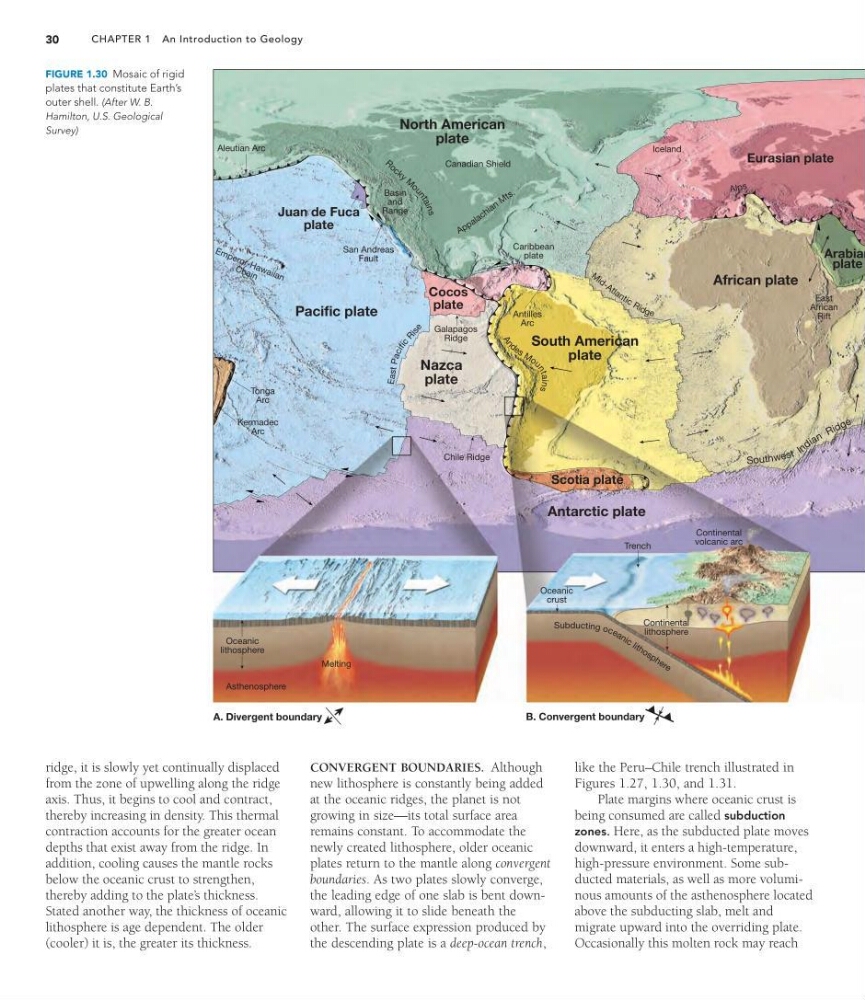
FIGURE 1.30 Mosaic of rigid
plates that constitute Earth’s
outer shell. (After W. B.
Hamilton, U.S. Geological
Survey)
ridge, it is slowly yet continually displaced
from the zone of upwelling along the ridge
axis. Thus, it begins to cool and contract,
thereby increasing in density. This thermal
contraction accounts for the greater ocean
depths that exist away from the ridge. In
addition, cooling causes the mantle rocks
below the oceanic crust to strengthen,
thereby adding to the plate’ s thickness.
Stated another way, the thickness of oceanic
lithosphere is age dependent. The older
(cooler) it is, the greater its thickness.
like the Peru–Chile trench illustrated in
Figures 1.27, 1.30, and 1.31.
Plate margins where oceanic crust is
being consumed are called subduction
zones. Here, as the subducted plate moves
downward, it enters a high-temperature,
high-pressure environment. Some subducted materials, as well as more voluminous amounts of the asthenosphere located
above the subducting slab, melt and
migrate upward into the overriding plate.
Occasionally this molten rock may reach
CONVERGENT BOUNDARIES. Although
new lithosphere is constantly being added
at the oceanic ridges, the planet is not
growing in size—its total surface area
remains constant. To accommodate the
newly created lithosphere, older oceanic
plates return to the mantle along convergent
boundaries. As two plates slowly converge,
the leading edge of one slab is bent downward, allowing it to slide beneath the
other. The surface expression produced by
the descending plate is a deep-ocean trench,
30
▲ ▲ ▲
▲ ▲ ▲ ▲ ▲
▲ ▲ ▲
▲
▲
▲
▲ ▲
▲ ▲ ▲ ▲
▲ ▲
▲ ▲
▲
▲
▲
▲ ▲
▲
▲
▲
▲ ▲
▲
▲
▲
▲
▲
▲
▲ ▲
▲
▲
▲
▲
▲
▲
▲
▲
▲
▲
▲
▲ ▲
▲
▲
▲
▲
▲
▲
▲
▲
▲
▲
▲ ▲
▲ ▲
▲
▲
▲
▲
▲
▲
▲
North American
plate
Juan de Fuca
plate
Pacific plate
Nazca
plate
Cocos
plate
Antarctic plate
Scotia plate
South American
plate
Caribbean
plate
Eurasian plate
African plate
M id
- A t la n t ic R id g e
Ea st P a c if ic
R i s e
Arabian
plate
Asthenosphere
Oceanic
lithosphere
Melting
Oceanic
crust
Trench
Continental
lithosphere
Continental
volcanic arc
Subductin g o c e a n ic li t h o s p h e r e
East
African
Rift
Sou thw es t I n d ia n
R id g e
E m p e ro r- H a w a ii a n
C h a in
Kermadec
Arc
Tonga
Arc
Aleutian Arc
A n
d e s M o u
n ta ins
R o c k y M
o
u n t a in s
A p p a la c h ia n
M
t s .
A lp s
Canadian Shield
Basin
and
Range
San Andreas
Fault
Galapagos
Ridge
Chile Ridge
Antilles
Arc
Iceland
▲ ▲
B. Convergent boundary
A. Divergent boundary
FIGURE 1.30 Mosaic of rigid
plates that constitute Earth’s
outer shell. (After W. B.
Hamilton, U.S. Geological
Survey)
ridge, it is slowly yet continually displaced
from the zone of upwelling along the ridge
axis. Thus, it begins to cool and contract,
thereby increasing in density. This thermal
contraction accounts for the greater ocean
depths that exist away from the ridge. In
addition, cooling causes the mantle rocks
below the oceanic crust to strengthen,
thereby adding to the plate’ s thickness.
Stated another way, the thickness of oceanic
lithosphere is age dependent. The older
(cooler) it is, the greater its thickness.
like the Peru–Chile trench illustrated in
Figures 1.27, 1.30, and 1.31.
Plate margins where oceanic crust is
being consumed are called subduction
zones. Here, as the subducted plate moves
downward, it enters a high-temperature,
high-pressure environment. Some subducted materials, as well as more voluminous amounts of the asthenosphere located
above the subducting slab, melt and
migrate upward into the overriding plate.
Occasionally this molten rock may reach
CONVERGENT BOUNDARIES. Although
new lithosphere is constantly being added
at the oceanic ridges, the planet is not
growing in size—its total surface area
remains constant. To accommodate the
newly created lithosphere, older oceanic
plates return to the mantle along convergent
boundaries. As two plates slowly converge,
the leading edge of one slab is bent downward, allowing it to slide beneath the
other. The surface expression produced by
the descending plate is a deep-ocean trench,