

CHAPTER 1 An Introduction to Geology
28
geologic past and will continue to shape it
in the future.
C O N C E P T C H E C K 1 . 1 1
Describe the general distribution of Earth’s
youngest mountains.
What is the difference between shields and
stable platforms?
What are the three major regions of the
ocean floor and some features associated
with each?
Dynamic Earth
Plate Tectonics:
Introduction
Earth is a dynamic planet! If we could go
back in time a few hundred million years,
we would find the face of our planet dramatically different from what we see today.
There would be no Mount St. Helens,
GEODe
ESSENTIALS
OF GEOLOGY
3
2
1
Rocky Mountains, or Gulf of Mexico.
Moreover, we would find continents having
different sizes and shapes and located in
different positions than today’ s landmasses.
By contrast, over the past few billion years
the Moon’ s surface has remained essentially
unchanged—only a few craters have been
added.
A Brief Introduction to the
Theory of Plate Tectonics
During the past several decades a great deal
has been learned about the workings of our
dynamic planet. This span has seen an
unequaled revolution in our understanding
of Earth. The revolution had its beginnings
in the early part of the 20th century with
the radical proposal of continental drift—the
idea that continents move about the face of
the planet. This proposal contradicted the
long established view that continents and
ocean basins are permanent and stationary
features on the face of Earth. For that
reason, the notion of drifting continents
was received with great skepticism and
even ridicule. More than 50 years passed
before enough data were gathered to transform this controversial hypothesis into a
sound theory that wove together the basic
processes known to operate on Earth. The
theory that finally emerged, called the
theory of plate tectonics, provided geologists with the first comprehensive model of
Earth’ s internal workings.
This section serves as a brief introduction to plate tectonics. It provides background and perspective that will be helpful
in some upcoming discussions, especially
those dealing with volcanoes and igneous
activity (Chapter 4) and metamorphic rocks
(Chapter 7). Later Chapter 15, “Plate
Tectonics: A Scientific Revolution Unfolds,”
explores the theory in detail.
According to the plate tectonics model,
Earth’ s rigid outer shell (lithosphere) is broken into numerous slabs called lithospheric
plates or simply plates, which are in
Hi malaya Mo un ta in s
Hi malaya Mo un ta in s
Canadian
shield
Greenland
shield
Brazilian
shield
African
shield
Indian
shield
Alps
Baltic
shield
Australian
shield
Key
Canadian shield
Himalaya Mts.
Appalachian Mts.
Shields
N .A
.
C
o
r
d
il
le
ra
A
n
d
e
s
M
ou
ntains
A p p a la c h ia n s
C a
ld
e d o n ia n B el t
D iv id in g Ra
n
g
e
Ur als
Gre at
Orinoco
shield
Angara
shield
Stable platforms (shields
covered by sedimentary rock)
Young mountain belts (less
than 100 million years old)
Old mountain belts
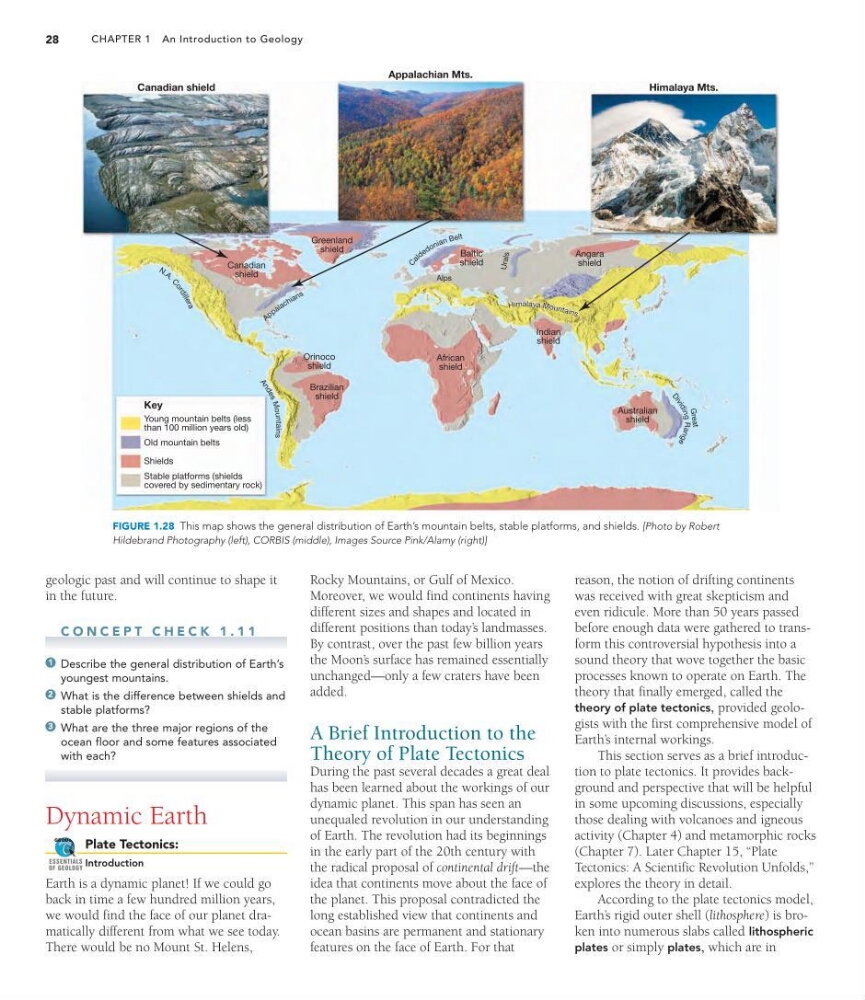
FIGURE 1.28 This map shows the general distribution of Earth’s mountain belts, stable platforms, and shields. [Photo by Robert
Hildebrand Photography (left), CORBIS (middle), Images Source Pink/Alamy (right)]
28
geologic past and will continue to shape it
in the future.
C O N C E P T C H E C K 1 . 1 1
Describe the general distribution of Earth’s
youngest mountains.
What is the difference between shields and
stable platforms?
What are the three major regions of the
ocean floor and some features associated
with each?
Dynamic Earth
Plate Tectonics:
Introduction
Earth is a dynamic planet! If we could go
back in time a few hundred million years,
we would find the face of our planet dramatically different from what we see today.
There would be no Mount St. Helens,
GEODe
ESSENTIALS
OF GEOLOGY
3
2
1
Rocky Mountains, or Gulf of Mexico.
Moreover, we would find continents having
different sizes and shapes and located in
different positions than today’ s landmasses.
By contrast, over the past few billion years
the Moon’ s surface has remained essentially
unchanged—only a few craters have been
added.
A Brief Introduction to the
Theory of Plate Tectonics
During the past several decades a great deal
has been learned about the workings of our
dynamic planet. This span has seen an
unequaled revolution in our understanding
of Earth. The revolution had its beginnings
in the early part of the 20th century with
the radical proposal of continental drift—the
idea that continents move about the face of
the planet. This proposal contradicted the
long established view that continents and
ocean basins are permanent and stationary
features on the face of Earth. For that
reason, the notion of drifting continents
was received with great skepticism and
even ridicule. More than 50 years passed
before enough data were gathered to transform this controversial hypothesis into a
sound theory that wove together the basic
processes known to operate on Earth. The
theory that finally emerged, called the
theory of plate tectonics, provided geologists with the first comprehensive model of
Earth’ s internal workings.
This section serves as a brief introduction to plate tectonics. It provides background and perspective that will be helpful
in some upcoming discussions, especially
those dealing with volcanoes and igneous
activity (Chapter 4) and metamorphic rocks
(Chapter 7). Later Chapter 15, “Plate
Tectonics: A Scientific Revolution Unfolds,”
explores the theory in detail.
According to the plate tectonics model,
Earth’ s rigid outer shell (lithosphere) is broken into numerous slabs called lithospheric
plates or simply plates, which are in
Hi malaya Mo un ta in s
Hi malaya Mo un ta in s
Canadian
shield
Greenland
shield
Brazilian
shield
African
shield
Indian
shield
Alps
Baltic
shield
Australian
shield
Key
Canadian shield
Himalaya Mts.
Appalachian Mts.
Shields
N .A
.
C
o
r
d
il
le
ra
A
n
d
e
s
M
ou
ntains
A p p a la c h ia n s
C a
ld
e d o n ia n B el t
D iv id in g Ra
n
g
e
Ur als
Gre at
Orinoco
shield
Angara
shield
Stable platforms (shields
covered by sedimentary rock)
Young mountain belts (less
than 100 million years old)
Old mountain belts
FIGURE 1.28 This map shows the general distribution of Earth’s mountain belts, stable platforms, and shields. [Photo by Robert
Hildebrand Photography (left), CORBIS (middle), Images Source Pink/Alamy (right)]