

479
Paleozoic Era: Life Explodes
During much of the Precambrian, life
consisted exclusively of single-celled
organisms. It wasn’t until perhaps 1.5 billion years ago that multicelled eukaryotes
evolved. Green algae, one of the first
multicelled organisms, contained
chloroplasts (used in photosynthesis) and
were the ancestors of modern plants. The
first primitive marine animals did not
appear until somewhat later, perhaps 600
million years ago (FIGURE 19.23).
Fossil evidence suggests that organic
evolution progressed at an excruciatingly
slow pace until the end of the Precambrian.
At this time, Earth’ s continents were barren,
and the oceans were populated primarily
by organisms too small to be seen with the
naked eye. Nevertheless, the stage was set
for the evolution of larger and more
complex plants and animals.
C O N C E P T C H E C K 1 9 . 6
Why do some researchers think that asteroids, or carbonaceous chrondrites, played
an important role in the development of
life on Earth?
Compare prokaryotes with eukaryotes.
Within which of these two groups do all
multicelled organisms belong?
Paleozoic Era:
Life Explodes
The Cambrian period marks the
beginning of the Paleozoic era, a time span
that saw the emergence of a spectacular
variety of new life-forms. All major
invertebrate (animals lacking backbones)
groups made their appearance, including
jellyfish, sponges, worms, mollusks (clams
2
1
A.
B.
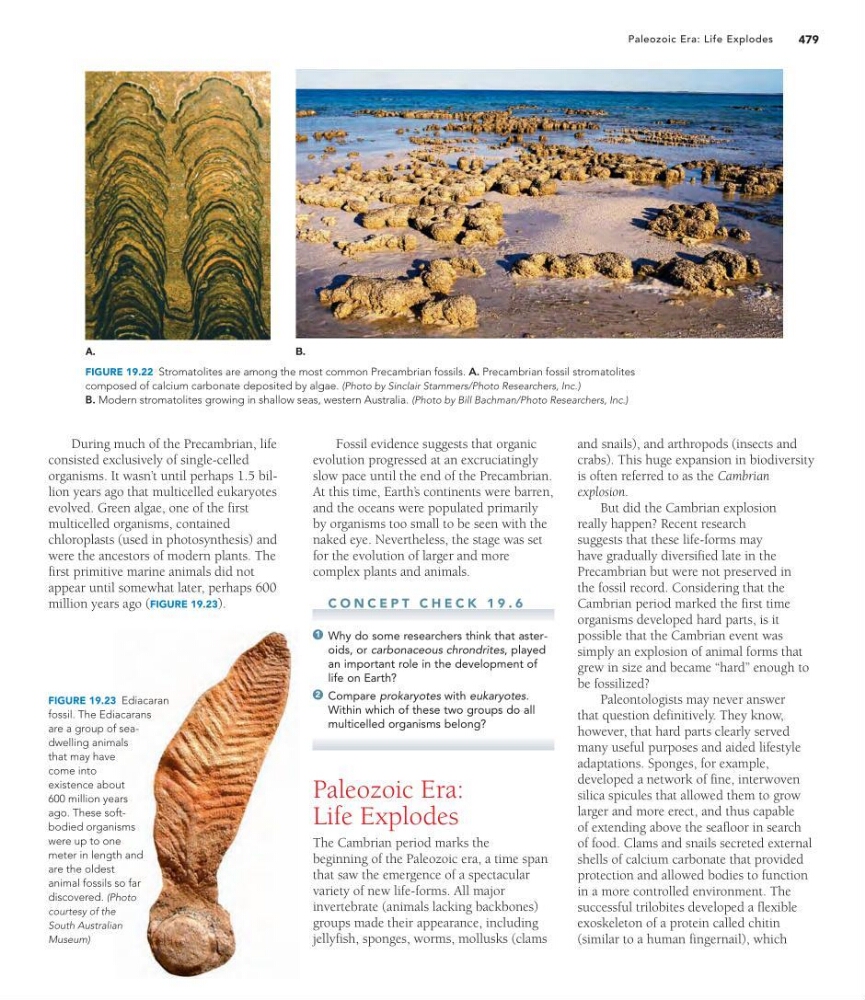
FIGURE 19.22 Stromatolites are among the most common Precambrian fossils. A. Precambrian fossil stromatolites
composed of calcium carbonate deposited by algae. (Photo by Sinclair Stammers/Photo Researchers, Inc.)
B. Modern stromatolites growing in shallow seas, western Australia. (Photo by Bill Bachman/Photo Researchers, Inc.)
FIGURE 19.23 Ediacaran
fossil. The Ediacarans
are a group of seadwelling animals
that may have
come into
existence about
600 million years
ago. These softbodied organisms
were up to one
meter in length and
are the oldest
animal fossils so far
discovered. (Photo
courtesy of the
South Australian
Museum)
and snails), and arthropods (insects and
crabs). This huge expansion in biodiversity
is often referred to as the Cambrian
explosion.
But did the Cambrian explosion
really happen? Recent research
suggests that these life-forms may
have gradually diversified late in the
Precambrian but were not preserved in
the fossil record. Considering that the
Cambrian period marked the first time
organisms developed hard parts, is it
possible that the Cambrian event was
simply an explosion of animal forms that
grew in size and became “hard” enough to
be fossilized?
Paleontologists may never answer
that question definitively. They know,
however, that hard parts clearly served
many useful purposes and aided lifestyle
adaptations. Sponges, for example,
developed a network of fine, interwoven
silica spicules that allowed them to grow
larger and more erect, and thus capable
of extending above the seafloor in search
of food. Clams and snails secreted external
shells of calcium carbonate that provided
protection and allowed bodies to function
in a more controlled environment. The
successful trilobites developed a flexible
exoskeleton of a protein called chitin
(similar to a human fingernail), which
Paleozoic Era: Life Explodes
During much of the Precambrian, life
consisted exclusively of single-celled
organisms. It wasn’t until perhaps 1.5 billion years ago that multicelled eukaryotes
evolved. Green algae, one of the first
multicelled organisms, contained
chloroplasts (used in photosynthesis) and
were the ancestors of modern plants. The
first primitive marine animals did not
appear until somewhat later, perhaps 600
million years ago (FIGURE 19.23).
Fossil evidence suggests that organic
evolution progressed at an excruciatingly
slow pace until the end of the Precambrian.
At this time, Earth’ s continents were barren,
and the oceans were populated primarily
by organisms too small to be seen with the
naked eye. Nevertheless, the stage was set
for the evolution of larger and more
complex plants and animals.
C O N C E P T C H E C K 1 9 . 6
Why do some researchers think that asteroids, or carbonaceous chrondrites, played
an important role in the development of
life on Earth?
Compare prokaryotes with eukaryotes.
Within which of these two groups do all
multicelled organisms belong?
Paleozoic Era:
Life Explodes
The Cambrian period marks the
beginning of the Paleozoic era, a time span
that saw the emergence of a spectacular
variety of new life-forms. All major
invertebrate (animals lacking backbones)
groups made their appearance, including
jellyfish, sponges, worms, mollusks (clams
2
1
A.
B.
FIGURE 19.22 Stromatolites are among the most common Precambrian fossils. A. Precambrian fossil stromatolites
composed of calcium carbonate deposited by algae. (Photo by Sinclair Stammers/Photo Researchers, Inc.)
B. Modern stromatolites growing in shallow seas, western Australia. (Photo by Bill Bachman/Photo Researchers, Inc.)
FIGURE 19.23 Ediacaran
fossil. The Ediacarans
are a group of seadwelling animals
that may have
come into
existence about
600 million years
ago. These softbodied organisms
were up to one
meter in length and
are the oldest
animal fossils so far
discovered. (Photo
courtesy of the
South Australian
Museum)
and snails), and arthropods (insects and
crabs). This huge expansion in biodiversity
is often referred to as the Cambrian
explosion.
But did the Cambrian explosion
really happen? Recent research
suggests that these life-forms may
have gradually diversified late in the
Precambrian but were not preserved in
the fossil record. Considering that the
Cambrian period marked the first time
organisms developed hard parts, is it
possible that the Cambrian event was
simply an explosion of animal forms that
grew in size and became “hard” enough to
be fossilized?
Paleontologists may never answer
that question definitively. They know,
however, that hard parts clearly served
many useful purposes and aided lifestyle
adaptations. Sponges, for example,
developed a network of fine, interwoven
silica spicules that allowed them to grow
larger and more erect, and thus capable
of extending above the seafloor in search
of food. Clams and snails secreted external
shells of calcium carbonate that provided
protection and allowed bodies to function
in a more controlled environment. The
successful trilobites developed a flexible
exoskeleton of a protein called chitin
(similar to a human fingernail), which